Baseline gut microbiome features associated with fecal calprotectin response to exclusive enteral nutrition in pediatric Crohn’s disease - Report - MDSpire

Baseline gut microbiome features associated with fecal calprotectin response to exclusive enteral nutrition in pediatric Crohn’s disease

  • By

  • Hongwei Zheng

  • Wenbiao Chen

  • June 8, 2026

  • 0 min

Share

Initial gut microbiome characteristics linked to fecal calprotectin changes during exclusive enteral nutrition in children with Crohn's disease

Overview

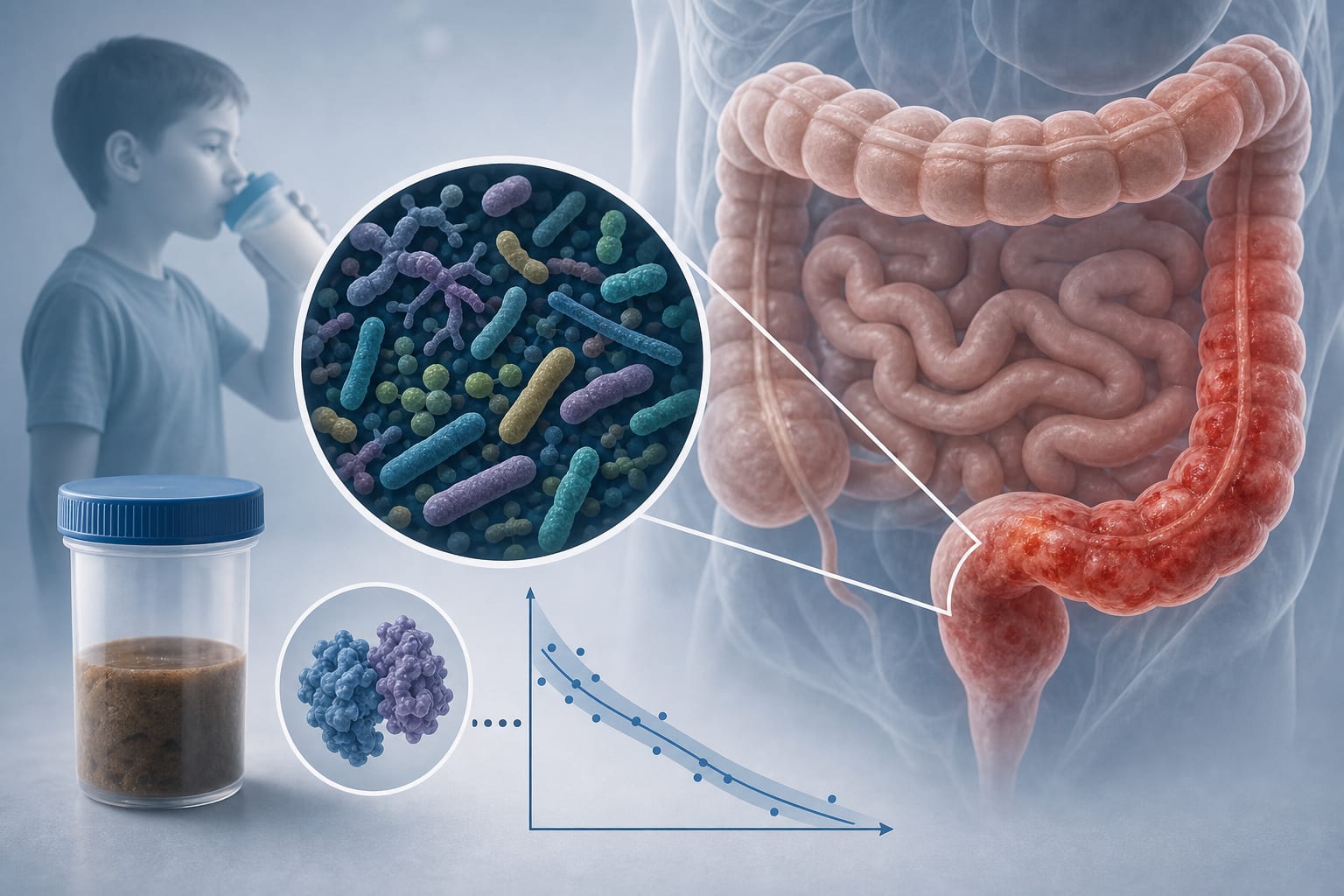
This study explores the association between baseline gut microbiome features and fecal calprotectin (FCP) response during exclusive enteral nutrition (EEN) in pediatric Crohn's disease. Findings suggest that while certain microbiome changes correlate with biochemical responses, the estimates remain imprecise.

Background

Crohn's disease often presents in childhood, impacting growth and quality of life. Exclusive enteral nutrition is a first-line therapy that can improve clinical outcomes, yet responses vary among patients. Understanding the microbiome's role in treatment response is crucial for developing effective biomarkers and personalized therapies.

Data Highlights

No specific numerical data presented in the article.

Key Findings

  • Baseline gut microbiome features showed exploratory associations with fecal calprotectin response.
  • Several genera changed consistently during EEN treatment.
  • Stool biochemical summaries indicated lower total amino acids and higher secondary bile-acid proportion post-treatment.
  • The baseline model for predicting response had a mean area under the receiver operating characteristic curve of 0.655.
  • External comparison revealed concordant directions in 7 of 12 overlapping genera.

Clinical Implications

Clinicians should consider the variability in microbiome responses when using EEN for pediatric Crohn's disease. Monitoring fecal calprotectin can provide insights into treatment efficacy and guide subsequent therapeutic decisions.

Conclusion

The study highlights the potential link between gut microbiome characteristics and fecal calprotectin response during EEN, although further research is needed to clarify these associations.

Related Resources & Content

  1. Journal of Crohn's and Colitis, 2023 -- A pro-inflammatory diet is associated with growth and virulence of Escherichia coli in pediatric Crohn’s disease
  2. Journal of Crohn's and Colitis, 2023 -- Fecal Calprotectin Diagnostic Level Gradient Along the Small Bowel in Patients With Crohn’s Disease
  3. Journal of Gastroenterology, 2017 -- Endoscopic Brush Sample Analysis Reveals Mucosal Dysbiosis in Patients with Inflammatory Bowel Disease
  4. Medical Management of Paediatric Crohn’s Disease: an ECCO-ESPGHAN Guideline Update | Journal of Crohn's and Colitis | Oxford Academic
  5. Enteral nutrition versus immunomodulators for induction and maintenance of remission in pediatric Crohn's disease: a systematic review and network meta-analysis - PMC
  6. Exclusive enteral nutrition initiates individual protective microbiome changes to induce remission in pediatric Crohn's disease - PubMed
  7. The Journal of Infectious Diseases — The Role of Gut Microbiota and Butyrate in Distinguishing Clostridioides difficile Colonization from Infection in Pediatric Patients
  8. Medical Management of Paediatric Crohn’s Disease: an ECCO-ESPGHAN Guideline Update | Journal of Crohn's and Colitis | Oxford Academic
  9. Enteral nutrition versus immunomodulators for induction and maintenance of remission in pediatric Crohn's disease: a systematic review and network meta-analysis - PMC
  10. Exclusive enteral nutrition initiates individual protective microbiome changes to induce remission in pediatric Crohn's disease - PubMed

Original Source(s)

Related Content