Distinct Relationships Between Inflammatory Markers and Laboratory-Confirmed Organ Damage and Hospital Stay Duration in Children with Respiratory Tract Infections
-
By
-
Jing Wang
-
Ruotong Dong
-
Song Mao
-
July 16, 2026
Clinical Report: Inflammatory Markers and Organ Damage in Pediatric RTIs
Overview
This study investigates the associations between inflammatory indices and laboratory-defined organ injury as well as hospitalization duration in children with respiratory tract infections (RTIs).
Background
Respiratory tract infections are prevalent in children and can lead to serious complications, including organ injuries. Identifying children at risk for organ damage or prolonged hospitalization is crucial.
Data Highlights
| Inflammatory Index | Associated Condition |
|---|---|
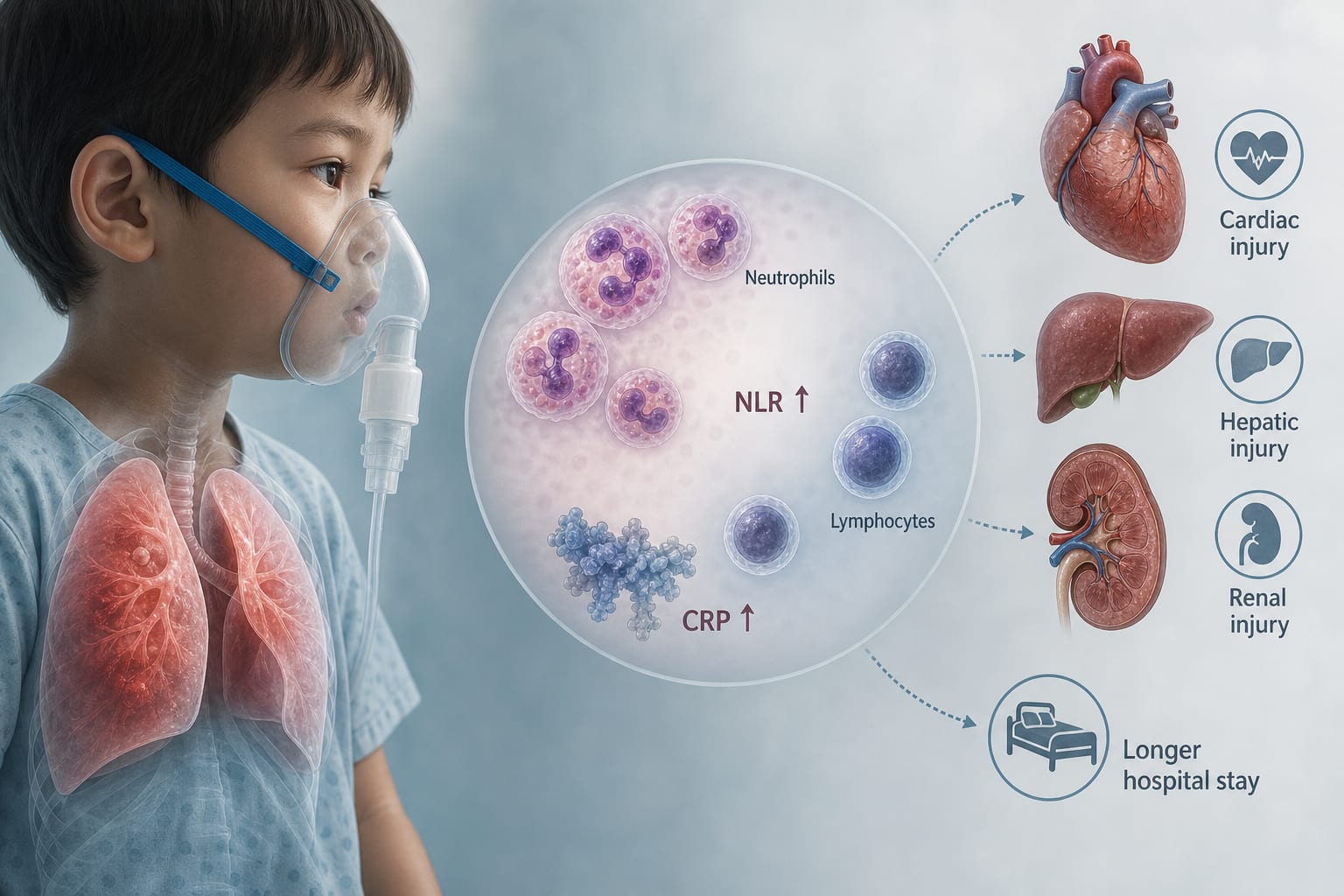
| Lower Neutrophils, CRP, SII, NLR, NPR, CLR | Cardiac Injury |
| Higher Lymphocytes, Lower Neutrophils, Platelets, CRP, SII, NLR, PLR, NPR, CLR | Liver Injury |
| Higher WBCs, Neutrophils, CRP, SII, NLR, PLR, CLR, Lower Lymphocytes | Kidney Involvement |
| Higher WBCs, Lymphocytes, CRP, NPR, CLR, Lower Platelets and Hb | Longer Hospitalization |
Key Findings
- Lower inflammatory indices are linked to cardiac injury in pediatric RTIs.
- Higher lymphocyte levels correlate with liver injury.
- Kidney involvement is associated with higher levels of WBCs and other inflammatory indices.
- Composite indices like NLR, SII, and CLR show discriminative ability for organ injuries.
- Longer hospitalization is associated with higher levels of certain inflammatory markers and lower levels of platelets and hemoglobin.
Clinical Implications
Inflammatory indices derived from routine blood tests can provide insights into the risk of organ injury and hospitalization duration in children with RTIs.
Conclusion
The study highlights the associations of inflammatory indices with organ injury and hospitalization in pediatric RTIs.
Related Resources & Content
- Infection — Inflammatory Responses Mimicking Bacterial Infections in Pediatric Adenovirus Cases Result in Misuse of Antibiotics: Findings from a Multicenter Cohort Analysis
- Infection — Assessment of TRAIL, IP-10, and CRP Levels in Pediatric Patients with Suspected COVID-19 and the Influence of a Computational Signature on Clinical Decision-Making: A Prospective Cohort Investigation
- Frontiers in Pediatrics — Low Levels of the Protein TRAIL are Associated with Illness Severity in Children with Suspected Infection
- Clinical Practice Guideline by the Infectious Diseases Society of America and the Pediatric Infectious Diseases Society: 2026 Guideline Update on The Management of Community-Acquired Pneumonia in Infants and Children Older than 3 Months of Age | Clinical Infectious Diseases | Oxford Academic
- Open Forum Infectious Diseases — Impact of Fine Particulate Matter (PM2.5) on the Severity of Acute Respiratory Infections in Young Children Across Major US Cities: A Claims-Based Cohort Analysis
- Clinical Practice Guideline by the Infectious Diseases Society of America and the Pediatric Infectious Diseases Society: 2026 Guideline Update on The Management of Community-Acquired Pneumonia in Infants and Children Older than 3 Months of Age | Clinical Infectious Diseases | Oxford Academic
- Identifying the thresholds of C-reactive protein, procalcitonin, and interleukin-6 among children ≤36 months' old with fever without source at risk of serious bacterial infections: a systematic review and meta-analysis - PubMed
- Pathogen distribution and liver injury severity in children with community-acquired pneumonia complicated by liver injury in Suzhou, China
- Effectiveness of biomarker-guided duration of antibiotic treatment in children hospitalised with confirmed or suspected bacterial infection: the BATCH RCT - PubMed
Based on findings from:
Differentiated associations of inflammatory indices with laboratory-defined organ injury/involvement and hospitalization length in pediatric respiratory tract infections
Jing Wang, Ruotong Dong, Song Mao. Frontiers In Pediatrics, 2026.
https://www.frontiersin.org/journals/pediatrics/articles/10.3389/fped.2026.1804507/full
This content is an AI-generated, fully rewritten summary based on a published scholarly article. It does not reproduce the original text and is not a substitute for the original publication. Readers are encouraged to consult the source for full context, data, and methodology.