Diagnostic value of contrast-enhanced ultrasound combined with other imaging techniques in differentiating benign and malignant thyroid nodules: a network meta-analysis - Report - MDSpire
Conexiant’s news site is now MDSpire News. Learn more
Advertisement
Evaluating the Diagnostic Efficacy of Contrast-Enhanced Ultrasound in Conjunction with Other Imaging Modalities for Distinguishing Benign from Malignant Thyroid Nodules: A Network Meta-Analysis
Clinical Report: Evaluating the Diagnostic Efficacy of Contrast-Enhanced Ultrasound
Overview
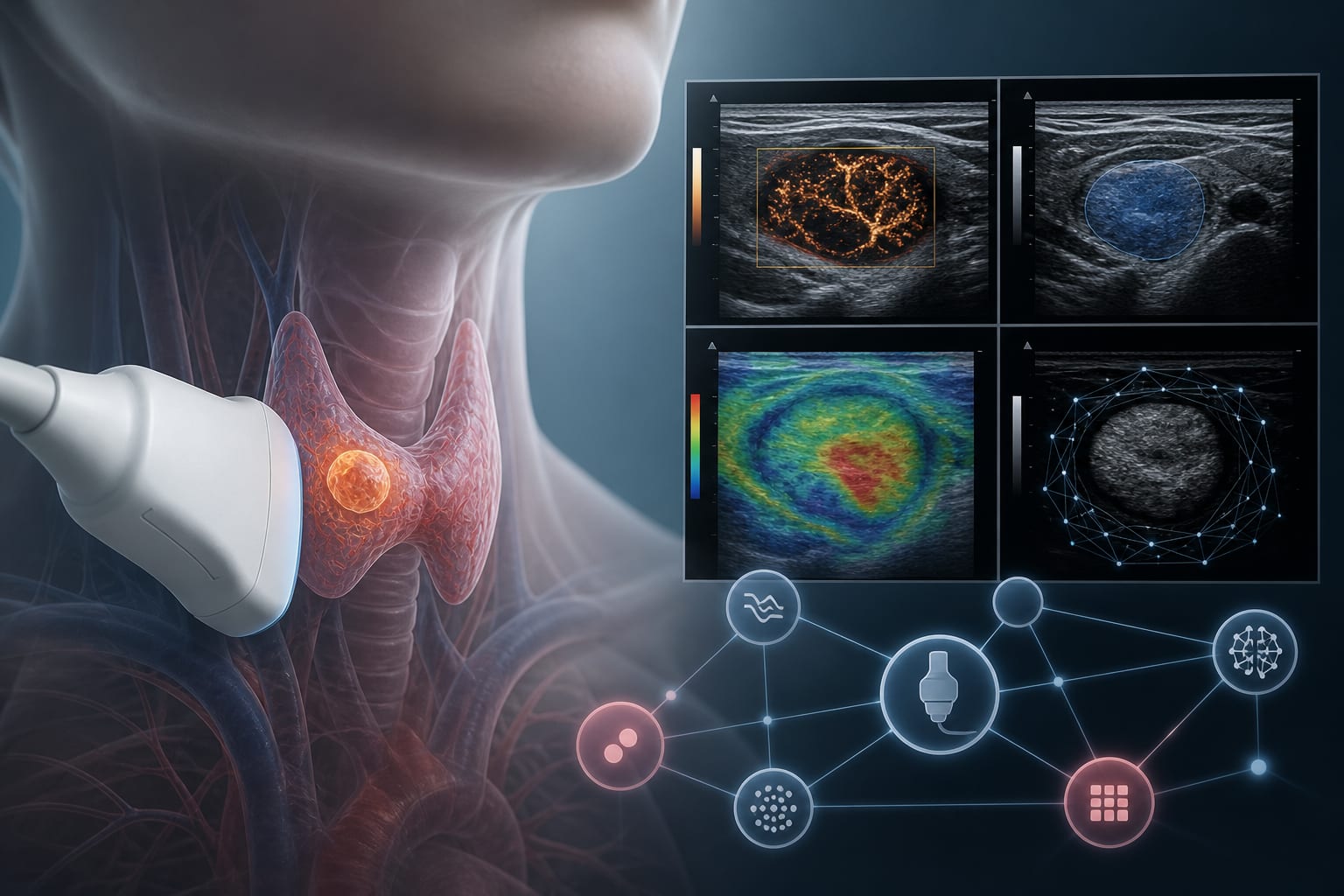
This network meta-analysis evaluates the diagnostic performance of contrast-enhanced ultrasound (CEUS) combined with other imaging modalities for distinguishing benign from malignant thyroid nodules.
Background
Thyroid nodules are frequently detected, yet only a small percentage are malignant. Accurate differentiation between benign and malignant nodules is critical for appropriate management and treatment decisions. The integration of advanced imaging techniques, such as CEUS, aims to enhance diagnostic efficacy and reduce unnecessary interventions.
Data Highlights
Technique
Superiority Index (SI)
Pooled Sensitivity (SE)
Pooled Specificity (SP)
CEUS-UE
3.47 (95%CI 0.2–7)
0.92 (95%CI 0.88–0.95)
0.83 (95%CI 0.75–0.89)
CEUS-AI
3.81 (95%CI 0.33–9)
0.95 (95%CI 0.91–0.98)
0.81 (95%CI 0.68–0.91)
CEUS-US
5.29 (95%CI 0.33–9)
0.89 (95%CI 0.74–0.97)
0.88 (95%CI 0.69–0.97)
Key Findings
CEUS-UE shows a pooled sensitivity of 0.92 and specificity of 0.83 for distinguishing TNs.
CEUS-AI has a pooled sensitivity of 0.95 and specificity of 0.81 for identifying high-risk TNs.
CEUS-US demonstrates a pooled sensitivity of 0.89 and specificity of 0.88 for non-risk-stratified TNs.
Twenty-six studies with 4484 patients and 5022 TNs were included in the analysis.
Validation of findings in larger, diverse cohorts is necessary.
Clinical Implications
Further validation in diverse populations is warranted.
Conclusion
Further validation in diverse populations is warranted.
Investigators examined Life’s Essential 8 scores and carotid ultrasonography measures across cardiovascular-kidney-metabolic stages in 1,283 young adults.