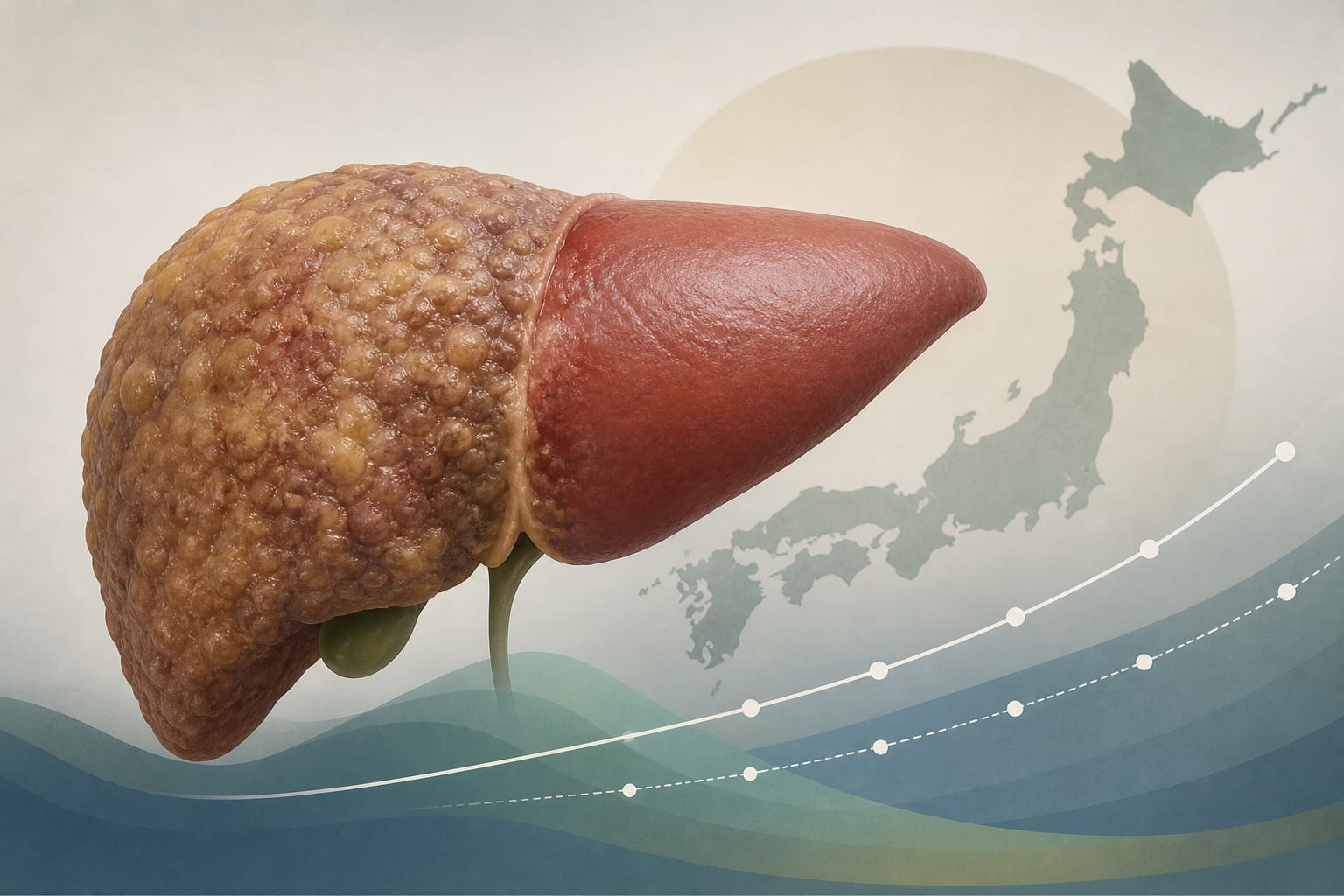
Semaglutide outcomes in Japanese patients with MASH align with results from the overall ESSENCE trial population
-
By
-
Hayato Nakagawa
-
October 27, 2026
Clinical Report: Semaglutide outcomes in Japanese patients with MASH
Overview
In a Japanese subgroup of the phase 3 ESSENCE trial, semaglutide 2.4 mg weekly was associated with MASH resolution without worsening fibrosis in 63.1% of participants, compared with 36.8% receiving placebo, closely matching the overall trial results. Fibrosis improvement and safety findings were broadly consistent with the global population, although the subgroup was small and the fibrosis treatment difference was imprecise.
Background
MASH is a progressive form of MASLD associated with fibrosis and increased risk of liver-related outcomes. The source reports that semaglutide was approved in Japan in June 2026 for non-cirrhotic MASH with F2–F3 fibrosis, based on the global ESSENCE trial. Japanese patients may have lower BMI than Western populations, making it important to assess whether trial findings apply across differences in body size. A Japanese nationwide cohort cited in the source found similar risks of liver-related events among lean and non-lean people with MASLD.
Data Highlights
| Outcome | Japanese semaglutide | Japanese placebo | Overall ESSENCE semaglutide | Overall ESSENCE placebo |
|---|---|---|---|---|
| MASH resolution without worsening fibrosis | 63.1% | 36.8% | 62.9% | 34.3% |
| Fibrosis improvement without worsening steatohepatitis | 36.5% | 28.9% | 36.8% | 22.4% |
| Mean percentage weight loss | 11.4% | Not reported in source | 10.5% | Not reported in source |
| Participants in Japanese subgroup | 78 | 38 | 116 Japanese participants among first 800 randomized | |
| Mean baseline BMI | 29.8 kg/m² | Not reported by treatment arm | 34.3 kg/m² overall population | |
Key Findings
- Among 116 Japanese participants in the first 800 randomized ESSENCE participants, 78 received semaglutide 2.4 mg weekly and 38 received placebo.
- MASH resolution without worsening fibrosis occurred in 63.1% of Japanese semaglutide recipients and 36.8% of placebo recipients, similar to overall trial rates of 62.9% and 34.3%.
- Semaglutide numerically favored MASH resolution across BMI categories; in participants with BMI below 27 kg/m², rates were 57.1% with semaglutide and 26.7% with placebo.
- Fibrosis improvement without worsening steatohepatitis occurred in 36.5% with semaglutide and 28.9% with placebo in the Japanese subgroup; the source notes that the treatment difference was imprecise in this small subgroup with a relatively high placebo response.
- Japanese participants had a lower mean BMI than the overall population (29.8 vs 34.3 kg/m²), and 21.8% had BMI below 25 kg/m², compared with 6.7% overall. Percentage weight loss was 11.4% in Japanese participants versus 10.5% overall.
- The source describes the safety profile as broadly consistent with the global trial and notes that subgroup analyses by BMI and age were exploratory; efficacy in non-obese participants with BMI below 25 kg/m² remains unestablished.
Clinical Implications
The subgroup findings support the applicability of the overall ESSENCE histologic results to the Japanese participants studied, including those with lower BMI, but do not establish efficacy specifically in non-obese patients with BMI below 25 kg/m². The source states that larger cohorts and extended follow-up are needed to confirm findings and determine whether treatment reduces liver-related events.
Conclusion
In this Japanese ESSENCE subgroup, semaglutide outcomes for MASH resolution and fibrosis improvement were broadly aligned with the overall trial population. The small subgroup and exploratory analyses limit conclusions for specific BMI and age groups.
Related Resources & Content
- Nakajima et al., Journal of Gastroenterology, 2026 — Semaglutide Administration in Japanese Individuals with Metabolic Dysfunction-Associated Steatohepatitis: Insights from the ESSENCE Trial Subgroup Analysis
- Sanyal et al., New England Journal of Medicine, 2025 — Phase 3 Trial of Semaglutide in Metabolic Dysfunction–Associated Steatohepatitis
- FDA, 2025 — Ongoing Non-malignant Hematological, Neurological, and Other Disorder Indications Accelerated Approvals
- MDSpire News — Semaglutide Shows Potential in Liver Disease Trial
- The New Gastroenterologist — Semaglutide Treatment Enhances Liver Histology in Patients with MASH
- MDSpire News — Semaglutide Shows Dual Benefit in Knee OA
- Semaglutide in Japanese participants with metabolic dysfunction-associated steatohepatitis: a subgroup analysis of the ESSENCE trial
- Phase 3 Trial of Semaglutide in Metabolic Dysfunction–Associated Steatohepatitis
- Ongoing Non-malignant Hematological, Neurological, and Other Disorder Indications Accelerated Approvals
- Ongoing | Non-malignant Hematological, Neurological, and Other Disorder Indications Accelerated Approvals | FDA
- Phase 3 Trial of Semaglutide in Metabolic Dysfunction–Associated Steatohepatitis | New England Journal of Medicine
- Semaglutide in Japanese participants with metabolic dysfunction-associated steatohepatitis: a subgroup analysis of the ESSENCE trial.
Based on findings from:
Semaglutide for MASH in Japanese patients: findings consistent with the overall ESSENCE population
Hayato Nakagawa. Journal Of Gastroenterology, 2026.
https://link.springer.com/article/10.1007/s00535-026-02528-9
This content is an AI-generated, fully rewritten summary based on a published scholarly article. It does not reproduce the original text and is not a substitute for the original publication. Readers are encouraged to consult the source for full context, data, and methodology.