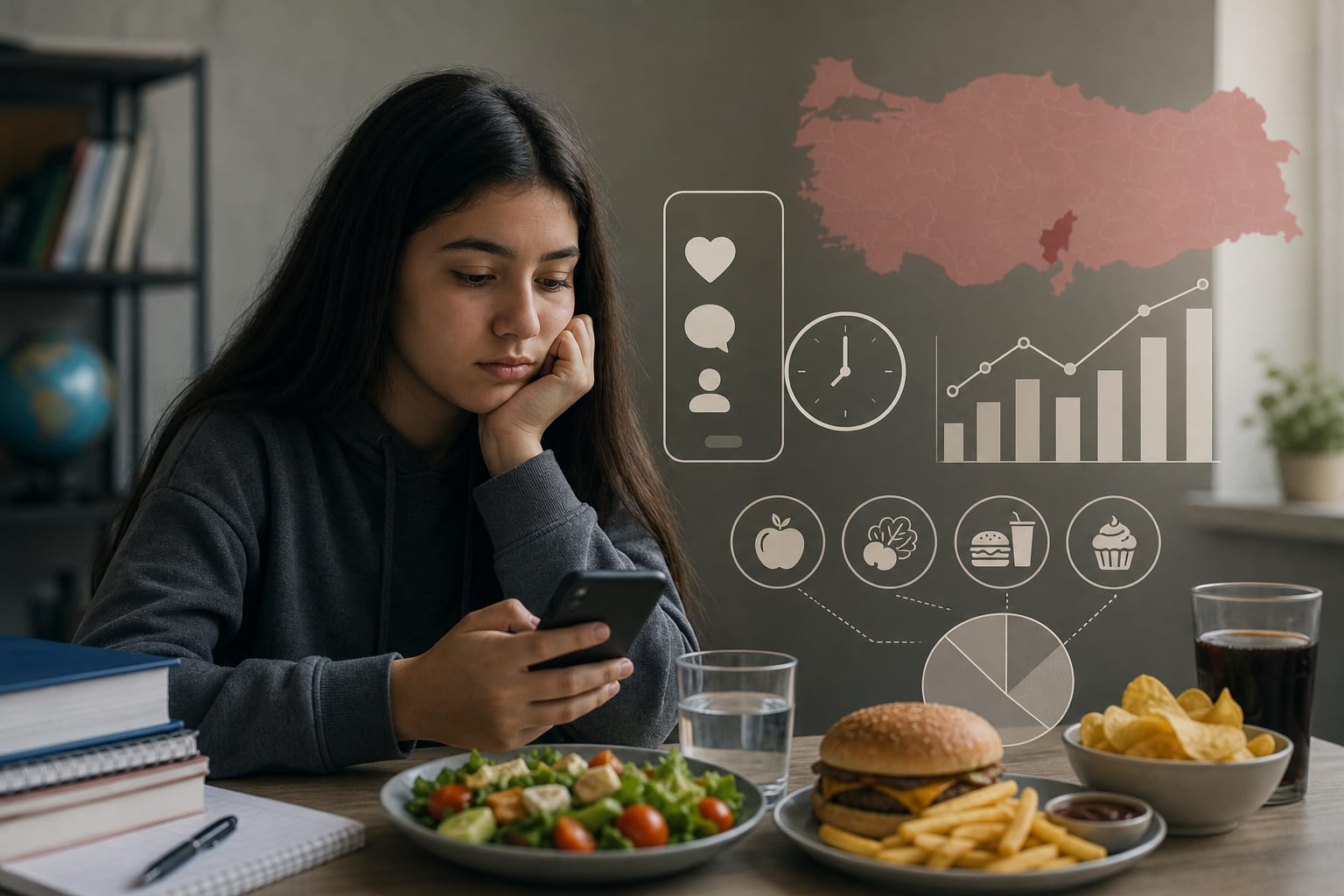
The association between social media use and dietary intake among adolescents in Türkiye: a cross sectional study
-
By
-
Meryem Elif Öztürk
-
June 25, 2026
-
0 min
Clinical Report: Examining the Link Between Adolescent Dietary Habits and Social Media Engagement in Türkiye
Overview
This study investigates the association between social media use and dietary intake among adolescents in Türkiye. Findings indicate that prolonged social media use is linked to higher consumption of energy, fat, sucrose, calcium, and zinc.
Background
The rise of social media usage among adolescents has raised concerns regarding its impact on dietary habits. Adolescents are influenced by digital marketing and peer interactions on these platforms. Understanding this relationship is crucial for addressing public health issues related to nutrition and obesity in this demographic.
Data Highlights
| Variable | β (Unstandardized) ± SE | p-value |
|---|---|---|
| Energy Intake | 356.21 ± 111.91 kcal | 0.002 |
| Carbohydrate Intake | 41.19 ± 14.82 g | 0.006 |
| Sucrose Intake | 10.75 ± 3.24 g | 0.001 |
| Fat Intake | 16.51 ± 5.83 g | 0.005 |
| Calcium Intake | 146.44 ± 54.72 mg | 0.008 |
| Zinc Intake | 2.16 ± 0.75 mg | 0.004 |
Key Findings
- 47.4% of participants reported using social media for over three hours daily.
- Prolonged social media use (>3 h) was associated with increased energy and nutrient intake.
- Higher consumption of milk, meat, and pastries was noted among those using social media for more than three hours.
- After FDR correction, no significant relationship was found between dairy, meat, and pastry consumption with social media duration.
- Increased added sugar consumption was linked to more time spent on social media.
Clinical Implications
Healthcare professionals should be aware of the dietary risks associated with prolonged social media use among adolescents.
Conclusion
The study indicates an association between social media engagement and dietary intake among adolescents.
Related Resources & Content
- BMC Psychiatry, 2026 -- Impulsivity facets and internet gaming disorder symptoms in male adolescents with ADHD: an exploratory cross-sectional study from Turkiye
- Frontiers in Psychiatry, 2026 -- Excessive Internet use and depressive symptom levels in adolescents with depressive disorders: chain mediation of social anxiety and sleep quality
- Frontiers in Psychiatry, 2026 -- Sex-specific interplay of combined lifestyle patterns and their association with depressive symptoms among Chinese adolescents: a school-based cross-sectional study
- Digital Ecosystems, Children, and Adolescents: Policy Statement | Pediatrics | American Academy of Pediatrics, 2026
- WHO urges schools worldwide to promote healthy eating for children, 2026
- Journal of Medical Internet Research (JMIR) — Prevalence of Social Media Addiction and Associations With Usage Patterns, Burnout, and Health Conditions Among Medical Trainees in China: Cross-Sectional Study
- TÜRKİYE SAĞLIKLI BESLENME VE HAREKETLİ HAYAT PRO
- Monitoring and restricting digital marketing of unhealthy products to children and adolescents
- Digital Ecosystems, Children, and Adolescents: Policy Statement | Pediatrics | American Academy of Pediatrics
- WHO urges schools worldwide to promote healthy eating for children
- Effect of Social Media Advertisements on Adolescents' Sugar‐Sweetened Beverage Choices: A Randomized Field Experiment - Treu - 2026 - Obesity - Wiley Online Library
- The Impact of Social Media on Adolescents’ Eating and Sleeping Habits: A Systematic Review and Meta-Analysis - PMC
This content is an AI-generated, fully rewritten summary based on a published scholarly article. It does not reproduce the original text and is not a substitute for the original publication. Readers are encouraged to consult the source for full context, data, and methodology.