Long-term remission after ALK inhibitor cessation in ALK-positive histiocytosis
Overview
In a cohort of 27 patients with ALK-positive histiocytosis treated with ALK inhibitors, universal objective responses were observed, with 56% achieving complete response. Notably, sustained remissions were maintained after discontinuation of therapy in 18 patients, with only one relapse reported.
Background
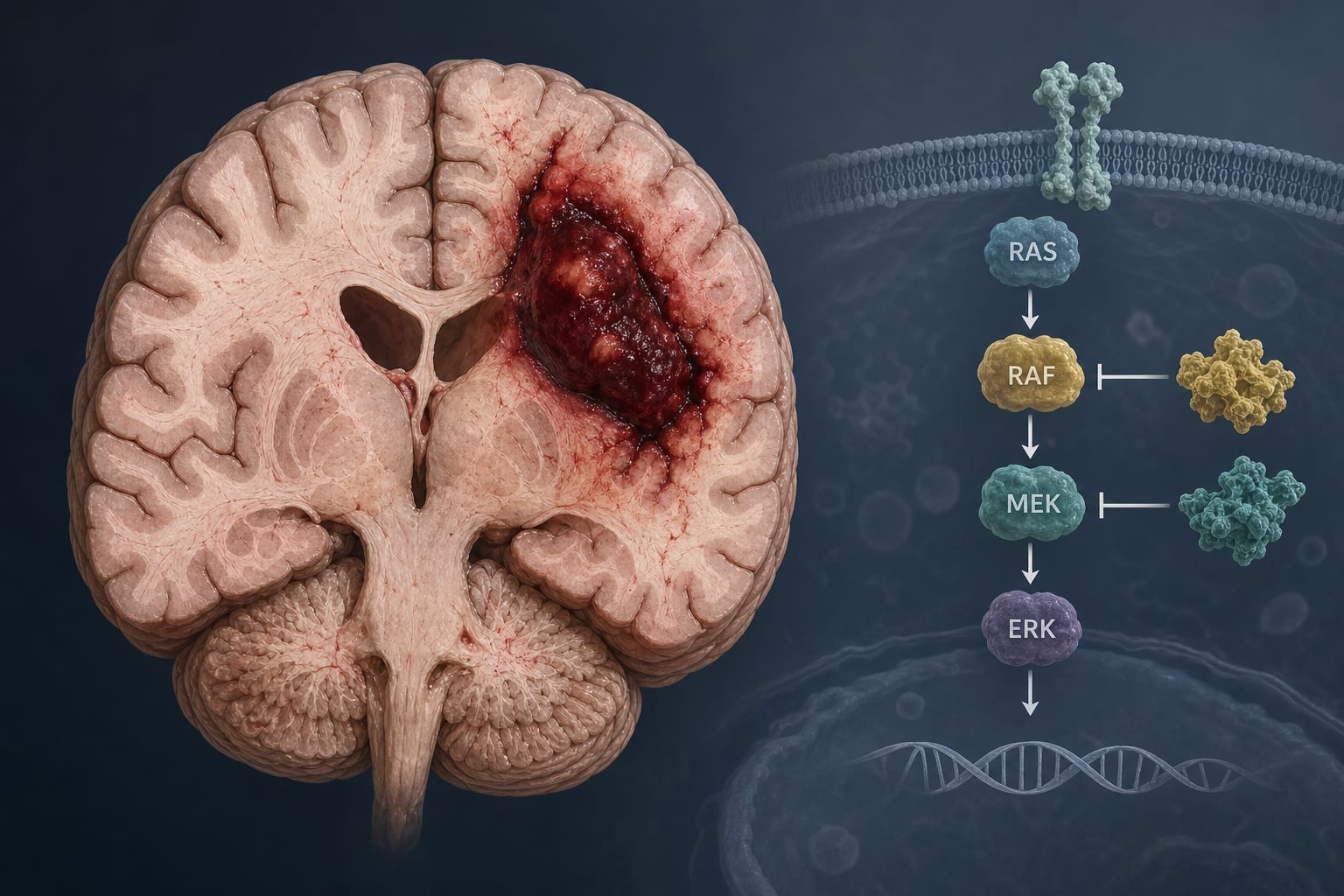
ALK-positive histiocytosis is a rare histiocytic neoplasm characterized by ALK gene fusions, most commonly KIF5B::ALK, and often involves the nervous system. Prior studies demonstrated robust responses to ALK inhibitors, but the durability of these responses and the feasibility of stopping therapy remained unclear. This study expands on previous findings by evaluating long-term outcomes and remission status following ALK inhibitor cessation in a larger, diverse patient cohort.
Data Highlights
Parameter
Value
Number of patients
27
Median age
13 years (range 2 months–70 years)
Neurologic involvement
74%
Objective response rate (CR + PR)
100% (CR 56%, PR 44%)
Median time to first response
2 months (range 2 weeks–6.5 months)
Median treatment duration
2.0 years (range 0.5–7.5 years)
Median follow-up since ALK inhibitor start
3.7 years (range 0.6–7.5 years)
Patients discontinuing treatment
19 (70%)
Relapse after cessation
1 patient
Median treatment-free remission
1.8 years (range 0.1–3.0 years)
Adverse events (any grade)
78%
Grade 3 adverse events
37%
Grade 4 adverse events
2 patients
Key Findings
All 27 patients treated with ALK inhibitors showed an objective response: 56% complete response and 44% partial response.
Median time to first objective response was rapid at 2 months.
Only one patient experienced disease relapse after treatment cessation, which was successfully managed by reinitiating therapy.
Median treatment-free remission after stopping ALK inhibitors was 1.8 years, indicating durable responses.
Adverse events were common but mostly manageable; 37% experienced grade 3 events and 2 patients had grade 4 events.
Clinical Implications
ALK inhibitors demonstrate high efficacy and rapid responses in ALK-positive histiocytosis, including neurologic involvement. Given the durability of remission after therapy discontinuation in most patients, clinicians may consider elective cessation of ALK inhibitors in sustained responders with careful monitoring. Adverse events should be managed proactively to maintain treatment tolerability.
Conclusion
This study confirms that ALK inhibition yields universal and durable responses in ALK-positive histiocytosis, with sustained remission achievable after stopping therapy in the majority of patients. These findings support the potential for treatment discontinuation in selected cases under close clinical surveillance.
Related Resources & Content
Haroche et al. 2008 -- First description of ALK-positive histiocytosis
Current study -- Long-term remission observed following cessation of ALK inhibition
by Paul G. Kemps, Jennifer L. Picarsic, Sébastien Héritier, Jean Donadieu, Julien Haroche, Laure Farnault, Stefania Gaspari, Dmitry A. Evseev, Daria S. Osipova, Alexander E. Druy, Milen Minkov, Susan Picton, Andreas Beilken, Robert Möhle, Miloš B. Kuzmanović, Hitomi S. Okuma, Chung W. Chow, Martin A. Campbell, Gregory S. Phillips, Yuhang Zhou, Gaurav Goyal, Ronald S. Go, Kee Kiat Yeo, Bryan A. Sisk, Joanna L. Weinstein, Patrick K. Campbell, Eli L. Diamond, Jean-François Emile