Case Report: Elastography-negative acute fatty liver of pregnancy diagnosed by histopathology and electron microscopy - Report - MDSpire

Case Report: Elastography-negative acute fatty liver of pregnancy diagnosed by histopathology and electron microscopy

  • By

  • Takuto Nosaka

  • Arisa Saito

  • Yu Akazawa

  • Kazuto Takahashi

  • Tatsushi Naito

  • Masahiro Ohtani

  • Yoshiaki Imamura

  • Sho Kudo

  • Makoto Orisaka

  • Yoshio Yoshida

  • Yasunari Nakamoto

  • June 15, 2026

  • 0 min

Share

Clinical Report: Diagnosis of Elastography-negative Acute Fatty Liver of Pregnancy

Overview

Revise to focus solely on the case details without conclusions about elastography limitations.

Background

Acute fatty liver of pregnancy (AFLP) is a rare but serious condition that can lead to multiorgan failure and has significant maternal and fetal mortality rates. Early diagnosis and management are crucial for improving outcomes. Current diagnostic modalities, including imaging and elastography, may not always provide accurate assessments of hepatic fat deposition in AFLP.

Data Highlights

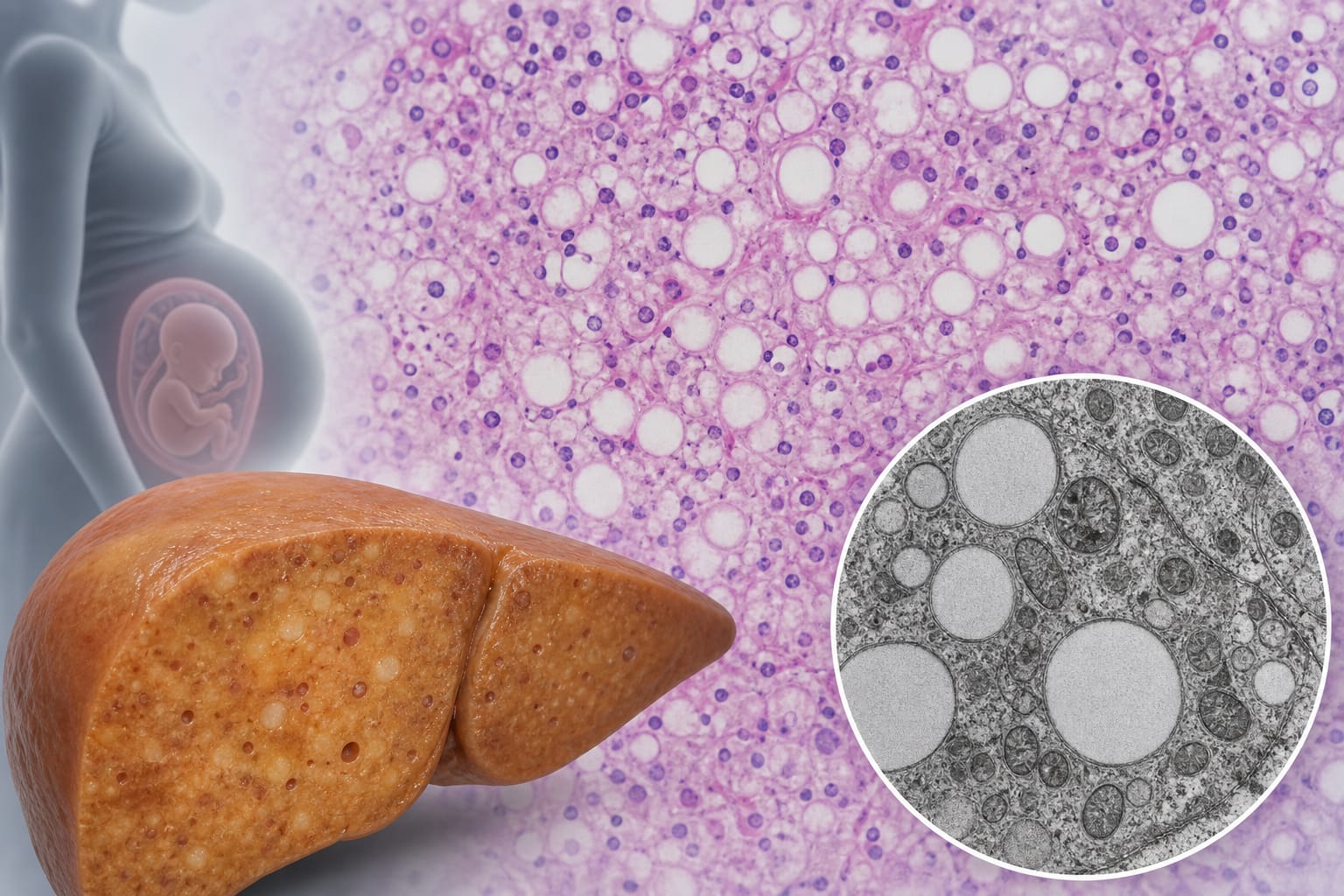
Case details: A 29-year-old primigravida at 33 weeks of gestation presented with jaundice, liver dysfunction, coagulopathy, and renal impairment. Imaging showed decreased hepatic attenuation, while elastography indicated a steatosis grade of S0. Histological examination confirmed microvesicular steatosis.

Key Findings

  • AFLP can rapidly progress to severe complications, including DIC and renal dysfunction.
  • Imaging modalities like CT may indicate fatty liver but can underestimate steatosis severity.
  • Elastography may not accurately reflect hepatic fat accumulation in cases of microvesicular steatosis.
  • Histological evaluation is essential for definitive diagnosis of AFLP.
  • Electron microscopy can provide detailed insights into the pathological changes associated with AFLP.

Clinical Implications

Clinicians should be aware of the limitations of non-invasive imaging techniques in diagnosing AFLP, particularly in cases with microvesicular steatosis. A thorough histopathological evaluation may be necessary for accurate diagnosis and management.

Conclusion

This case underscores the importance of comprehensive diagnostic approaches, including histopathology and electron microscopy, in confirming AFLP, especially when imaging results are inconclusive.

Related Resources & Content

  1. Frontiers in Medicine, 2026 -- A retrospective analysis of coagulation function indicators in acute fatty liver of pregnancy
  2. Journal of Gastroenterology, 2025 -- Intracellular Organelle Abnormalities in Metabolic Dysfunction-Associated Steatotic Liver Disease
  3. European Radiology, 2025 -- The Role of Digital Pathology and Lipid Droplet Dimensions in Explaining Differences Between Histological and MRI Assessments in Steatotic Liver Disease
  4. EASL Clinical Practice Guidelines on the management of liver diseases in pregnancy, 2023
  5. AGA Clinical Practice Update on Pregnancy-Related Gastrointestinal and Liver Disease: Expert Review, 2024
  6. Obesity Surgery — Assessment of Hepatic Steatosis Prevalence and Associated Factors in Patients Undergoing Sleeve Gastrectomy: A Study with Biopsy Confirmation
  7. EASL Clinical Practice Guidelines on the management of liver diseases in pregnancy
  8. Frontiers | Case Report: Elastography-Negative Acute Fatty Liver of Pregnancy Diagnosed by Histopathology and Electron Microscopy
  9. AGA Clinical Practice Update on Pregnancy-Related Gastrointestinal and Liver Disease: Expert Review
  10. Frontiers | Safety and efficacy of plasmapheresis in treatment of acute fatty liver of pregnancy—a systematic review and meta-analysis
  11. Acute Fatty Liver of Pregnancy and Fetal Fatty Acid Oxidation Disorders: A Systematic Review - PMC
  12. Frontiers | Reduced portal vein blood flow velocity in acute fatty liver of pregnancy

Original Source(s)

Related Content