Quantifying cerebral autoregulation following endovascular thrombectomy using wavelet transformation - Report - MDSpire

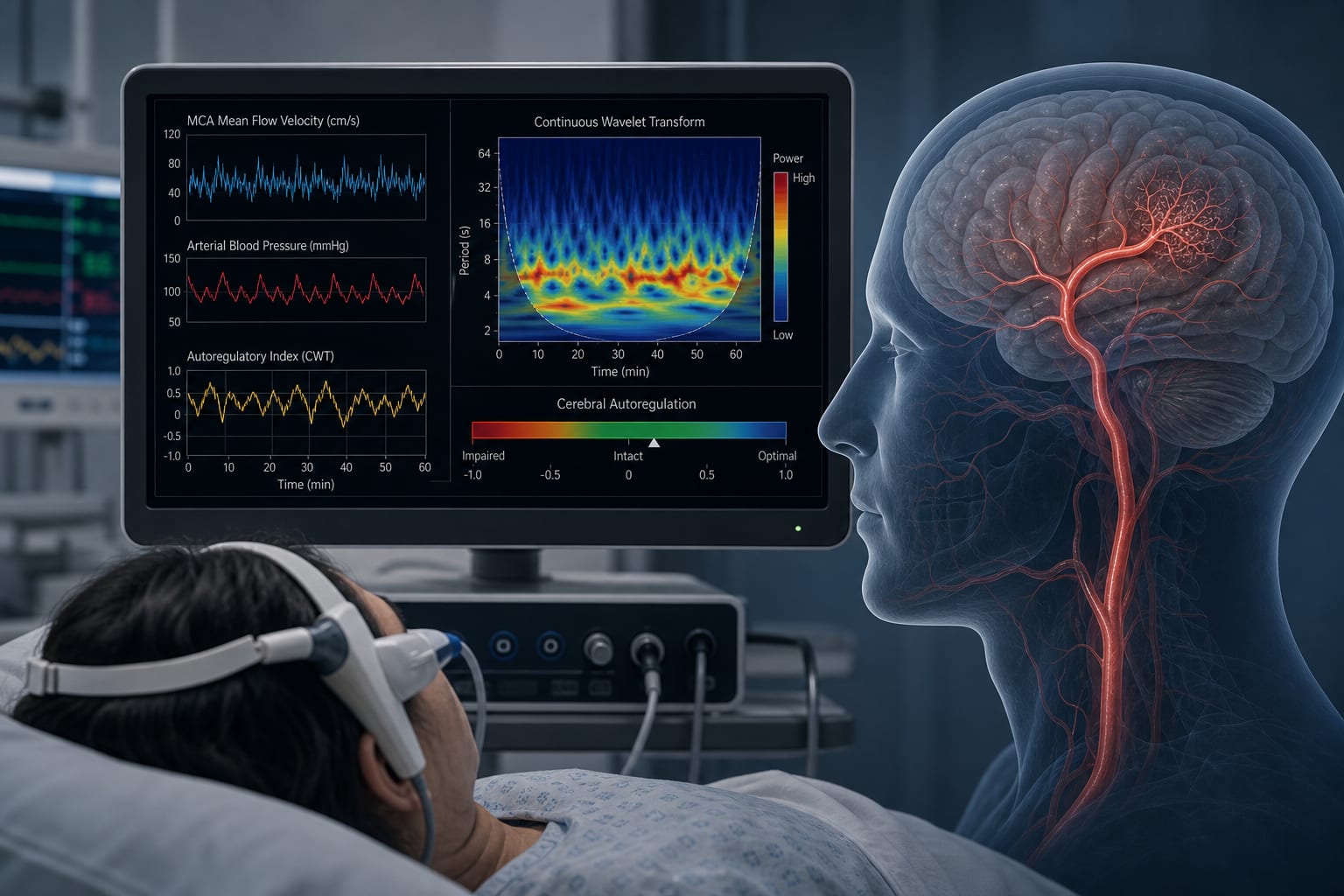
Quantifying cerebral autoregulation following endovascular thrombectomy using wavelet transformation

  • By

  • Lars Tveit

  • Maria Skytioti

  • Thor Håkon Skattør

  • Brian Anthony Enriquez

  • Anne Hege Aamodt

  • Karolina Skagen

  • Markus Wiedmann

  • Mona Skjelland

  • June 16, 2026

  • 0 min

Share

Clinical Report: Assessing Cerebral Autoregulation Post-Endovascular Thrombectomy

Overview

Revise to specify the nature of the correlation between SI and clinical outcomes, providing context.

Background

Cerebral autoregulation is crucial for maintaining stable cerebral blood flow despite fluctuations in blood pressure, particularly in AIS patients. Impaired CA can lead to poor functional outcomes and increased infarct size, making its assessment vital in the post-EVT context. Understanding CA dynamics post-recanalization may inform treatment strategies and improve patient outcomes.

Data Highlights

OutcomeMedian SI (Favorable)Median SI (Unfavorable)p-value
Early Neurological Recovery0.36 ±0.170.63 ±0.140.005
ASPECTS Correlation--Spearman's rho = −0.52, p = 0.043

Key Findings

Adjust the statement regarding median SI to align with the data presented in the highlights.

Clinical Implications

The assessment of CA using CWT may provide critical insights into the hemodynamic status of AIS patients post-EVT. Clinicians should consider CA metrics in their treatment strategies to optimize patient recovery and minimize adverse outcomes.

Conclusion

CWT-derived metrics of cerebral autoregulation can enhance understanding of cerebral hemodynamics following EVT. This approach may aid in identifying patients at risk for poor outcomes and guide clinical management.

Related Resources & Content

  1. European Radiology, 2025 -- Forecasting Lesion Recovery in Acute Cerebral Ischemia Using Apparent Diffusion Coefficient Thresholds from Diffusion-Weighted MRI
  2. European Radiology, 2023 -- Baseline CT Imaging of Cortical Atrophy as a Predictor of Clinical Outcomes in Acute Ischemic Stroke Patients Undergoing Endovascular Therapy
  3. Critical Care (Springer), 2026 -- Diagnostic accuracy of transcranial Doppler for cerebral vasospasm in aneurysmal subarachnoid hemorrhage: a systematic review and meta-analysis
  4. European Radiology, 2025 -- Assessing DWI Signal Reversal and Long-Term Tissue Recovery After Endovascular Treatment in Acute Ischemic Stroke
  5. Guidelines for the Early Management of Patients With Acute Ischemic Stroke: 2019 Update to the 2018 Guidelines for the Early Management of Acute Ischemic Stroke
  6. Individual Patient Data Meta-Analysis of Dynamic Cerebral Autoregulation and Functional Outcome After Ischemic Stroke - PubMed
  7. Frontiers | Quantifying cerebral autoregulation following endovascular thrombectomy using wavelet transformation
  8. Guidelines for the Early Management of Patients With Acute Ischemic Stroke: 2019 Update to the 2018 Guidelines for the Early Management of Acute Ischemic Stroke: A Guideline for Healthcare Professionals From the American Heart Association/American Stroke Association
  9. Individual Patient Data Meta-Analysis of Dynamic Cerebral Autoregulation and Functional Outcome After Ischemic Stroke - PubMed
  10. Frontiers | Quantifying cerebral autoregulation following endovascular thrombectomy using wavelet transformation

Original Source(s)

Related Content