Colesevelam Effectively Manages Lenalidomide-Induced Diarrhea in Multiple Myeloma
Overview
In a phase 2 trial involving 25 multiple myeloma patients with lenalidomide-associated diarrhea, colesevelam treatment led to an 88% response rate, with 68% achieving complete resolution of diarrhea. Pharmacokinetic analysis showed colesevelam did not affect lenalidomide plasma concentrations, supporting its safe use.
Background
Lenalidomide is a cornerstone immunomodulatory drug used in induction and maintenance therapy for multiple myeloma, improving progression-free and overall survival. However, diarrhea is a common adverse effect during maintenance, often impairing quality of life and leading to treatment discontinuation. Standard anti-diarrheal agents have limited efficacy in this setting. Prior observations suggested bile acid malabsorption as a mechanism, prompting investigation of bile acid binders like colesevelam as a therapeutic option.
Colesevelam treatment resulted in diarrhea improvement by at least one CTCAE grade in 88% of patients with lenalidomide-associated diarrhea.
Complete resolution of diarrhea was observed in 68% of patients after up to 12 weeks of colesevelam therapy.
Lenalidomide pharmacokinetics were not significantly altered by colesevelam, indicating no drug-drug interaction affecting lenalidomide plasma levels.
Patients maintained their multiple myeloma treatment response throughout the trial, with no disease progression reported.
Colesevelam was well tolerated, with dose adjustments based on response and adverse events.
Clinical Implications
Colesevelam offers an effective and safe therapeutic option for managing lenalidomide-induced diarrhea in multiple myeloma patients, potentially improving adherence to maintenance therapy. Its lack of impact on lenalidomide pharmacokinetics supports concurrent use without compromising drug efficacy. Clinicians should consider colesevelam for patients experiencing persistent diarrhea despite standard anti-diarrheal treatments.
Conclusion
Colesevelam significantly improves lenalidomide-associated diarrhea without affecting lenalidomide pharmacokinetics, enhancing patient quality of life and supporting continued multiple myeloma maintenance therapy.
References
Dimopoulos et al. 2022 -- Lenalidomide Maintenance in Multiple Myeloma
ClinicalTrials.gov NCT03767257 -- Colesevelam for Lenalidomide-Associated Diarrhea
FDA and MSKCC Pharmacokinetic Data -- Lenalidomide and Colesevelam Interaction
by Malin Hultcrantz, Hani Hassoun, Neha Korde, Kylee MacLachlan, Sham Mailankody, Dhwani Patel, Urvi A. Shah, Carlyn Rose Tan, David J. Chung, Oscar B. Lahoud, Heather J. Landau, Michael Scordo, Gunjan L. Shah, Sergio A. Giralt, Matthew J. Pianko, Miranda Burge, Kelly Barnett, Meghan Salcedo, Julia Caple, Linh Tran, Jenna Blaslov, Tala Shekarkhand, Selena Hamid, David Nemirovsky, Andriy Derkach, Oluwatobi Arisa, Cody J. Peer, William D. Figg, Saad Z. Usmani, Ola Landgren, Alexander M. Lesokhin
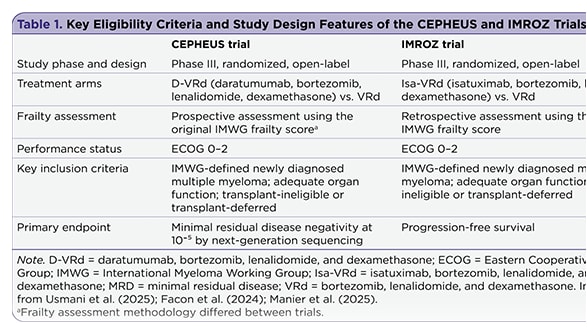
The management of newly diagnosed transplant-ineligible multiple myeloma remains challenging, in part due to the complexity of treatment decisions for frail patients. Recent subgroup analyses provide insight into whether quadruplet therapy may offer advantages over triplet therapy in this population.