Correction: The inflammatory marker SIRI acts as a statistical mediator between ApoB/ApoA1 ratio and atrial fibrillation, and combined biomarkers show higher discriminative ability for the presence of atrial fibrillation than single indicators - Report - MDSpire
Coming Soon: Introducing MDSpire News. Learn more
Conexiant’s news site is now MDSpire News. Learn more

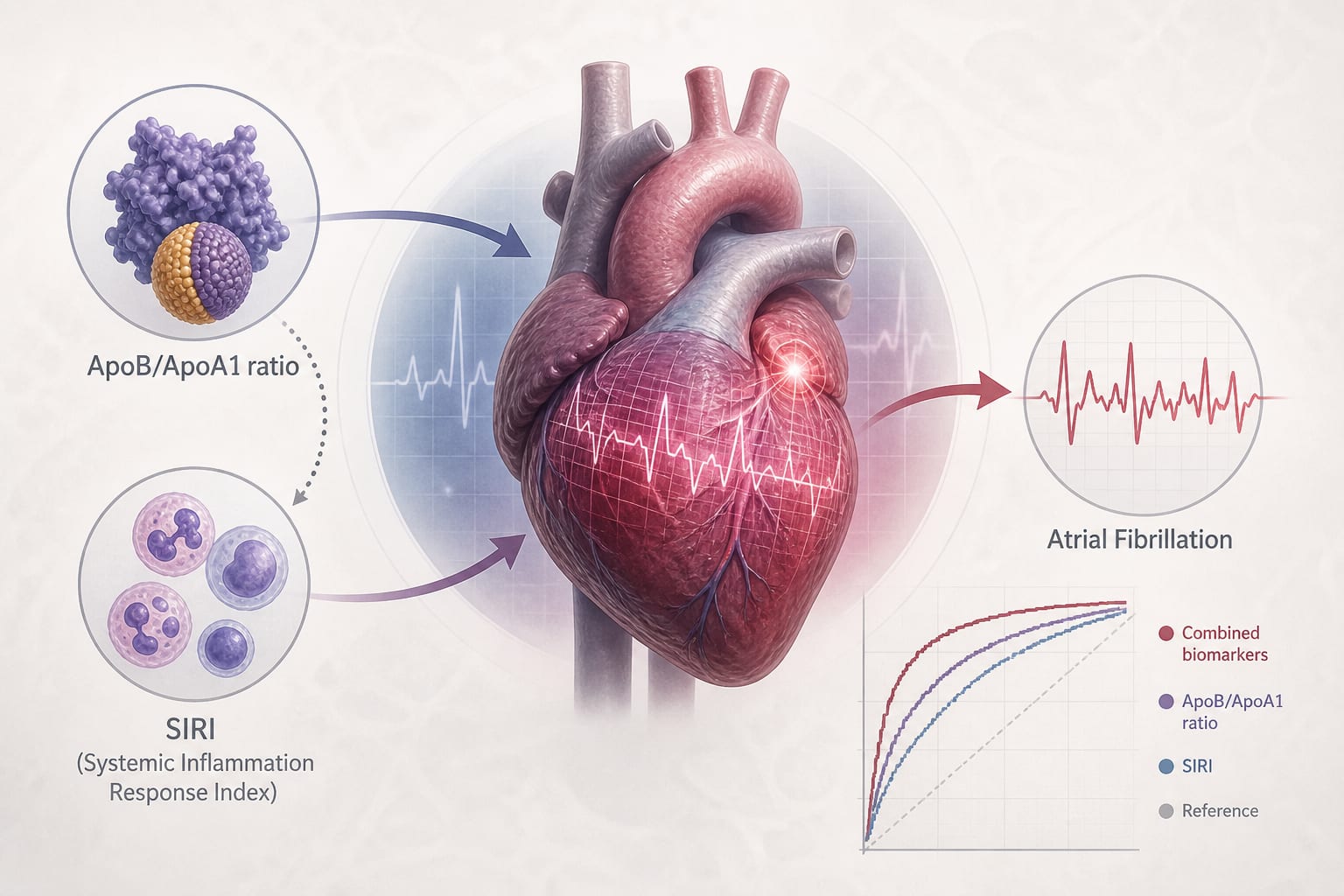
Correction: The inflammatory marker SIRI serves as a statistical mediator linking the ApoB/ApoA1 ratio to atrial fibrillation, with combined biomarkers demonstrating superior discriminative power for atrial fibrillation compared to individual markers.

  • By

  • Chenyang Zheng

  • Meixue Jia

  • Bin Ning

  • September 2, 2026

Share

Correction: The inflammatory marker SIRI serves as a statistical mediator

Overview

This correction addresses the role of the systemic inflammation response index (SIRI) as a mediator in the relationship between the ApoB/ApoA1 ratio and atrial fibrillation. It also clarifies the data availability statement regarding the study's original contributions.

Background

Atrial fibrillation (AF) is a significant clinical concern due to its association with increased morbidity and mortality. This correction highlights the importance of accurate data reporting in clinical research.

Data Highlights

No numerical data is presented in the correction.

Key Findings

  • The systemic inflammation response index (SIRI) acts as a mediator between the ApoB/ApoA1 ratio and atrial fibrillation.
  • Combined biomarkers demonstrate superior discriminative power for atrial fibrillation compared to individual markers.
  • The correction clarifies the data availability statement for the original study.
  • The original article has been updated to reflect these corrections.

Clinical Implications

Accurate reporting of data availability is essential for reproducibility in clinical research.

Conclusion

This correction emphasizes the need for precise data representation in research articles.

Related Resources & Content

  1. Zheng C, Jia M, Ning B, Frontiers in Cardiovascular Medicine, 2026 -- Correction: The inflammatory marker SIRI serves as a statistical mediator
  2. Clinical Research in Cardiology (Springer) — The prognostic value of systemic inflammatory response index (SIRI) in acute coronary syndrome patients treated with primary percutaneous coronary intervention: a meta-analysis and systematic review
  3. Frontiers in Cardiovascular Medicine — Systemic immune-inflammation Index and blood pressure control are independent and interactive predictors of atrial fibrillation recurrence after ablation
  4. Frontiers in Cardiovascular Medicine — Association of systemic inflammation response index and triglyceride-glucose index with the severity of coronary artery stenosis in elderly patients: a retrospective cross-sectional study
  5. Guideline Publication Schedule - Professional Heart Daily | American Heart Association
  6. 2024 ESC Guidelines for the management of atrial fibrillation developed in collaboration with the European Association for Cardio-Thoracic Surgery (EACTS)
  7. Frontiers | Association of inflammatory markers with clinical outcomes in atrial fibrillation: a meta-analysis
  8. Identification of biomarkers for predicting new-onset atrial fibrillation: a systematic review and meta-analysis | European Journal of Preventive Cardiology | Oxford Academic
  9. A population-based study of the sex-specific associations between apolipoprotein B and incidence of atrial fibrillation - PMC
  10. Apolipoprotein B and atrial fibrillation — a clinical paradox with practical consequences - PMC
  11. Frontiers | The Inflammatory Marker SIRI Acts as a Statistical Mediator Between ApoB/ApoA1 Ratio and Atrial Fibrillation, and Combined Biomarkers Show Higher Discriminative Ability for the Presence of Atrial Fibrillation Than Single Indicators

Original Source(s)

Related Content