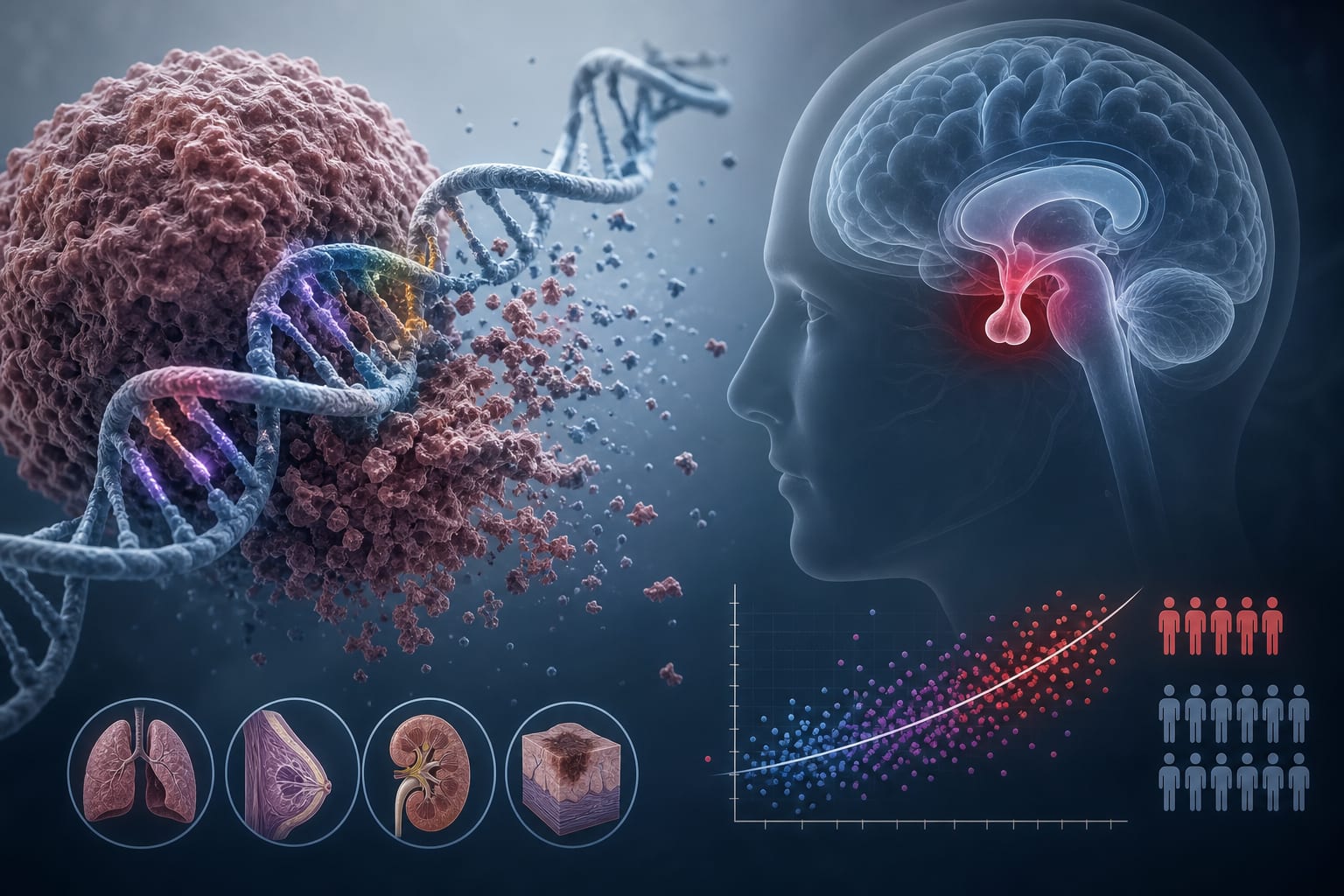
Linking Tumor Genomic Alterations to the Risk of Hypophysitis Induced by PD-1 Inhibitors: A Retrospective Cohort Analysis
-
By
-
Yuanyuan Zheng
-
Yizhen Chen
-
Wei Lin
-
Le Min
-
June 8, 2026
Clinical Report: Linking Tumor Genomic Alterations to Hypophysitis Risk from PD-1 Inhibitors
Overview
This study identifies a higher tumor mutational burden and specific gene mutations in patients with hypophysitis induced by PD-1 inhibitors.
Background
Immune checkpoint inhibitors (ICIs) have transformed cancer treatment but can lead to serious immune-related adverse events (irAEs), including hypophysitis. This endocrine toxicity can result in significant complications such as adrenal crisis, necessitating hormone replacement therapy. Understanding the genomic factors associated with hypophysitis is crucial for risk stratification and management of patients undergoing ICI therapy.
Data Highlights
| Group | Tumor Mutational Burden (mut/Mb) | Significant Mutations |
|---|---|---|
| Hypophysitis | 6.02 | BABAM1, KDM5C, CDH4, TAL1 |
| Non-Hypophysitis | 5.19 | PAXIP1 |
Key Findings
- The hypophysitis group exhibited a higher tumor mutational burden (6.02 vs. 5.19 mut/Mb, P = 0.002).
- Significantly higher mutation rates were observed in BABAM1 (18.2% vs. 0%, P = 0.014) and KDM5C (18.2% vs. 0%, P = 0.014) in the hypophysitis group.
- CDH4 mutations were more prevalent in the hypophysitis group (19.2% vs. 1.8%, P = 0.018).
- TAL1 mutations were also significantly higher in the hypophysitis group (19.2% vs. 1.8%, P = 0.018).
- PAXIP1 mutations were more common in the non-hypophysitis group (19.6% vs. 0%, P = 0.037), indicating a potential protective role.
Clinical Implications
The findings suggest that tumor genomic profiling may aid in identifying patients at higher risk for developing hypophysitis during PD-1 inhibitor therapy. Clinicians should consider monitoring these patients closely for endocrine complications.
Conclusion
This study provides insights into the genomic factors associated with PD-1 inhibitor-induced hypophysitis.
Related Resources & Content
- Frontiers in Immunology, 2026 -- Multi-omics biomarkers for predicting resistance, hyperprogression, and immune-related toxicity during PD-1/PD-L1 therapy in lung cancer
- Gastric Cancer, 2022 -- Evaluating Gene Hyperamplification and PD-L1 Expression as Predictive Biomarkers for Tislelizumab Efficacy in Gastric and Gastroesophageal Junction Adenocarcinoma
- Journal of Neuro-Oncology, 2024 -- The Prognostic Significance of Intracranial PD-L1 Levels in a Real-World Population of NSCLC Patients Undergoing Immune Checkpoint Therapy After Brain Metastasis Surgery
- The Journal of Clinical Endocrinology & Metabolism, 2025 -- Understanding the Clinical Manifestations and Causes of Hypophysitis Emphasizes the Importance of Ongoing Systematic Research
- Consensus-based disease definitions for endocrine immune-related adverse events of immune checkpoint inhibitors | Journal for ImmunoTherapy of Cancer
- National Comprehensive, 2025 -- Management of Immunotherapy-Related Toxicities
- Risk of Pituitary Immune-Related Adverse Events Caused by Immune Checkpoint Inhibitors: A Systematic Review and Meta-Analysis - ScienceDirect
- Clinical characteristics and comparative analysis of PD-1/PD-L1 inhibitor-induced pituitary dysfunction versus other pituitary disorders | Scientific Reports
- Frontiers | Association Between Tumor Genomic Mutations and the Risk of PD-1 Inhibitor-Induced Hypophysitis: A Retrospective Cohort Study
- Endocrine Adverse Events of Immune Checkpoint Inhibitors: A Comprehensive Review - PubMed
- Consensus-based disease definitions for endocrine immune-related adverse events of immune checkpoint inhibitors | Journal for ImmunoTherapy of Cancer
- National Comprehensive
- Risk of Pituitary Immune-Related Adverse Events Caused by Immune Checkpoint Inhibitors: A Systematic Review and Meta-Analysis - ScienceDirect
- Clinical characteristics and comparative analysis of PD-1/PD-L1 inhibitor-induced pituitary dysfunction versus other pituitary disorders | Scientific Reports
- Frontiers | Association Between Tumor Genomic Mutations and the Risk of PD-1 Inhibitor-Induced Hypophysitis: A Retrospective Cohort Study
- Endocrine Adverse Events of Immune Checkpoint Inhibitors: A Comprehensive Review - PubMed
Based on findings from:
Association between tumor genomic mutations and the risk of PD-1 inhibitor-induced hypophysitis: a retrospective cohort study
Yuanyuan Zheng, Yizhen Chen, Wei Lin, Le Min. Frontiers In Endocrinology, 2026.
https://www.frontiersin.org/journals/endocrinology/articles/10.3389/fendo.2026.1845186/full
This content is an AI-generated, fully rewritten summary based on a published scholarly article. It does not reproduce the original text and is not a substitute for the original publication. Readers are encouraged to consult the source for full context, data, and methodology.