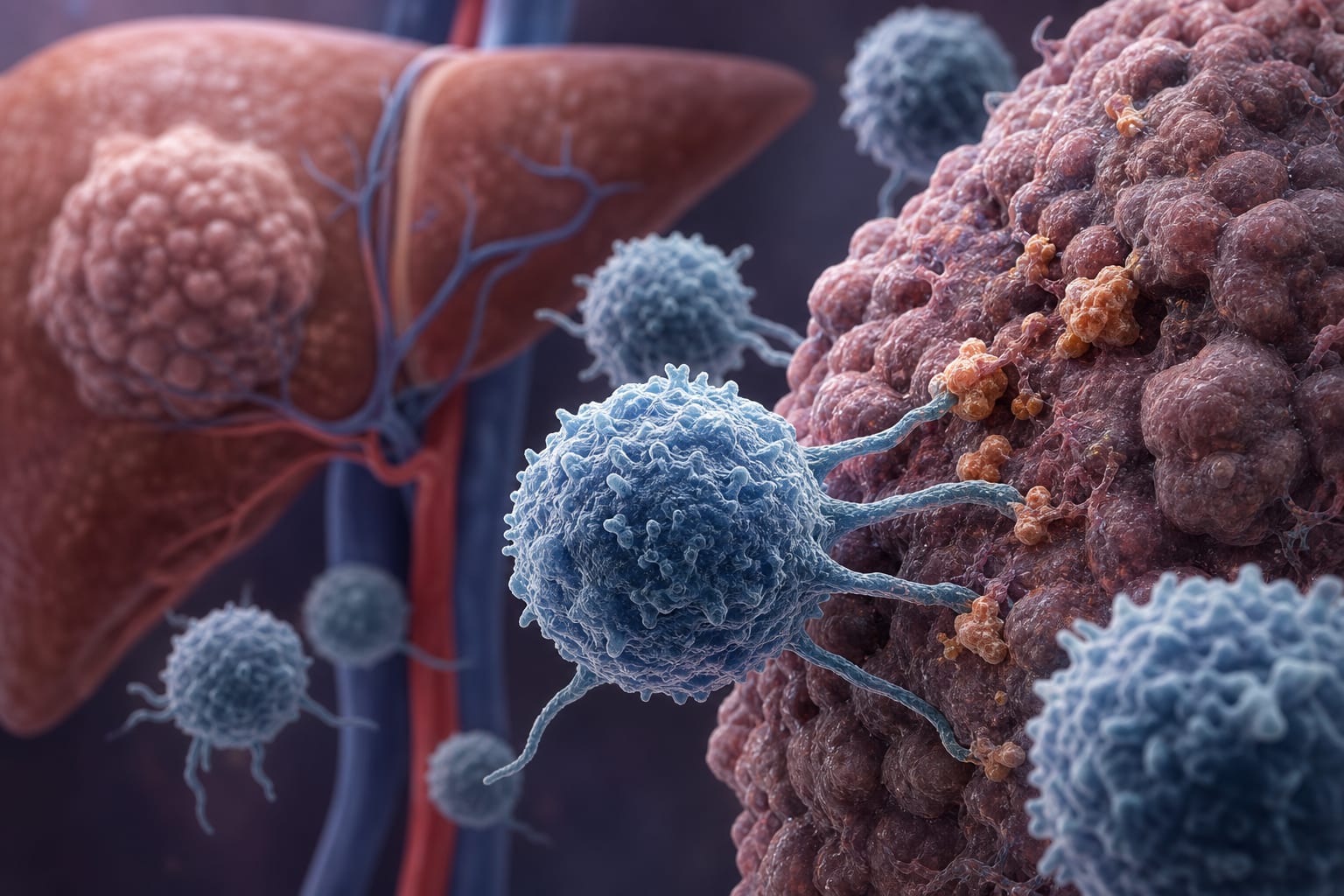
Understanding the Role, Clinical Importance, and Research Developments of Tumor Antigen-Specific T Cells in Hepatocellular Carcinoma Treatment
-
By
-
Liu Liu
-
Wang Tao
-
Lu Wei
-
Li Hongwei
-
June 24, 2026
Clinical Report: Understanding the Role of Tumor Antigen-Specific T Cells in HCC
Background
Hepatocellular carcinoma (HCC) is a significant global health issue, particularly in China, where it accounts for over 50% of new cases and deaths. The complexity of HCC, characterized by tumor heterogeneity and a challenging immune microenvironment, complicates effective treatment. Understanding the role of tumor antigen-specific T cells (TASCs) is essential for improving immunotherapy outcomes in HCC.
Data Highlights
No numerical data or trial data provided in the source material, which limits the comprehensiveness of the report.
Key Findings
- TASCs are crucial for recognizing and targeting specific antigens in HCC cells.
- Only 20-30% of patients benefit from immune checkpoint inhibitors, indicating a need for better understanding of TASC regulation.
- The HCC immune microenvironment systematically suppresses TASC activation and function.
- Chronic HBV infection plays a significant role in HCC development and TASC responses.
- Combination therapies targeting TASCs may enhance treatment efficacy, as suggested by recent studies.
Clinical Implications
Understanding TASC dynamics within the HCC immune microenvironment is important for developing more effective immunotherapies.
Conclusion
The review highlights the necessity of addressing the challenges faced by TASCs in HCC to improve immunotherapy outcomes.
Related Resources & Content
- Author(s)/Org, Source, Year -- Understanding the Role, Clinical Importance, and Research Developments of Tumor Antigen-Specific T Cells in Hepatocellular Carcinoma Treatment
- The ASCO Post — Improving Hepatocellular Carcinoma Outcomes Through Enhanced Immunotherapy
- Advancements in Renal Cell Carcinoma Treatment: Transitioning from Molecular Therapies to Targeted Immunotherapy
- dana-farber — Phenotype, Specificity and Avidity of Antitumour CD8+ T Cells in Melanoma
- The ASCO Post — Targeted Suppression of a Reactivated Developmental Pathway in Hepatocellular Cancer
- Improving Hepatocellular Carcinoma Outcomes Through Enhanced Immunotherapy
- EASL Clinical Practice Guidelines on the management of hepatocellular carcinoma
- Nivolumab plus ipilimumab versus lenvatinib or sorafenib as first-line treatment for unresectable hepatocellular carcinoma (CheckMate 9DW): an open-label, randomised, phase 3 trial - ScienceDirect
- FDA approves nivolumab with ipilimumab for unresectable or metastatic hepatocellular carcinoma | FDA
- EMERALD-3 Study Shows That New Combination Treatment Strategies for Embolization-Eligible Hepatocellular Carcinoma Are Superior - ASCO
- Efficacy and safety results from EMERALD-3: A phase 3, randomized study of tremelimumab plus durvalumab with or without lenvatinib combined with transarterial chemoembolization (TACE) in participants (pts) with unresectable embolization-eligible hepatocellular carcinoma (eeHCC). | Journal of Clinical Oncology
- Efficacy and safety results from EMERALD-3: A phase 3, randomized study of tremelimumab plus durvalumab with or without lenvatinib combined with transarterial chemoembolization (TACE) in participants (pts) with unresectable embolization-eligible hepatocellular carcinoma (eeHCC). | Journal of Clinical Oncology
- Phase I trial of ADP-A2AFP TCR T-cell therapy in patients with advanced hepatocellular or gastric hepatoid carcinoma - UCL Discovery
- Safety and efficacy of JWATM204, a novel Glypican-3 (GPC3)-targeted CAR T cell therapy for advanced hepatocellular carcinoma: A phase I dose-escalation study - PubMed
- A first-in-human study of MT-303, an innovative in vivo mRNA chimeric antigen receptor (CAR) therapy targeting GPC3, in adults with hepatocellular carcinoma. | Journal of Clinical Oncology
- CAR-T cell therapy in hepatocellular carcinoma: from mechanistic insights to clinical translation - PubMed
Based on findings from:
The mechanism of action, clinical significance, and research progress of tumor antigen-specific T cells in the treatment of HCC
Liu Liu, Wang Tao, Lu Wei, Li Hongwei. Frontiers In Oncology, 2026.
https://www.frontiersin.org/journals/oncology/articles/10.3389/fonc.2026.1704905/full
This content is an AI-generated, fully rewritten summary based on a published scholarly article. It does not reproduce the original text and is not a substitute for the original publication. Readers are encouraged to consult the source for full context, data, and methodology.