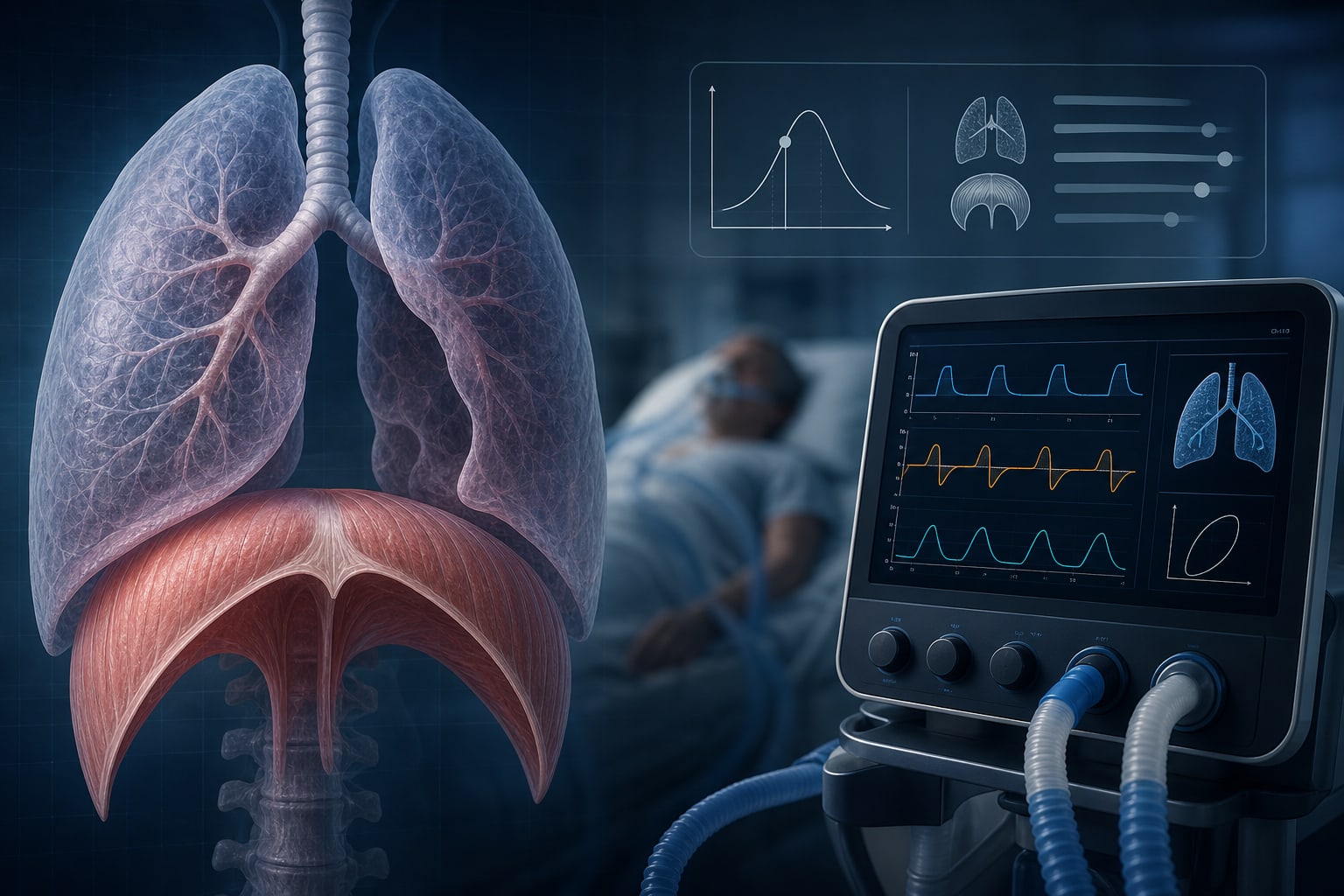
Editorial: Progress in Mechanical Ventilation: Insights into Physiology for Reducing Complications
-
By
-
Luigi Vetrugno
-
Adrián Gallardo
-
July 16, 2026
Clinical Report: Progress in Mechanical Ventilation: Insights into Physiology
Overview
This editorial discusses advancements in mechanical ventilation, emphasizing the shift towards personalized, physiology-guided strategies to reduce complications such as ventilator-induced lung injury (VILI) and diaphragmatic dysfunction (VIDD). Key studies highlight the importance of individualized ventilator settings based on real-time respiratory mechanics.
Background
Mechanical ventilation has evolved significantly, moving from rigid protocols to more personalized approaches that consider individual patient physiology. This evolution is critical as improper ventilation strategies can lead to serious complications, including VILI and VIDD.
Data Highlights
No numerical data provided in the source material.
Key Findings
- Personalization of mechanical ventilation is essential for preventing VILI, as highlighted by Merola et al.
- Shortening inspiratory rise time increases mechanical power in volume-controlled modes, according to Tontu et al.
- A lung-protective ventilation strategy significantly reduced intraoperative atelectasis in infants, as shown by Yue et al.
- Pressure-controlled ventilation with volume guarantee improved dynamic compliance in children undergoing thoracic surgery, per Wang et al.
- Inspiratory muscle training enhances respiratory muscle strength and weaning success, as reviewed by Andrade-Rebolledo et al.
Clinical Implications
Clinicians should consider individualized ventilator settings based on real-time assessments of respiratory mechanics to minimize the risk of VILI and VIDD.
Conclusion
The shift towards physiology-guided mechanical ventilation represents a significant advancement in critical care.
Related Resources & Content
- Merola et al., Intensive Care Medicine, 2022 -- Progress in Mechanical Ventilation: Insights into Physiology for Reducing Complications
- Tontu et al., Intensive Care Medicine, 2022 -- Progress in Mechanical Ventilation: Insights into Physiology for Reducing Complications
- Yue et al., Intensive Care Medicine, 2022 -- Progress in Mechanical Ventilation: Insights into Physiology for Reducing Complications
- Wang et al., Intensive Care Medicine, 2022 -- Progress in Mechanical Ventilation: Insights into Physiology for Reducing Complications
- Andrade-Rebolledo et al., Intensive Care Medicine, 2022 -- Progress in Mechanical Ventilation: Insights into Physiology for Reducing Complications
- Intensive Care Medicine — Review of Key Developments in Intensive Care Medicine, 2008: Focus on Experimental Approaches, Acute Respiratory Failure, ARDS, Mechanical Ventilation, and Endotracheal Intubation
- Intensive Care Medicine — Minimizing Mechanical Ventilation: A More Effective Approach
- Intensive Care Medicine — Highlights from Intensive Care Medicine 2012: Focus on Noninvasive Ventilation, Patient Monitoring, Ventilator Interactions, Acute Respiratory Distress Syndrome, Sedation Practices, Pediatric Considerations, and Additional Topics
- Clinical Guideline for Treating Acute Respiratory Insufficiency with Invasive Ventilation and Extracorporeal Membrane Oxygenation
- Electrical impedance tomography-guided positive end-expiratory pressure and mortality of patients with the acute respiratory distress syndrome
- Recommendations for lung ventilation and perfusion assessment with chest electrical impedance tomography
Based on findings from:
Editorial: Advancements in mechanical ventilation: understanding physiology to mitigate complications
Luigi Vetrugno, Adrián Gallardo. Frontiers In Medicine, 2026.
https://www.frontiersin.org/journals/medicine/articles/10.3389/fmed.2026.1920884/full
This content is an AI-generated, fully rewritten summary based on a published scholarly article. It does not reproduce the original text and is not a substitute for the original publication. Readers are encouraged to consult the source for full context, data, and methodology.