BAG3+ CAF-T cell neighborhood predicts resistance to neoadjuvant chemoimmunotherapy in NSCLC - Report - MDSpire

BAG3+ CAF-T cell neighborhood predicts resistance to neoadjuvant chemoimmunotherapy in NSCLC

  • By

  • Jing Sun

  • Zhengqi Cao

  • Yueping Jin

  • Anni Wang

  • Li Lu

  • Lixuan Chen

  • Wenhui Shi

  • Peiyi Xu

  • Yuxin Ouyang

  • Junjie Tang

  • Zhouwenli Meng

  • Ziming Li

  • July 7, 2026

  • 0 min

Share

Clinical Report: BAG3+ CAF-T Cell Microenvironment as a Predictor of NCIT Resistance

Overview

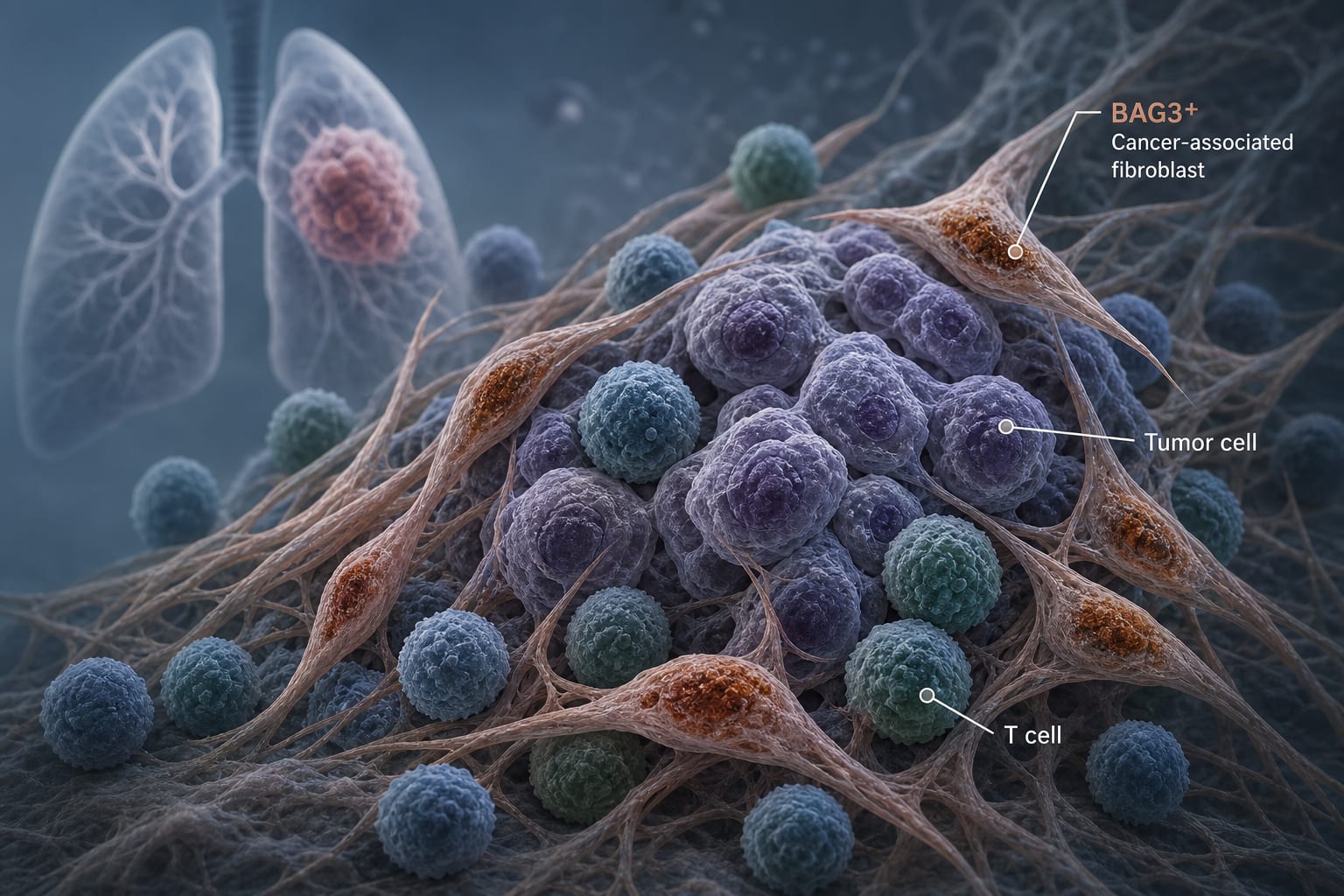
This study identifies the BAG3+ CAF-T Cell Neighborhood as a significant predictor of non-response to neoadjuvant chemoimmunotherapy (NCIT) in non-small cell lung cancer (NSCLC).

Background

Neoadjuvant chemoimmunotherapy has improved outcomes in NSCLC, yet over 40% of patients do not achieve major pathological response (MPR). Identifying non-responders before treatment initiation is crucial for optimizing therapeutic strategies and improving patient outcomes. Current biomarkers have limited efficacy in predicting treatment responses, highlighting the need for more reliable indicators.

Data Highlights

IndicatorAUC95% CI
BAG3+IFITM2+ CAFs0.840.746-0.931
BAG3+CD8+ T cells0.720.603-0.835
BAG3+ CAF-T Cell Neighborhood0.870.787-0.948

Key Findings

  • 40.35% of radiological responders failed to achieve MPR.
  • Activation of stress-related signaling pathways was observed in CAFs and T cells from non-MPR patients.
  • BAG3+IFITM2+ CAFs and BAG3+CD8+ T cells were significantly more abundant in non-MPR patients.
  • The BAG3+ CAF-T Cell Neighborhood was significantly more abundant in the non-MPR group compared to the MPR group (p<0.05).
  • The BAG3+ CAF-T Cell Neighborhood outperformed other indicators in predicting non-response to NCIT.

Clinical Implications

The identification of the BAG3+ CAF-T Cell Neighborhood as a predictive biomarker may aid in stratifying patients for neoadjuvant chemoimmunotherapy.

Conclusion

The BAG3+ CAF-T Cell Neighborhood presents a promising biomarker for predicting non-response to NCIT in NSCLC.

Related Resources & Content

  1. Frontiers in Immunology, 2026 -- BAG3+ CAF-T Cell Neighborhood predicts resistance to neoadjuvant chemoimmunotherapy in NSCLC
  2. Frontiers in Immunology, 2026 -- An IHC-derived TLS–CD8–macrophage immune niche score predicts major pathological response to neoadjuvant chemoimmunotherapy in resectable NSCLC
  3. Frontiers in Immunology, 2026 -- Predicting response to immunochemotherapy in EGFR-mutant lung adenocarcinoma after third-generation TKI resistance using CT radiomics-based habitat imaging
  4. Frontiers in Medicine, 2026 -- Inducing tumor-intrinsic innate immune response to break cancer immunotherapy resistance
  5. Early and locally advanced non-small-cell lung cancer: ESMO Clinical Practice Guideline for diagnosis, treatment and follow-up - PubMed
  6. Frontiers in Immunology — The impact of the large B-cell lymphoma tumor microenvironment on efficacy of CD19-directed CAR-T immunotherapy
  7. Early and locally advanced non-small-cell lung cancer: ESMO Clinical Practice Guideline for diagnosis, treatment and follow-up - PubMed
  8. IASLC MULTIDISCIPLINARY RECOMMENDATIONS FOR PATHOLOGIC ASSESSMENT OF LUNG CANCER RESECTION SPECIMENS FOLLOWING NEOADJUVANT THERAPY - PMC
  9. Frontiers | BAG3+ CAF-T Cell Neighborhood predicts resistance to neoadjuvant chemoimmunotherapy in NSCLC

Original Source(s)

Related Content