Machine learning-based prediction of difficult laryngoscopy in infants with Pierre Robin sequence using quantitative 3D computed tomography parameters - Report - MDSpire

Machine learning-based prediction of difficult laryngoscopy in infants with Pierre Robin sequence using quantitative 3D computed tomography parameters

  • By

  • Danling Hu

  • Weiwei Cai

  • Anwen Zheng

  • ShuaiLi You

  • Shan Zhong

  • June 24, 2026

  • 0 min

Share

Clinical Report: Utilizing Machine Learning to Forecast Challenging Laryngoscopy in Infants with Pierre Robin Sequence

Overview

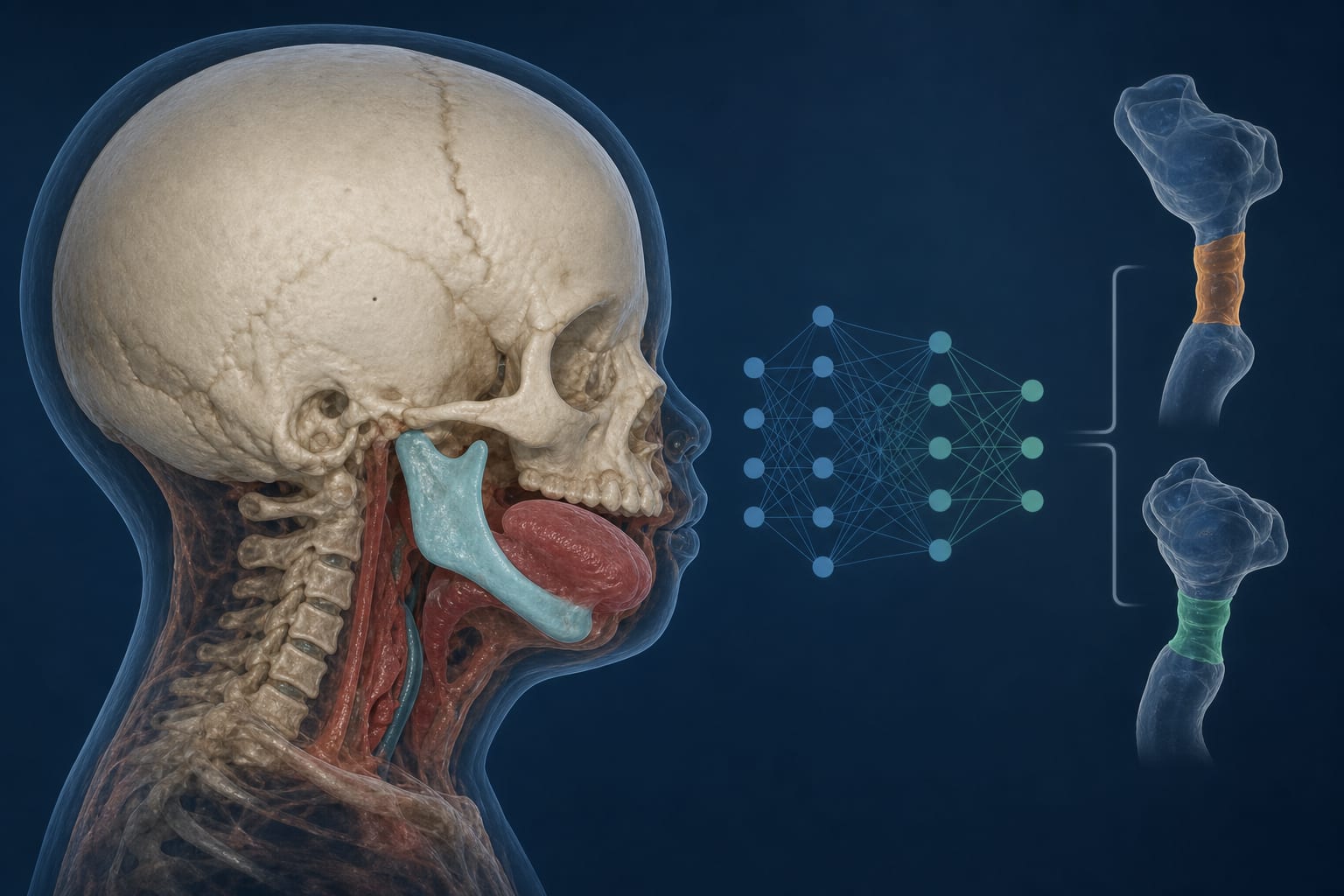
This study identifies quantitative 3D-CT parameters that predict difficult laryngoscopic exposure in infants with Pierre Robin sequence (PRS) and develops machine learning models. The Extra Trees model demonstrated superior generalizability in an independent validation cohort.

Background

Pierre Robin sequence (PRS) is a congenital condition that often leads to airway obstruction due to anatomical anomalies. Accurate preoperative assessment of airway difficulty is crucial for safe anesthesia management in this vulnerable population. Traditional assessment methods may not adequately predict difficult laryngoscopy, highlighting the need for advanced predictive models.

Data Highlights

ParameterOdds Ratio (OR)p-value
Tongue Length (D1)1.0580.005
Tongue Base–Posterior Pharyngeal Wall Distance (D4)0.718<0.001
Sagittal Oropharyngeal Cross-Sectional Area (S2)0.2710.001
Tongue Base–Epiglottic Angle (A2)0.9520.028

Key Findings

  • Four independent predictors of difficult laryngoscopy were identified: tongue length, tongue base–posterior pharyngeal wall distance, sagittal oropharyngeal cross-sectional area, and tongue base–epiglottic angle.
  • The XGBoost model achieved the highest discrimination in the training cohort (AUC = 0.961).
  • The Extra Trees model showed superior generalizability in the validation cohort (AUC = 0.876).
  • Calibration analysis for the Extra Trees model indicated excellent agreement between predicted and observed outcomes.
  • Decision curve analysis demonstrated substantial net clinical benefit across various threshold probabilities.

Clinical Implications

The identification of specific 3D-CT parameters can enhance preoperative airway assessments in infants with PRS.

Conclusion

Quantitative 3D-CT parameters are relevant for predicting difficult laryngoscopy in infants with PRS.

Related Resources & Content

  1. Frontiers in Pediatrics, 2026 -- Establishment of a CT-based prediction model for endotracheal tube size in infants aged <1 year
  2. European Radiology, 2023 -- Assessing the Role of Ultrasonic Measurements of Hyomental Distance and Skin-to-Epiglottis Distance in Anticipating Difficult Laryngoscopy in Pediatric Patients
  3. Data-Driven Automation for Plate Design in Preoperative Management of Cleft Lip and Palate, 2023
  4. 2022 American Society of Anesthesiologists Practice Guidelines for Management of the Difficult Airway, PubMed
  5. Airway management in the paediatric difficult intubation registry: a propensity score matched analysis of outcomes over time, PMC
  6. Frontiers in Surgery — Predicting future surgical steps during MCA aneurysm clipping using a multimodal transformer
  7. 2022 American Society of Anesthesiologists Practice Guidelines for Management of the Difficult Airway - PubMed
  8. Airway management in the paediatric difficult intubation registry: a propensity score matched analysis of outcomes over time - PMC
  9. Accuracy and Reliability of 4D-CT and Flexible Laryngoscopy in Upper Airway Evaluation in Robin Sequence - PMC

Original Source(s)

Related Content