Real-world characteristics and management of ventricular tachycardias in ICD patients: Data from the VIDEO registry - Report - MDSpire

Real-world characteristics and management of ventricular tachycardias in ICD patients: Data from the VIDEO registry

  • By

  • Fabienne Kreimer

  • Julian Wolfes

  • Thomas Riemer

  • Jochen Senges

  • Christian Perings

  • Roland Tilz

  • Ibrahim Akin

  • Christian Meyer

  • Thomas Kleemann

  • Malte Kuniss

  • Daniel Steven

  • Lars Eckardt

  • June 24, 2026

  • 0 min

Share

Clinical Report: Characteristics and Management of Ventricular Tachycardias in Patients with ICDs

Background

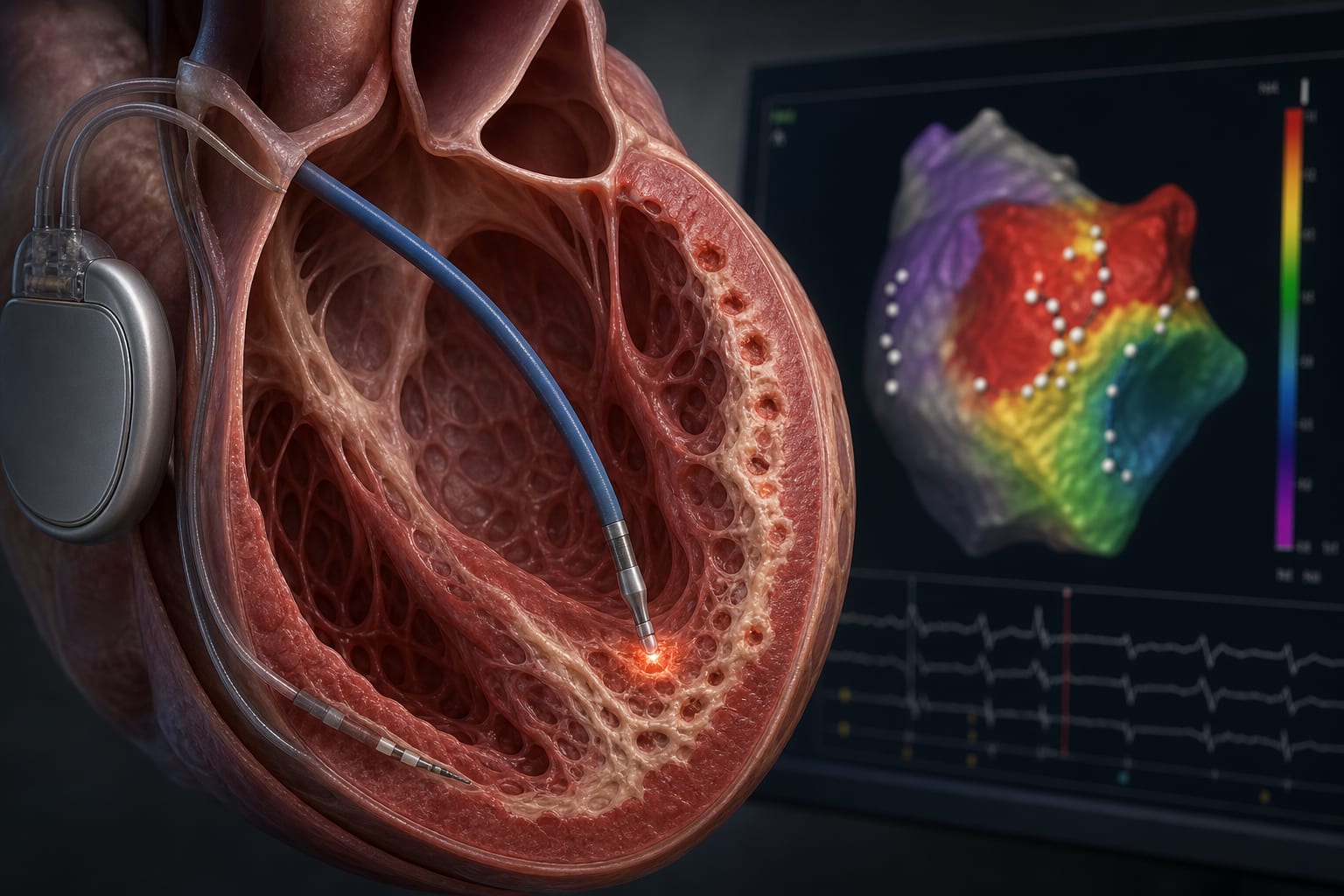
Recurrent VT poses significant challenges in patients with ICDs, often necessitating additional therapeutic interventions beyond device therapy. Catheter ablation has emerged as a strategy to reduce VT recurrences and improve patient outcomes. However, the application of ablation in clinical settings varies.

Data Highlights

No specific numerical data was provided in the source material.

Key Findings

  • Recurrent VT is a prognostic marker in patients with ICDs.
  • Catheter ablation can reduce VT recurrences and ICD therapies.
  • Evidence from the VANISH-2 trial supports first-line ablation over antiarrhythmic drugs in preventing VT recurrences.
  • The PAUSE-SCD trial indicates prophylactic VT ablation at ICD implantation reduces arrhythmia-related endpoints.
  • Real-world data from the VIDEO registry provide insights into the management of VT in a heterogeneous cohort of ICD patients.

Clinical Implications

The findings suggest that catheter ablation should be considered as a primary management strategy for recurrent VT in ICD patients. Clinicians should be aware of the variability in the application of ablation and the need for individualized patient assessment.

Conclusion

The analysis of the VIDEO registry underscores the importance of understanding real-world practices in managing recurrent VT in ICD patients, particularly regarding the role of catheter ablation.

Related Resources & Content

  1. Clinical Research in Cardiology, 2020 -- Challenges Associated with S-ICD Therapy: Insights from a Major Tertiary Care Center
  2. Clinical Research in Cardiology, 2023 -- Ventricular Arrhythmia Incidence in ICD Patients During the COVID-19 Pandemic's Second Wave
  3. Temple Health -- Case Study: EV-ICD and Epicardial Ablation in a 40-Year-Old Patient
  4. Clinical Research in Cardiology, 2022 -- Subcutaneous ICDs for Many, While Transvenous ICDs for a Select Few?
  5. 2022 ESC Guidelines for Ventricular Arrhythmias: Key Points - American College of Cardiology
  6. Management of patients with an electrical storm or clustered ventricular arrhythmias: a clinical consensus statement
  7. Ventricular Tachycardia Ablation vs. Escalated Antiarrhythmic Drug Therapy in Ischemic Heart Disease
  8. Preventive Ablation of Ventricular Tachycardia in Patients With Myocardial Infarction
  9. Catheter Ablation of Ventricular Tachycardia After the First ICD Shock: Impact on Mortality and Heart Failure Hospitalization
  10. 2022 ESC Guidelines for Ventricular Arrhythmias: Key Points - American College of Cardiology
  11. Substrate Ablation vs Antiarrhythmic Drug Therapy for Symptomatic Ventricular Tachycardia | JACC
  12. Efficacy and Safety of Catheter Ablation vs. Antiarrhythmic Drugs For Ventricular Tachycardia (VANISH2) - American College of Cardiology
  13. Catheter Ablation for Ventricular Tachycardia in Ischemic Cardiomyopathy: A Meta-Analysis With Reconstructed Time-to-Event and Trial Sequential Analysis - PubMed
  14. Catheter ablation versus medical therapy for ventricular tachycardia in patients with ischemic heart disease: A systematic review and meta-analysis of randomized controlled trials - PubMed

Original Source(s)

Related Content