Analgesic effects of different patient-controlled intravenous analgesia infusion modes post cesarean section under multimodal analgesia: a retrospective cohort study - Report - MDSpire

Analgesic effects of different patient-controlled intravenous analgesia infusion modes post cesarean section under multimodal analgesia: a retrospective cohort study

  • By

  • Lin Chen

  • Yang Wang

  • Shanshan Ye

  • Tao Xu

  • Ding Huang

  • June 18, 2026

  • 0 min

Share

Comparative Analysis of Patient-Controlled Intravenous Analgesia Infusion Strategies Following Cesarean Delivery

Overview

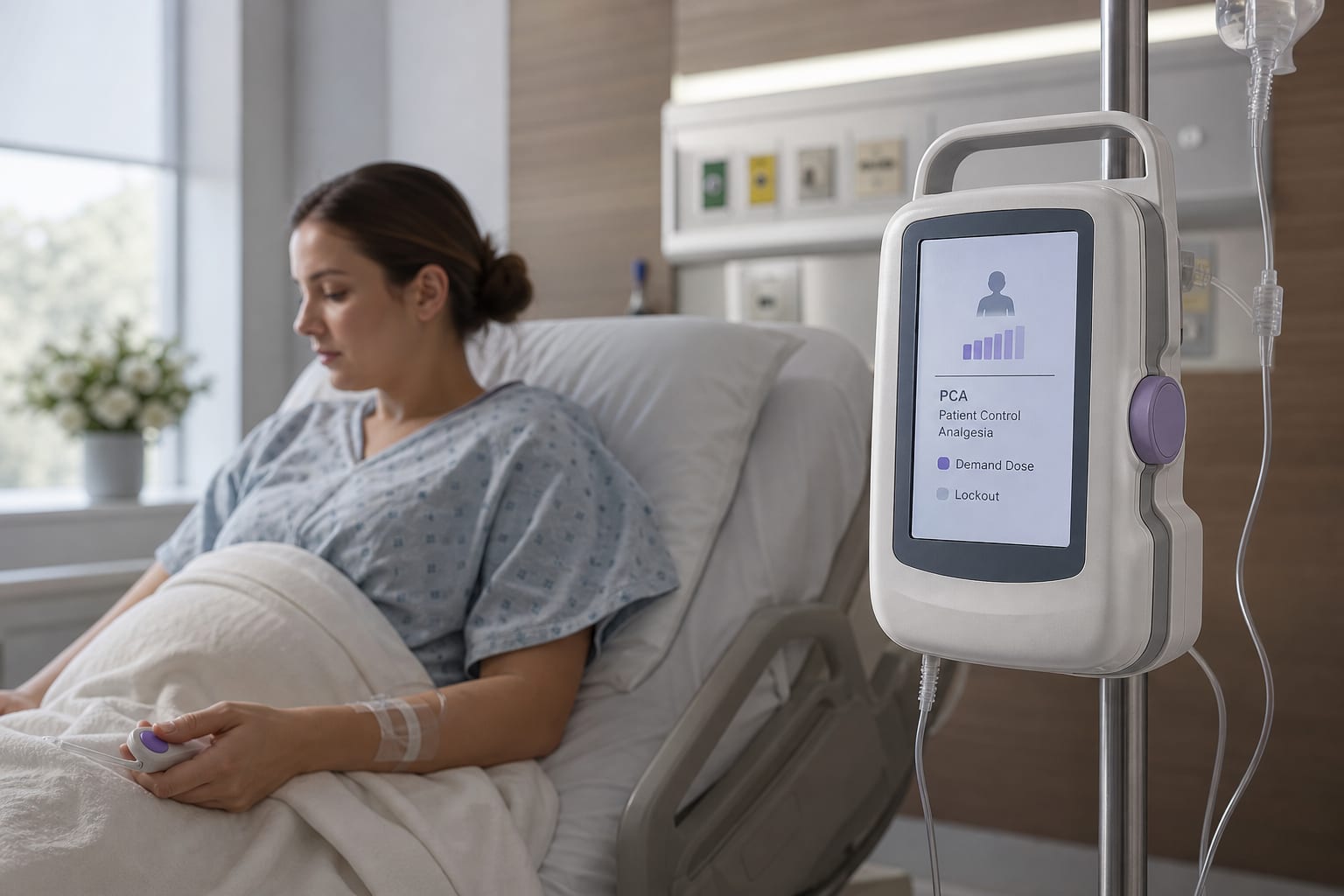
This study investigates the analgesic efficacy of patient-controlled intravenous analgesia (PCIA) with and without background infusion in parturients receiving multimodal analgesia after cesarean delivery. The findings indicate that background infusion does not enhance analgesic efficacy and is associated with increased opioid consumption.

Background

Expand on the consequences of chronic pain and the necessity for effective pain management.

Data Highlights

ParameterBackground InfusionNo Background InfusionP-value
PCIA demands (0-24 h)3 (0, 6)2 (1, 6)0.829
PCIA demands (24-48 h)5 (1, 12)4 (1, 10)0.303
48-h intravenous morphine equivalent dose54.6 (44.9, 62.0) mg3.5 (0.7, 8.5) mg< 0.001

Key Findings

  • No significant difference in PCIA demands between groups at 0-24 h and 24-48 h.
  • Higher 48-h intravenous morphine equivalent doses were observed in the background infusion group.
  • Background infusion did not improve rest/ambulation pain scores compared to no background infusion.
  • Multimodal analgesia including liposomal bupivacaine TAP block was utilized in both groups.
  • Increased opioid exposure was noted with background infusion despite no enhanced analgesic effect.

Clinical Implications

Clinicians should consider avoiding background infusion in PCIA for parturients receiving multimodal analgesia after cesarean delivery, as it does not improve pain control and increases opioid consumption. This approach aligns with contemporary guidelines advocating for opioid-sparing strategies.

Conclusion

Reinforce the alignment with current clinical guidelines for postoperative care.
Related Resources & Content

  1. Guidelines for postoperative care in cesarean delivery: Enhanced Recovery After Surgery Society recommendations (part 3)—2025 update, ScienceDirect, 2025 -- Guidelines for postoperative care in cesarean delivery
  2. Pain management after elective caesarean section under neuraxial anaesthesia: an updated systematic review and procedure-specific postoperative pain management (PROSPECT) recommendations, PubMed, 2026 -- Pain management after elective caesarean section
  3. Recovery quality of transversus abdominis plane block with liposomal bupivacaine after cesarean delivery: a randomized trial, ScienceDirect, 2024 -- Recovery quality of transversus abdominis plane block
  4. Drugs - Real World Outcomes — Efficacy of Intravenous Lidocaine in Managing Acute Pain: A Retrospective Analysis from One Institution
  5. Enhancing Postoperative Care Following Scoliosis Surgery in Both Healthy and Compromised Pediatric Patients: A Comparison of Intravenous Opioid and Epidural Analgesia
  6. Response to the editorial on "Comparative analysis of two-stage laparoscopic transversus abdominis plane block versus thoracic epidural anesthesia in bowel resection—an exploratory cohort investigation
  7. Journal of Gastrointestinal Surgery — Comparison of Epidural and Alternative Analgesic Techniques in Patients Undergoing Open Pancreatectomy: A Retrospective Cohort Analysis
  8. Guidelines for postoperative care in cesarean delivery: Enhanced Recovery After Surgery Society recommendations (part 3)—2025 update - ScienceDirect
  9. Pain management after elective caesarean section under neuraxial anaesthesia: an updated systematic review and procedure-specific postoperative pain management (PROSPECT) recommendations - PubMed
  10. Recovery quality of transversus abdominis plane block with liposomal bupivacaine after cesarean delivery: A randomized trial - ScienceDirect
  11. Transversus Abdominis Plane Block With Liposomal Bupivacaine for Pain After Cesarean Delivery in a Multicenter, Randomized, Double-Blind, Controlled Trial - PubMed
  12. Epidural analgesia combined with transversus abdominis plane block with liposomal bupivacaine reduces pain after caesarean delivery: a double-blind, randomised controlled trial - PMC
  13. Frontiers | Transversus abdominis plane block with liposomal bupivacaine versus standard bupivacaine for postoperative analgesia in elective cesarean section: a systematic review and meta-analysis
  14. Frontiers | Analgesic effects of different patient-controlled intravenous analgesia infusion modes post cesarean section under multimodal analgesia: a retrospective cohort study
  15. SPECIAL ARTICLESPractice Guidelines for Acute Pain Management in the

Original Source(s)

Related Content