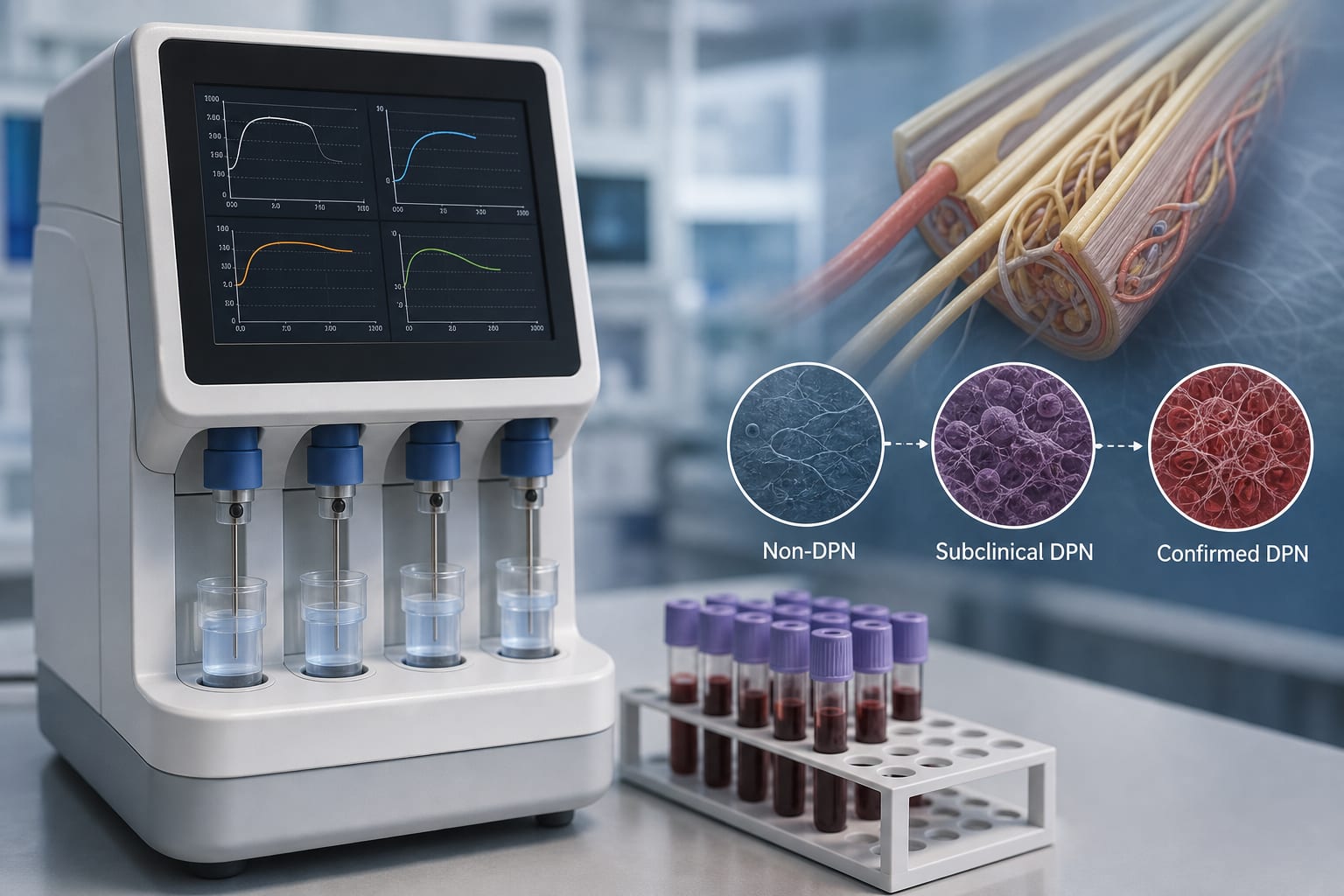
Clinical Report: Alterations in Sonoclot Coagulation Profiles in DPN
Overview
This study evaluates whole-blood viscoelastic profiles in patients with diabetic peripheral neuropathy (DPN) using the Sonoclot analyzer. It identifies a significant association between coagulation parameters and the presence of DPN.
Background
Diabetic peripheral neuropathy (DPN) is a prevalent complication of type 2 diabetes mellitus (T2DM), affecting up to 50% of patients. It is characterized by nerve degeneration leading to pain and sensory loss, significantly impacting quality of life.
Data Highlights
Parameter
Value
Participants with sDPN
93 (32.2%)
Participants with confirmed DPN
70 (24.2%)
Optimal CR cutoff value
31.1
AUC for ROC analysis
0.729
Sensitivity
47.1%
Specificity
98.9%
Key Findings
93 participants (32.2%) had subclinical DPN (sDPN) and 70 (24.2%) had confirmed DPN.
CR levels were significantly elevated in patients with confirmed DPN compared to non-DPN and sDPN groups.
CR was independently associated with DPN after adjusting for confounding factors (odds ratio 1.154, 95% CI 1.075–1.239).
RCS analysis showed a significant nonlinear association between CR levels and DPN presence.
ROC analysis indicated an optimal CR cutoff value of 31.1 with moderate sensitivity and high specificity.
Clinical Implications
The findings indicate that Sonoclot-derived CR levels were significantly elevated in patients with confirmed DPN compared to non-DPN and sDPN groups.
Conclusion
Sonoclot-derived CR is significantly associated with clinically confirmed DPN.