Portable automated rapid testing for auditory assessment: repeated at-home testing in older adults - Report - MDSpire

Portable automated rapid testing for auditory assessment: repeated at-home testing in older adults

  • By

  • Quentin Coppola

  • Lakshmi Kannan

  • Esteban Sebastian Lelo de Larrea-Mancera

  • Audrey A. Carrillo

  • Frederick Gallun

  • Susanne M. Jaeggi

  • Aaron R. Seitz

  • May 15, 2026

  • 0 min

Share

Clinical Report: Mobile Automated Quick Testing for Hearing Evaluation

Overview

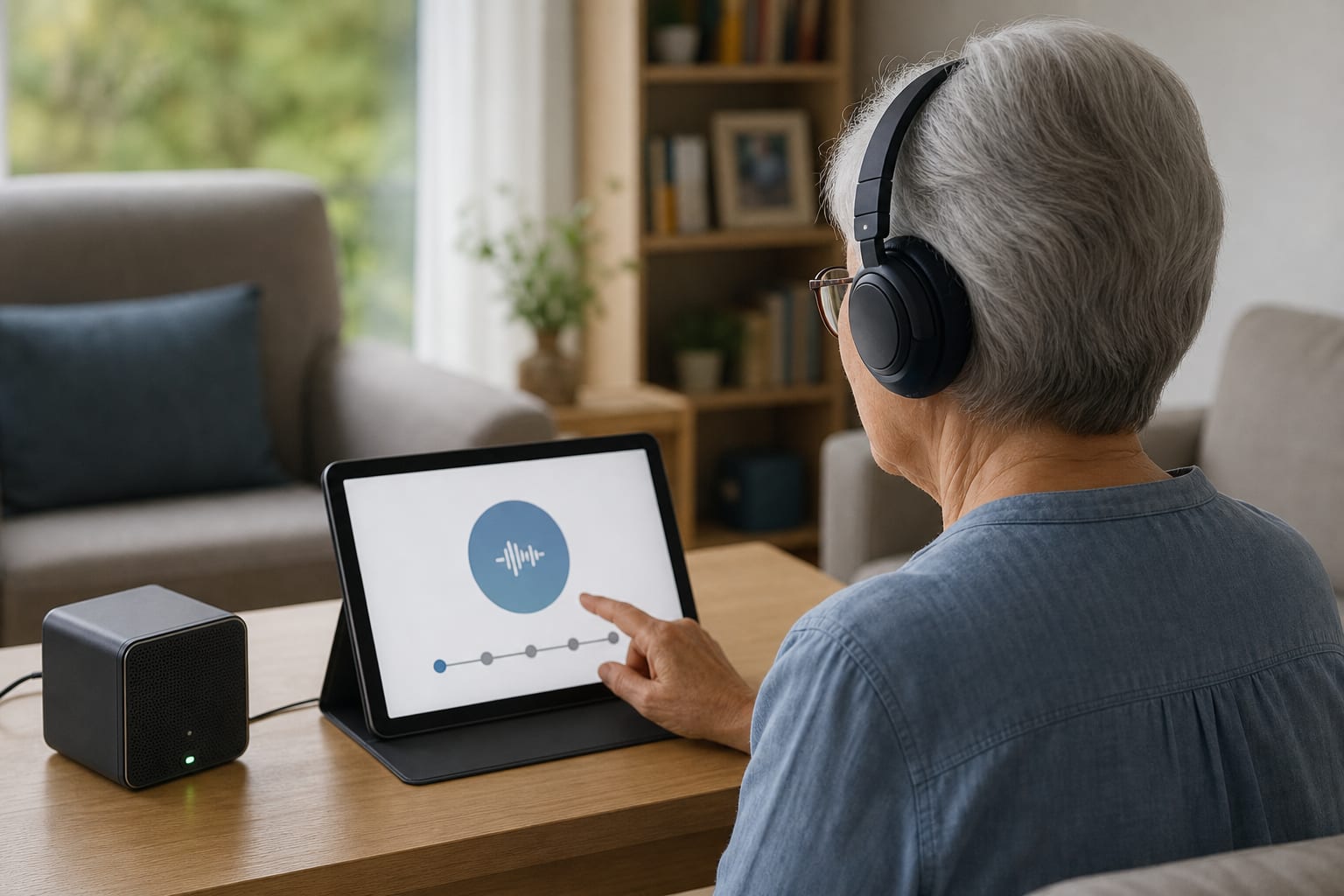
This study evaluates the Portable Automated Rapid Testing (PART) system for remote auditory assessments in elderly individuals. The findings indicate that PART demonstrates moderate-to-high test-retest reliability and significant acceptability, suggesting its potential as an effective tool for home-based hearing evaluations.

Background

Hearing impairment is prevalent among older adults, affecting approximately two-thirds of those aged 70 and above. It is associated with cognitive decline, making early detection crucial for timely intervention. Traditional hearing assessments are often inaccessible, highlighting the need for scalable and reliable evaluation methods that can be conducted in the home environment.

Data Highlights

MeasureReliabilityAcceptability
Frequency modulation detectionModerate-to-highHigh
Speech-in-noise comprehensionModerate-to-highHigh
Spatial release from maskingModerate-to-highHigh

Key Findings

  • The PART system allows for remote auditory processing evaluations in elderly individuals.
  • Moderate-to-high test-retest reliability was observed across various auditory tasks.
  • High acceptability among participants indicates the feasibility of home assessments.
  • PART may facilitate early detection of hearing impairments linked to cognitive decline.
  • Future research should explore the relationship between central auditory mechanisms and cognitive health.

Clinical Implications

Healthcare providers should consider integrating mobile auditory assessment tools like PART into routine evaluations for elderly patients. This approach may enhance accessibility to hearing assessments and support early intervention strategies for cognitive decline associated with hearing loss.

Conclusion

The PART system represents a promising advancement in auditory evaluation for older adults, potentially improving early detection and management of hearing impairments. Further studies are warranted to validate its effectiveness in diverse populations.

Related Resources & Content

  1. Frontiers | Portable Automated Rapid Testing (PART) for Auditory Assessment: Repeated At-Home Testing in Older Adults, 2026 -- Study on PART system
  2. New Clinical Practice Guideline Provides Evidence-based Recommendations for Age-related Hearing Loss (ARHL) - American Academy of Otolaryngology-Head and Neck Surgery (AAO-HNS), 2024 -- Clinical guidelines
  3. conexiant — Empowering Visiting Nurses in Audiology
  4. conexiant — Smell Screening With a Mobile Test
  5. npj Digital Medicine — Developing a Speech-Driven Digital Biomarker for Cognitive Decline: Utilizing Speech as an Indicator for Cognitive Evaluation
  6. npj Digital Medicine — Automated AI based identification of autism spectrum disorder from home videos
  7. Empowering Visiting Nurses in Audiology
  8. Smell Screening With a Mobile Test
  9. Developing a Speech-Driven Digital Biomarker for Cognitive Decline
  10. New Clinical Practice Guideline Provides Evidence-based Recommendations for Age-related Hearing Loss (ARHL) - American Academy of Otolaryngology-Head and Neck Surgery (AAO-HNS)
  11. Frontiers | Portable Automated Rapid Testing (PART) for Auditory Assessment: Repeated At-Home Testing in Older Adults
  12. Hearing intervention versus health education control to reduce cognitive decline in older adults with hearing loss in the USA (ACHIEVE): a multicentre, randomised controlled trial - ScienceDirect

Original Source(s)

Related Content