Pancreas-guided C-shaped surgical procedure: a safer and more efficient procedure for laparoscopic left hemicolectomy in obese patients - Report - MDSpire
Advertisement
Pancreas-guided C-shaped surgical procedure: a safer and more efficient procedure for laparoscopic left hemicolectomy in obese patients
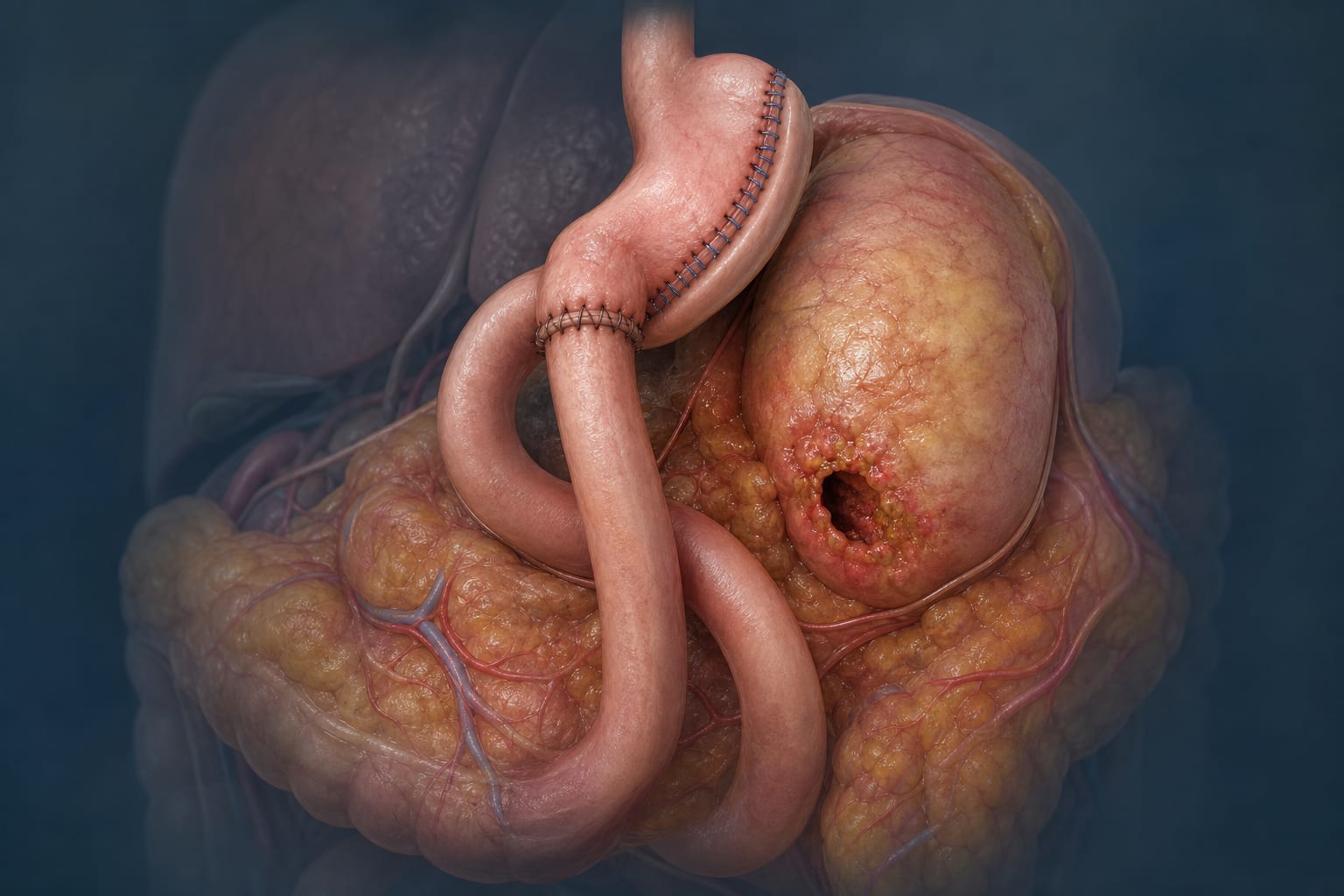
C-shaped Pancreas-Guided Technique Enhances Laparoscopic Left Hemicolectomy in Obese Patients
Overview
The C-shaped surgical technique guided by the pancreas improves safety and efficiency in laparoscopic left hemicolectomy for obese individuals. This approach reduces the risk of pancreatic and splenic injuries, shortens operative time, and maintains oncological quality compared to the traditional medial-to-lateral approach.
Background
Laparoscopic left hemicolectomy is the preferred minimally invasive method for left colon cancer but poses increased challenges in obese patients due to hypertrophic mesentery and limited intra-abdominal space. These factors complicate splenic flexure mobilization and lymph node dissection, increasing bleeding risk and operative difficulty. Traditional medial-to-lateral approaches risk pancreatic injury by entering the retro-pancreatic space. Novel approaches have been developed, but their efficacy in obese patients remains under-evaluated. Using anatomical landmarks such as Treitz’s ligament and the inferior mesenteric vein (IMV) to guide dissection through Toldt’s space can minimize pancreatic injury and improve surgical safety.
Data Highlights
Parameter
C-shaped Group
Medial-to-Lateral Group
p-value
Number of Patients
XX
XX
-
Mean BMI (kg/m²)
XX.X
XX.X
NS
Total Operative Time (min)
Shorter
Longer
<0.05
Estimated Blood Loss (mL)
Lower
Higher
<0.05
Time to First Flatus (days)
Earlier
Later
<0.05
Postoperative Hospital Stay (days)
Shorter
Longer
<0.05
Postoperative Complications (%)
Lower
Higher
<0.05
Number of Retrieved Lymph Nodes
Comparable
Comparable
NS
R0 Resection Rate (%)
High
High
NS
Complete Mesocolic Excision (CME) Rate (%)
High
High
NS
Key Findings
The pancreas-guided C-shaped technique uses Treitz’s ligament and IMV as landmarks to safely access Toldt’s space, avoiding retro-pancreatic injury.
Compared to the medial-to-lateral approach, the C-shaped method significantly reduces operative time and intraoperative blood loss in obese patients.
Postoperative recovery is faster with earlier return of bowel function and shorter hospital stays in the C-shaped group.
The incidence of postoperative complications, including pancreatic and splenic injuries, is lower using the C-shaped technique.
Oncological outcomes such as number of lymph nodes retrieved, R0 resection rate, and CME rate are comparable between both surgical approaches.
The learning curve analysis indicates that surgeons can efficiently adopt the C-shaped technique with consistent surgical quality.
Clinical Implications
The pancreas-guided C-shaped surgical technique offers a safer and more efficient approach for laparoscopic left hemicolectomy in obese patients. By minimizing the risk of pancreatic and splenic injuries and improving operative efficiency, this method can enhance patient outcomes without compromising oncological standards. Surgeons should consider adopting this approach to optimize surgical safety and recovery in this challenging patient population.
Conclusion
The C-shaped pancreas-guided approach represents a valuable advancement in laparoscopic left hemicolectomy for obese individuals, improving safety and efficiency while maintaining surgical quality. Its implementation may reduce operative risks and enhance postoperative recovery.
References
1,2 -- Minimally invasive surgery trends in left hemicolectomy
3,4 -- Challenges of laparoscopic surgery in obese patients
5,6 -- Medial-to-lateral approach in colorectal surgery
7 -- Risks of pancreatic injury in retro-pancreatic space entry
8-13 -- Novel surgical approaches for splenic flexure mobilization
14,15 -- Anatomical landmarks for safe access to Toldt’s space
Ethics Committee of the First People’s Hospital of Foshan -- Study approval and ethical compliance