Clinical Monitoring Reduces Myeloma-Related Complications in Precursor Plasma Cell Disorders
Overview
In a retrospective study of 415 multiple myeloma (MM) patients, those with a prior diagnosis of precursor plasma cell disorders (pPCD) such as MGUS or smoldering MM had significantly fewer myeloma-related complications at diagnosis. Clinical monitoring was associated with earlier detection, reduced symptom duration, and lower healthcare utilization compared to patients without known precursor disorders.
Background
Multiple myeloma is consistently preceded by asymptomatic precursor states including MGUS and smoldering multiple myeloma. MGUS prevalence is high in older adults, making early detection and longitudinal follow-up increasingly important. Prior studies have linked known precursor diagnoses to improved survival in MM, but data on morbidity and patient-centered outcomes remain limited. This study aimed to evaluate differences in clinical complications and healthcare utilization between MM patients with and without prior precursor plasma cell disorder diagnoses.
Data Highlights
Parameter
pPCD Patients (n=95)
nPCD Patients (n=320)
Hypercalcemia
6%
13%
Renal insufficiency
11%
23%
Anemia
35%
65%
Osteolytic lesions
45%
59%
Bone pain
41%
58%
Pathologic fractures
26%
42%
Cord compression
6%
13%
Dialysis
2%
8%
Red blood cell transfusions
16%
39%
Emergency department visits
37%
64%
Hospitalizations
35%
57%
Median time symptom onset to MM diagnosis (months)
4.5
7.6
Key Findings
MM patients with prior pPCD diagnosis had significantly shorter symptom duration before MM diagnosis (median 4.5 vs 7.6 months, p < 0.001).
Lower rates of hypercalcemia (6% vs 13%), renal insufficiency (11% vs 23%), anemia (35% vs 65%), and osteolytic lesions (45% vs 59%) were observed in pPCD patients.
pPCD patients experienced fewer bone pain symptoms, pathologic fractures, cord compression events, dialysis requirements, and red blood cell transfusions at MM diagnosis.
Healthcare utilization prior to MM diagnosis was reduced in pPCD patients, with fewer emergency department visits (37% vs 64%) and hospitalizations (35% vs 57%).
Multivariable analysis showed a 71% reduction in odds of presenting with clinically significant myeloma-defining events in pPCD patients (OR 0.29, 95% CI 0.18–0.47, p < 0.001).
pPCD patients were more likely to be diagnosed at earlier ISS stages (I/II), suggesting earlier disease detection through clinical monitoring.
Clinical Implications
Structured clinical monitoring of patients with precursor plasma cell disorders enables earlier detection of multiple myeloma and reduces the incidence of severe myeloma-related complications. Regular hematologic follow-up facilitates timely intervention, potentially preventing irreversible organ damage and decreasing healthcare resource utilization. These findings support the integration of routine surveillance protocols for MGUS and smoldering MM patients in clinical practice.
Conclusion
Prior diagnosis and clinical monitoring of precursor plasma cell disorders are associated with reduced myeloma-related morbidity and earlier stage at MM diagnosis. This underscores the clinical value of early detection and longitudinal follow-up in improving patient outcomes.
References
Kyle et al. 2007 -- Prevalence of MGUS in older adults
Landgren et al. 2014 -- Improved survival in MM with known MGUS
Rajkumar et al. 2014 -- IMWG criteria for SMM risk stratification
Korde et al. 2020 -- Early intervention in high-risk SMM
Ottawa Hospital Research Ethics Board -- Study approval
by Edward Koo, Sarah Albert, Benjamin Patrick, Meriem Henia, Yona Rhiwi, Christopher McCudden, Victor Jimenez Zepeda, Irwindeep Sandhu, Michael Chu, Hira Mian, Alissa Visram
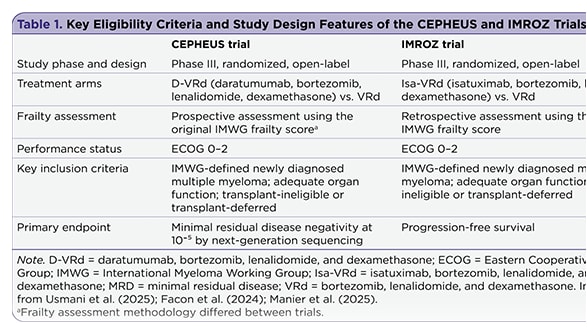
The management of newly diagnosed transplant-ineligible multiple myeloma remains challenging, in part due to the complexity of treatment decisions for frail patients. Recent subgroup analyses provide insight into whether quadruplet therapy may offer advantages over triplet therapy in this population.