Swimming ameliorates intervertebral disc degeneration accompanied by Rpl23a downregulation and changes in its immune-inflammatory pathway - Report - MDSpire

Swimming ameliorates intervertebral disc degeneration accompanied by Rpl23a downregulation and changes in its immune-inflammatory pathway

  • By

  • Yong Ji

  • Haixin Ma

  • Rong Tan

  • Xin Sha

  • Xin Li

  • June 2, 2026

  • 0 min

Share

Clinical Report: Aquatic Exercise Mitigates Degeneration of Intervertebral Discs

Overview

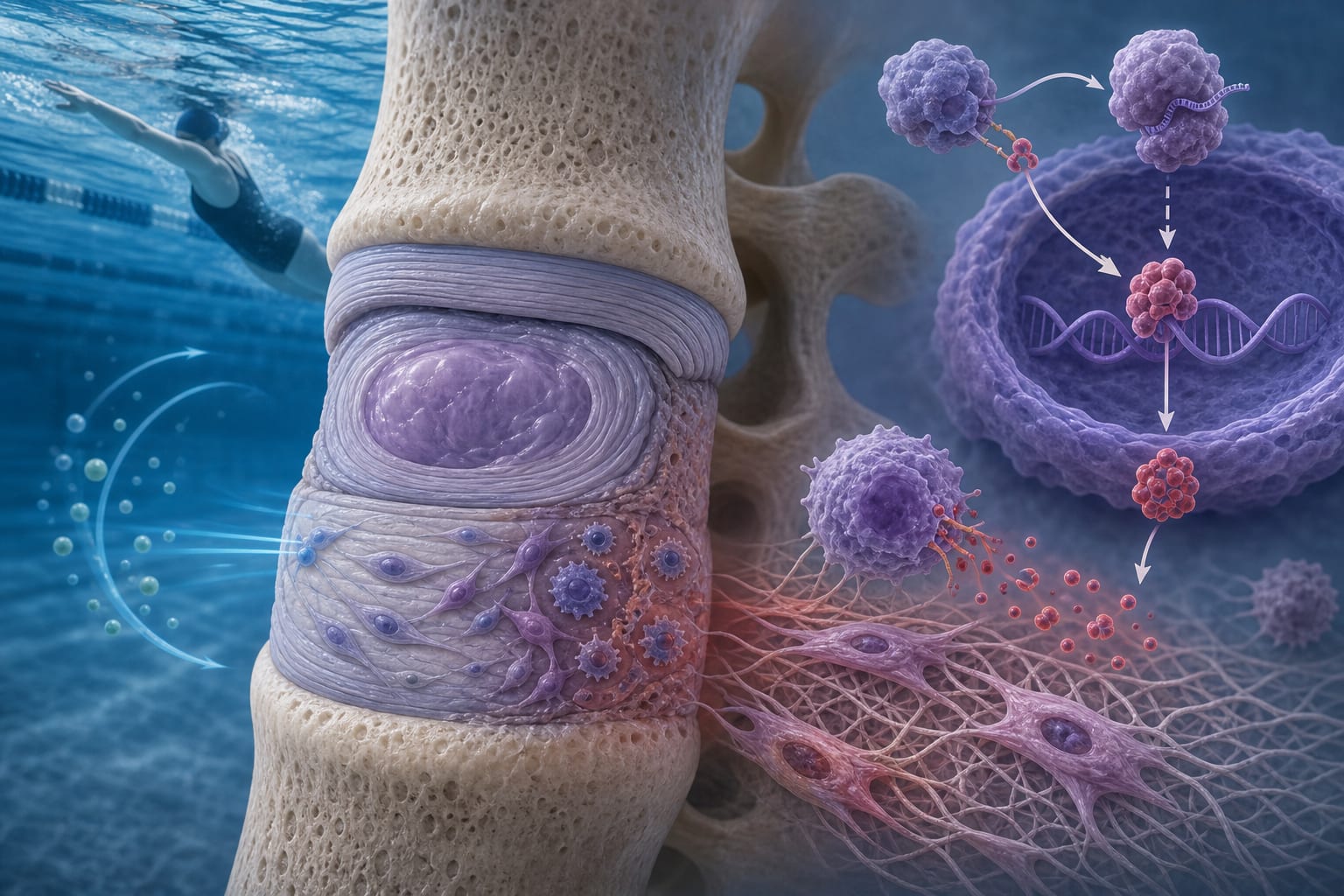
This study investigates the role of ribosomal protein L23a (Rpl23a) in intervertebral disc degeneration (IVDD) and the effects of swimming as an exercise intervention. Findings indicate that swimming reduces Rpl23a expression and inflammatory responses.

Background

Intervertebral disc degeneration (IVDD) is a significant contributor to low back pain and related dysfunctions, characterized by inflammation and extracellular matrix degradation. Understanding the immune microenvironment's role in IVDD is crucial for developing effective treatments. Ribosomal protein L23a (Rpl23a) has been implicated in inflammatory processes, but its specific role in IVDD remains unclear.

Data Highlights

No numerical data provided in the source material.

Key Findings

  • Rpl23a is significantly upregulated in degenerated intervertebral discs, primarily in fibroblasts.
  • Intercellular communication analysis shows extensive crosstalk between Rpl23a-positive fibroblasts, macrophages, and T lymphocytes.
  • In vitro, Rpl23a overexpression increases TNF-α and IL-1β secretion, activates NF-κB signaling, and induces apoptosis and matrix catabolism.
  • Swimming alleviates IVDD in a rat model, reducing Rpl23a expression and immune cell infiltration.
  • Swimming inhibits NF-κB activation, suggesting a mechanism for exercise's protective effects on IVDD.

Clinical Implications

The findings indicate the role of Rpl23a in IVDD. Further research is needed to explore its potential as a therapeutic target.

Conclusion

Rpl23a plays a significant role in the inflammatory processes associated with IVDD.
Related Resources & Content

  1. Frontiers in Immunology, 2026 -- Swimming Ameliorates Intervertebral Disc Degeneration Accompanied by Rpl23a Downregulation and Changes in Its Immune-Inflammatory Pathway
  2. Frontiers in Immunology — Single-cell extracellular vesicle-program scoring maps immunometabolic rewiring and immune crosstalk of mesenchymal stromal cells in intervertebral disc degeneration, prioritizing AP2S1 and CSTB
  3. Frontiers in Endocrinology — Cellular and molecular mechanisms of diabetes-mediated disc degeneration
  4. Frontiers in Immunology — Revisiting Intervertebral Disc Degeneration: Lipid Metabolism Disorders as Overlooked Contributors to Complex Pathology
  5. Frontiers in Neurology — Integrating multi-omics and machine learning to explore the role of amino acid metabolism in intervertebral disk degeneration
  6. WHO Guideline on Low Back Pain
  7. BMJ Clinical Practice Guideline on Chronic Spine Pain
  8. Network Meta-Analysis of Aquatic Exercise for Chronic Low Back Pain
  9. Aquatic exercise versus standard care on paraspinal muscle morphology and function in chronic low back pain patients: a randomized controlled trial - PMC
  10. Study on the effect of aquatic exercise combined with hot spring bathing for patients with chronic low back pain: a randomized controlled trial | BMC Sports Science, Medicine and Rehabilitation | Springer Nature Link
  11. Efficacy of Therapeutic Aquatic Exercise vs Physical Therapy Modalities for Patients With Chronic Low Back Pain: A Randomized Clinical Trial | Physical Medicine and Rehabilitation | JAMA Network Open | JAMA Network
  12. Intervertebral disc degeneration | Nature Reviews Disease Primers
  13. Immune microenvironment in intervertebral disc degeneration: pathophysiology and therapeutic potential - PMC
  14. Role of macrophage in intervertebral disc degeneration | Bone Research
  15. Frontiers | Swimming Ameliorates Intervertebral Disc Degeneration Accompanied by Rpl23a Downregulation and Changes in Its Immune-Inflammatory Pathway

Original Source(s)

Related Content