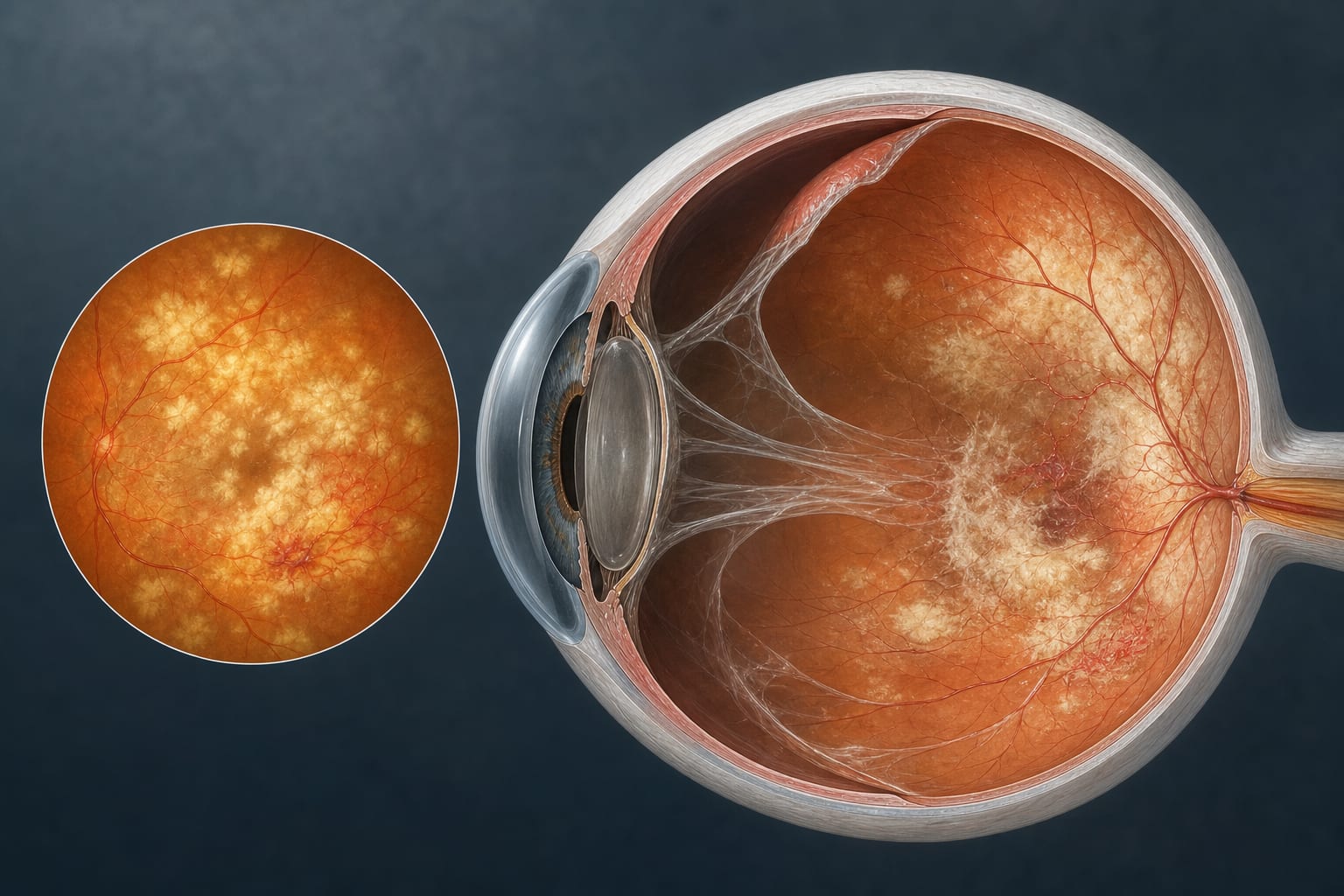
Clinical Report: Bilateral Panuveitis Linked to Ulcerative Colitis
Overview
{'text': 'This report presents a rare case of bilateral panuveitis associated with ulcerative colitis, characterized by serous ciliary body and choroidal detachment. The patient achieved significant visual improvement following prompt corticosteroid treatment.', 'suggestion': "Clarify the term 'serous ciliary body and choroidal detachment' for better understanding."}
Background
{'text': 'Ulcerative colitis (UC) is an inflammatory bowel disease that can manifest with extraintestinal complications, including ocular manifestations such as uveitis. Uveitis is a significant cause of visual impairment in patients with inflammatory bowel disease, necessitating timely diagnosis and management to prevent long-term complications.', 'suggestion': 'Include specific statistics on the prevalence of uveitis in UC patients for completeness.'}
Data Highlights
{'text': '
No numerical data available in the article.
', 'suggestion': "Consider providing qualitative data or case specifics instead of stating 'no numerical data available'."}
Key Findings
{'text': '
A 51-year-old female with UC presented with bilateral visual disturbances and ocular discomfort.
Best-corrected visual acuity was 20/60 in the right eye and 20/100 in the left eye upon presentation.
Diagnosis of bilateral panuveitis was established after excluding other causes.
Treatment with corticosteroids led to improvement in visual acuity to 20/20 in the right eye and 20/30 in the left eye after 9 months.
', 'suggestion': 'Ensure all imaging modalities and their findings are accurately represented.'}
Clinical Implications
{'text': 'Healthcare professionals should be vigilant for ocular manifestations in patients with ulcerative colitis, as timely intervention can significantly improve visual outcomes. Systemic corticosteroids are crucial in managing severe cases of uveitis associated with inflammatory bowel disease.', 'suggestion': 'Expand on the types of ocular manifestations to provide a broader context.'}
Conclusion
{'text': 'This case underscores the importance of recognizing and treating uveitis in patients with ulcerative colitis to prevent vision loss. Prompt corticosteroid therapy can lead to favorable anatomical and visual recovery.', 'suggestion': 'Reiterate the importance of differential diagnosis in uveitis cases related to UC.'}