Prognosis and recovery trajectories in prolonged disorders of consciousness: protocol for the PDOCC 5-year prospective cohort study - Report - MDSpire

Prognosis and recovery trajectories in prolonged disorders of consciousness: protocol for the PDOCC 5-year prospective cohort study

  • By

  • Hanbo Chen

  • Yong Luo

  • Weifeng Wen

  • Yunhong Deng

  • Zeyue Wen

  • Shujuan Huang

  • Li Qin

  • Si Chen

  • Xiao Lu

  • July 13, 2026

Share

Outcomes and Recovery Patterns in Extended Disorders of Consciousness

Overview

The PDOCC study aims to investigate the 5-year outcomes of prolonged disorders of consciousness (pDoC) in a cohort of 1,000 patients. This prospective cohort study will utilize standardized assessments and biomarkers.

Background

Prolonged disorders of consciousness, including vegetative state and minimally conscious state, present significant challenges in clinical prognostication following severe brain injury. Understanding the long-term trajectories of these conditions is crucial for improving patient management and rehabilitation strategies. Current literature lacks comprehensive longitudinal data.

Data Highlights

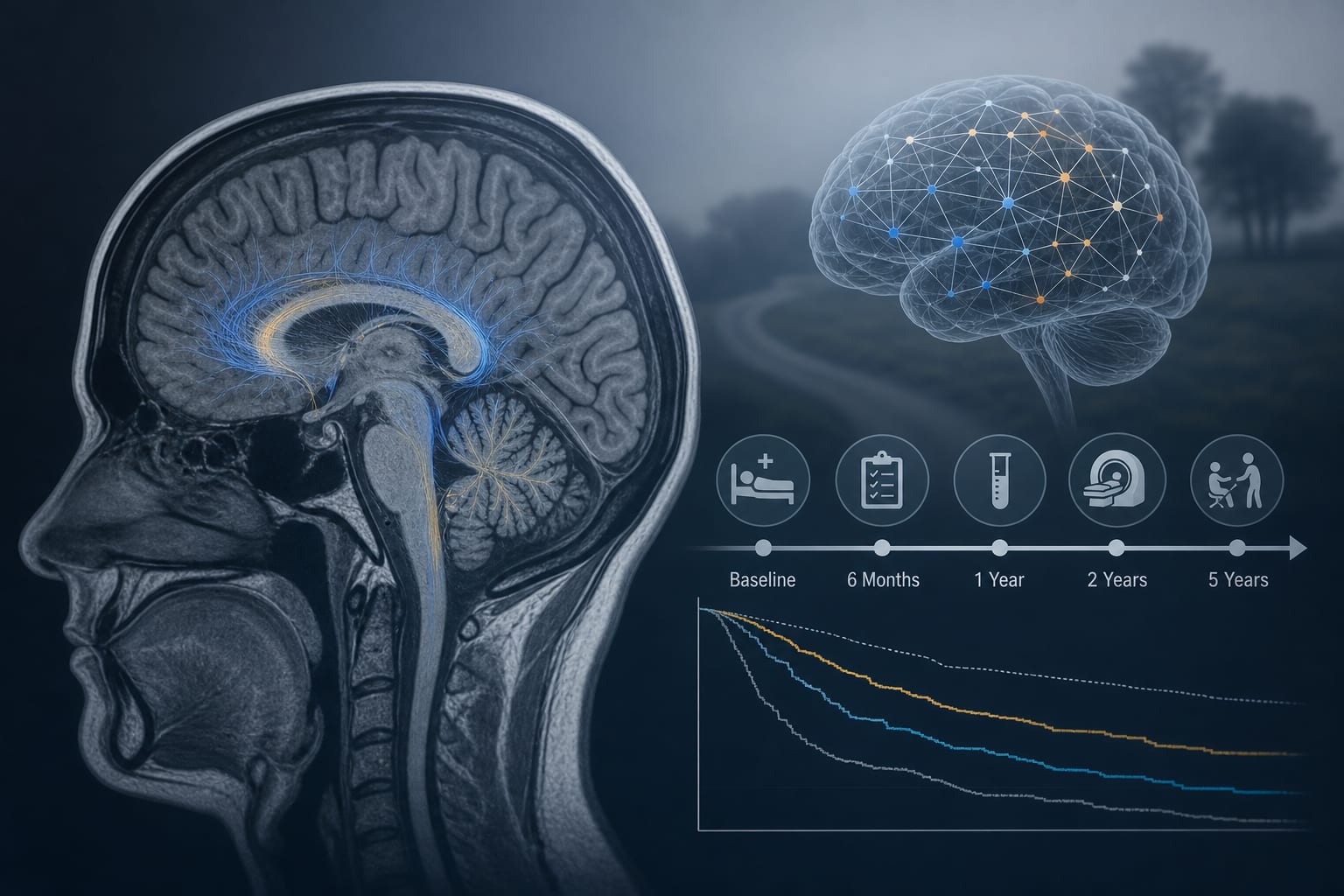
The PDOCC study will enroll 1,000 patients aged 18-80 with pDoC and will assess outcomes over 5 years using various clinical and biomarker evaluations.

Key Findings

  • The study will utilize standardized clinical assessments including CRS-R, GOS-E, DRS, EQ-5D, and SF-36.
  • Neuroimaging techniques such as MRI, DTI, and fMRI will be employed to evaluate brain function.
  • Primary outcomes include consciousness recovery, all-cause mortality, and major cardiovascular events.
  • Secondary outcomes will assess functional status changes and health-related quality of life.
  • Time-to-event analyses will incorporate competing-risk models.

Clinical Implications

The findings from the PDOCC study are expected to inform individualized rehabilitation strategies and optimize healthcare resource allocation. The incorporation of competing-risk analysis may improve prognostic assessments in clinical practice.

Conclusion

The PDOCC study represents a significant step towards understanding the long-term outcomes of prolonged disorders of consciousness.
Related Resources & Content

  1. Frontiers in Neurology, 2026 -- Neurophysiological Predictors of Full Clinical Consciousness Recovery in Patients with DoC
  2. BMC Psychiatry (Springer), 2025 -- Longitudinal Analysis of Recovery Domains in Patients with Schizophrenia Spectrum Disorders
  3. Brain, 2021 -- Comprehensive Multicenter Study on Diagnostic and Prognostic Indicators in Consciousness Disorders
  4. Frontiers in Neurology — Multimodal MRI reveals three-tiered pathological co-alterations in prolonged disorders of consciousness: structural disconnection, network disintegration, and regional hyperconnectivity
  5. Practice Guideline Update Recommendations: Disorders of Consciousness
  6. European Academy of Neurology guideline on the diagnosis of coma and other disorders of consciousness
  7. https://www.rcp.ac.uk/media/ptcoggi5/pdoc-guidelines_final_online_0_0.pdf
  8. Disorders of consciousness diagnosis, interventions, and prognostication for the intensivist: Report of the 2025 ISICEM roundtable | Intensive Care Medicine | Springer Nature Link
  9. https://www.aan.com/Guidelines/Home/GetGuidelineContent/928
  10. Predicting outcome in disorders of consciousness: A mega‐analysis - PMC
  11. Long-term outcomes of prolonged disorders of consciousness: a prospective cohort study in specialized neurorehabilitation - PubMed
  12. EEG connectivity and network analyses predict outcome in patients with disorders of consciousness – A systematic review and meta-analysis - PMC
  13. Exploring the prognostic value of resting state brain activity in Disorders of Consciousness: A coordinate-based meta-analysis - ScienceDirect
  14. Cognitive Motor Dissociation in Disorders of Consciousness - PubMed
  15. Placebo-Controlled Trial of Amantadine for Severe Traumatic Brain Injury | New England Journal of Medicine
  16. Efficacy of non-pharmacological treatments for prolonged disorders of consciousness: a network meta-analysis of randomized controlled trials
  17. An individual patient data meta-analysis on vagal nerve stimulation for recovery from disorders of consciousness - PMC
  18. Central thalamic deep brain stimulation for disorders of consciousness: an individual participant data meta-analysis - PubMed

Original Source(s)

Related Content