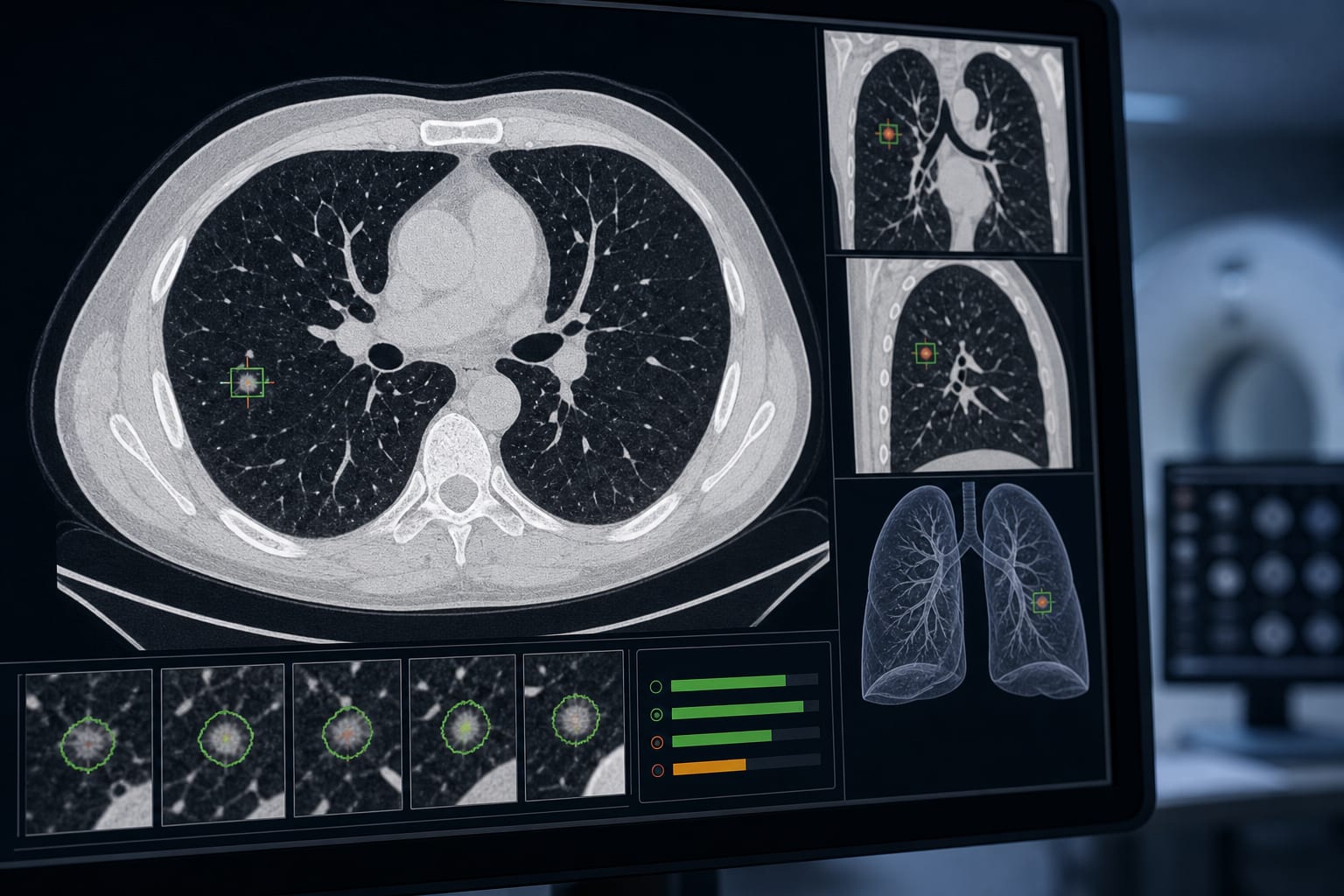
Lung nodule detection and potential impact on guideline-based management: a retrospective post-market evaluation of three commercial software systems - Report - MDSpire
Clinical Report: Evaluation of Lung Nodule Identification and Its Influence
Overview
This study evaluates the performance of three commercial AI software tools in detecting lung nodules. The findings indicate variability in the number of actionable nodules identified.
Background
Lung nodules are common findings in CT imaging, with significant implications for lung cancer management. The increasing use of AI tools for nodule detection presents a means to improve diagnostic accuracy and efficiency.
Data Highlights
The study analyzed the performance of AI tools on a dataset of lung CT scans, focusing on nodules ranging from 5 mm to 3 cm in diameter. The evaluation was conducted by experienced radiologists, and the results highlighted differences in the detection rates of actionable nodules across the three AI software tools.
Key Findings
Three AI software tools were evaluated for lung nodule detection: AI-Rad Companion, contextflow ADVANCE, and Veolity LungCAD.
The study focused on nodules between 5 mm and 3 cm in diameter, reviewed by experienced radiologists.
Actionable nodules were defined based on the British Thoracic Society criteria.
Variability in the number of detected actionable nodules was observed across different software tools.
The study did not compare human versus AI sensitivity, as AI results were not blinded.
Clinical Implications
The variability in actionable nodule detection among different AI tools suggests that clinicians should be aware of the specific software used in their practice.
Conclusion
The study evaluates AI tools for lung nodule detection and their implications for clinical management.
Related Resources & Content
Frontiers in Medicine, 2026 -- Comparison of three commercial AI tools for detection and malignancy assessment of incidental lung nodules
European Radiology, 2025 -- Low-Dose CT Screening for Lung Cancer: Clarifying Positive, Indeterminate, and Negative Results with Recommendations for Nodule Management from the European Society of Thoracic Imaging
European Radiology, 2025 -- Evaluation of Artificial Intelligence Models in Classifying Pulmonary Nodules: A Comprehensive Diagnostic Assessment
European Radiology, 2024 -- Evaluating Malignancy Risk in Pulmonary Nodules: A Comparison of Deep Learning Techniques and Multiparametric Statistical Models Across Various Disease Categories
Guidelines for Management of Incidental Pulmonary Nodules Detected on CT Images: From the Fleischner Society 2017
New England Journal of Medicine, 2011 -- Reduced Lung-Cancer Mortality with Low-Dose Computed Tomographic Screening
Interreader Agreement of Lung-RADS: A Systematic Review and Meta-Analysis - PubMed
Guidelines for Management of Incidental Pulmonary Nodules Detected on CT Images: From the Fleischner Society 2017
Reduced Lung-Cancer Mortality with Low-Dose Computed Tomographic Screening | New England Journal of Medicine
Interreader Agreement of Lung-RADS: A Systematic Review and Meta-Analysis - PubMed
by Anna Jöbstl, Anna K. Luger, Bernhard Nilica, Florian Kocher, Thomas Sonnweber, Ivan Tancevski, Florian Augustin, Laurenz Nagl, Daniel Leitner, Gerlig Widmann
Automated lesion measurements increased agreement on treatment response, although expert-generated proposals were accepted more often and required fewer adjustments.