Diffuse cauda equina nerve root enlargement: diagnostic challenges, clinicopathological spectrum, and the role of surgical biopsy - Report - MDSpire
Advertisement
Challenges in Diagnosing Diffuse Enlargement of Cauda Equina Nerve Roots: A Review of Clinical and Pathological Aspects and the Importance of Surgical Biopsy
Challenges in Diagnosing Diffuse Enlargement of Cauda Equina Nerve Roots
Overview
This review highlights the diagnostic challenges associated with diffuse enlargement of cauda equina nerve roots, emphasizing the diverse underlying etiologies. Surgical biopsy may be considered in cases where non-invasive investigations yield inconclusive results.
Background
Diffuse enlargement of the cauda equina nerve roots is a rare radiological finding that can arise from various conditions, including neoplastic and inflammatory processes. Accurate diagnosis is critical, as overlapping imaging features can lead to misdiagnosis.
Data Highlights
Parameter
Findings
Number of Patients
12
Conditions Identified
Malignant lymphoma, immune-mediated neuropathies
Diagnostic Approach
Surgical biopsy in selected cases
Response to Treatment
Responses varied based on underlying conditions.
Key Findings
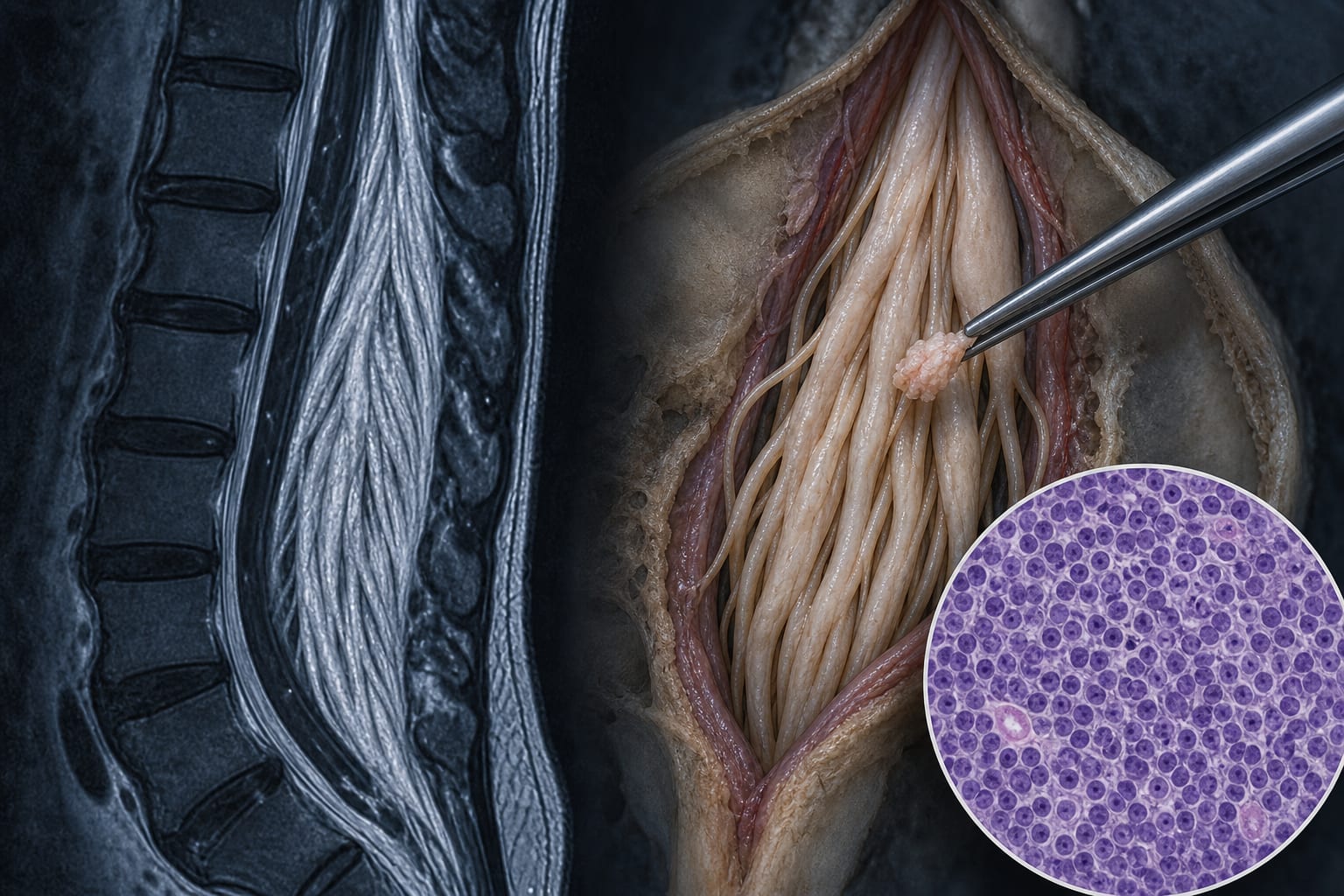
Diffuse enlargement of cauda equina nerve roots can result from various etiologies, including lymphoma and immune-mediated neuropathies.
All patients in the study exhibited diffuse enlargement on MRI, highlighting the nonspecific nature of this finding.
Surgical biopsy provided important pathological information in cases with diagnostic uncertainty.
Clinical outcomes varied based on the underlying disease.
Accurate differentiation between conditions is essential to avoid misdiagnosis.
Clinical Implications
Awareness of the diverse etiologies associated with diffuse cauda equina nerve root enlargement is important, as non-invasive diagnostic methods have limitations.
Conclusion
Diffuse cauda equina nerve root enlargement is a complex clinical entity requiring thorough evaluation. Surgical biopsy may assist in establishing a definitive diagnosis.