Multicentre validation of the PRECISE scoring system for prostate MRI during active surveillance - Report - MDSpire

Multicentre validation of the PRECISE scoring system for prostate MRI during active surveillance

  • By

  • Francesco Giganti

  • Riccardo Leni

  • Vinayak Wagaskar

  • Giorgio Gandaglia

  • Tristan Barrett

  • Valeria Panebianco

  • Francesco Sanguedolce

  • Erik JRJ van der Hoeven

  • Sangeet Ghai

  • Jeremy Grummet

  • Jasmin Gmeiner

  • Jan Philipp Radtke

  • Ryan D. Ward

  • Ronaldo Hueb Baroni

  • Francesco Porpiglia

  • Juan Gomez Rivas

  • Fabio Zattoni

  • Raphaële Renard-Penna

  • Claudia Kesch

  • Marco Gatti

  • Nicola Schieda

  • Guillaume Ploussard

  • Sara Lewis

  • Giorgio Brembilla

  • Christof Kastner

  • Emanuele Messina

  • Ash Tewari

  • Caroline M. Moore

  • Massimo Valerio

  • Armando Stabile

  • Veeru Kasivisvanathan

  • May 4, 2026

  • 0 min

Share

Clinical Report: Validation of the PRECISE Scoring System for Prostate MRI

Overview

This study validates the PRECISE scoring system for prostate MRI in active surveillance across multiple centers. The findings demonstrate its utility in assessing radiological changes and guiding management decisions in patients with low and favorable intermediate-risk prostate cancer.

Background

Active surveillance (AS) is a critical strategy for managing low-risk prostate cancer, aiming to minimize overtreatment while maintaining the potential for curative intervention. MRI plays a pivotal role in AS by enhancing patient selection and monitoring disease progression. The PRECISE scoring system was developed to standardize MRI assessments, which is essential for effective clinical decision-making.

Data Highlights

No numerical data available in the provided material.

Key Findings

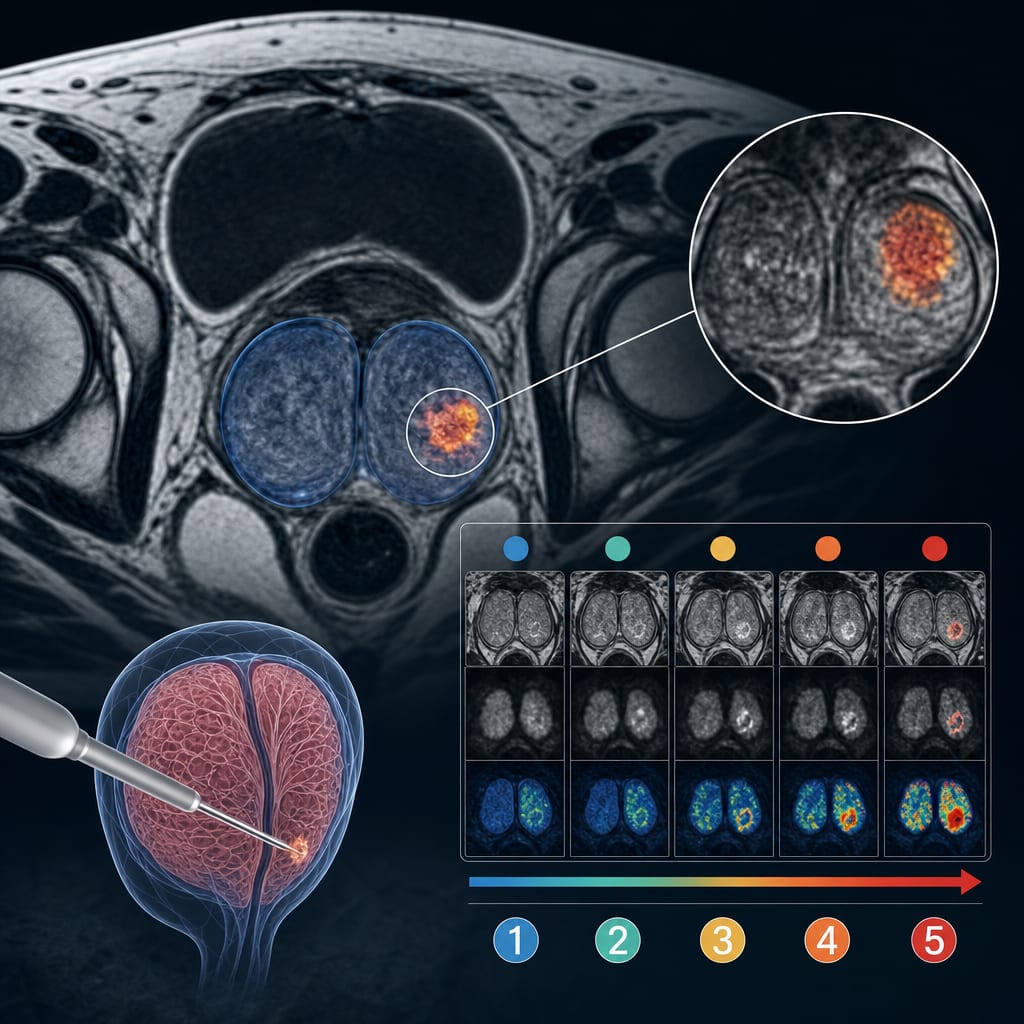
  • The PRECISE scoring system effectively categorizes radiological changes in prostate cancer patients on active surveillance.
  • PRECISE 1-2 indicates radiological regression, while PRECISE 4-5 suggests progression.
  • Patients with PRECISE 3 stability may defer further biopsies under certain conditions.
  • The study included a diverse, international cohort, enhancing the generalizability of the findings.
  • Histopathology from biopsies served as the reference standard for assessing the accuracy of the PRECISE scores.

Clinical Implications

The validation of the PRECISE scoring system supports its use in clinical practice for monitoring patients on active surveillance. Clinicians can utilize this standardized approach to make informed decisions regarding the need for biopsies and treatment interventions.

Conclusion

The study confirms the PRECISE scoring system's effectiveness in evaluating prostate MRI during active surveillance, providing a valuable tool for clinicians managing low-risk prostate cancer.

References

  1. European Radiology, 2024 -- Evaluating the Safety of Biparametric MRI in Prostate Cancer Patients Undergoing Active Surveillance
  2. European Radiology, 2021 -- Evaluating the Role of Prostate MRI in Active Surveillance: An Overview of the Evidence
  3. European Radiology, 2024 -- Fundamentals of ESR: Implementing Appropriate Scoring Systems in Prostate MRI—Guidelines from ESUR
  4. European Radiology, 2024 -- Evaluating the Role of Prostate MRI and AI in Active Surveillance: Is It Time to Embrace This Approach?
  5. EAU Guidelines on Prostate Cancer 2025
  6. MRI and active surveillance: thoughts from across the pond | European Radiology | Springer Nature Link
  7. European Society of Urogenital Radiology (ESUR) perspectives on the role of prostate MRI in active surveillance | Insights into Imaging | Springer Nature Link
  8. Magnetic Resonance Imaging–led Risk-adapted Active Surveillance for Prostate Cancer: Updated Results from a Large Cohort Study - ScienceDirect
  9. HSE National Clinical Guideline: Active Surveillance of patients with prostate cancer
  10. PRECISE v2: Updated recommendations for reporting prostate MRI in patients on active surveillance

Original Source(s)

Related Content