Clinical features of type A aortic dissection initially presenting with neurological symptoms: a single-center case series - Report - MDSpire

Clinical features of type A aortic dissection initially presenting with neurological symptoms: a single-center case series

  • By

  • Haoyu Zou

  • Yujing Zhu

  • Xinyu Li

  • Guang Zhang

  • June 11, 2026

  • 0 min

Share

Clinical Characteristics of Type A Aortic Dissection with Neurological Symptoms

Overview

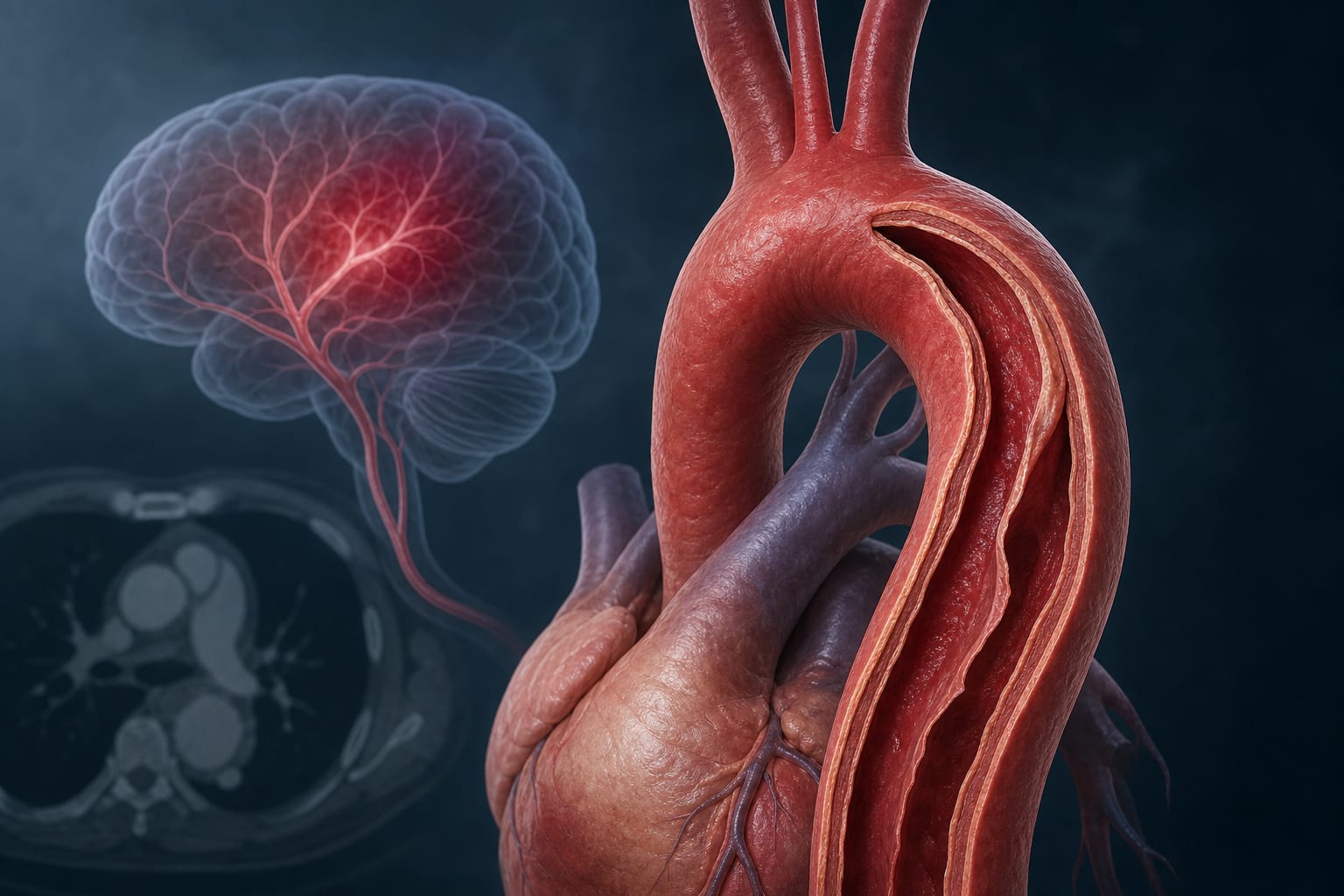
This report details the clinical characteristics and outcomes of 23 patients with type A aortic dissection (TAAD) who presented with neurological symptoms. The findings highlight the risk of misdiagnosis and inappropriate treatment, emphasizing the need for increased awareness among healthcare professionals.

Background

Type A aortic dissection (TAAD) is a critical condition that can present atypically, often mimicking neurological disorders. Misdiagnosis can lead to significant delays in treatment, increasing mortality rates. Understanding the clinical features associated with TAAD is essential for timely diagnosis and management.

Data Highlights

CharacteristicValue
Mean Age62.4 ± 12.2 years
Women34.8%
Altered Consciousness65.2%
Limb Weakness56.5%
Chest/Back Pain21.7%
In-Hospital Mortality65.2%
Long-term Survival Rate17.4%

Key Findings

  • 65.2% of patients presented with altered consciousness.
  • 56.5% exhibited limb weakness, with a notable incidence of left-sided weakness.
  • Only 21.7% reported chest or back pain, complicating diagnosis.
  • 39.1% received intravenous thrombolysis prior to TAAD diagnosis.
  • The overall in-hospital mortality rate was 65.2%.
  • Long-term survival rate post-discharge was 17.4%.

Clinical Implications

Healthcare professionals should maintain a high index of suspicion for TAAD in patients presenting with neurological symptoms, especially when typical chest pain is absent. Early identification and appropriate imaging can significantly improve outcomes.

Conclusion

The study underscores the importance of recognizing atypical presentations of TAAD to prevent misdiagnosis and improve patient management. Enhanced awareness among neurologists and emergency physicians is crucial.
Related Resources & Content

  1. Temple Health, Aortic Dissection, 2023 -- Aortic Dissection
  2. Frontiers in Neurology, 2026 -- Clinical Characteristics of Hypoglossal Nerve Palsy Secondary to Internal Carotid Artery Dissection: A Systematic Review and Illustrative Case
  3. A Systematic Review and Meta-Analysis of Dissecting Aneurysms in the Distal Posterior Inferior Cerebellar Artery, 2025 -- A Systematic Review and Meta-Analysis of Dissecting Aneurysms in the Distal Posterior Inferior Cerebellar Artery
  4. Diagnostic strategies for suspected acute aortic syndrome, 2025 -- Diagnostic strategies for suspected acute aortic syndrome: systematic review, meta-analysis, decision-analytic modelling and value of information analysis
  5. 2026 Guideline for the Early Management of Patients With Acute Ischemic Stroke, 2026 -- 2026 Guideline for the Early Management of Patients With Acute Ischemic Stroke: A Guideline From the American Heart Association/American Stroke Association
  6. A Report on a Ruptured Pseudoaneurysm of the Vasa Corona: Case Study and Literature Analysis
  7. Aortic Dissection - Cardiology - Merck Manual Professional Edition
  8. Diagnostic strategies for suspected acute aortic syndrome: systematic review, meta-analysis, decision-analytic modelling and value of information analysis
  9. 2026 Guideline for the Early Management of Patients With Acute Ischemic Stroke: A Guideline From the American Heart Association/American Stroke Association - PubMed

Original Source(s)

Related Content