Endoscopic-Assisted evacuation vs. burr-hole drainage for chronic subdural hematoma: a retrospective comparative study - Report - MDSpire

Endoscopic-Assisted evacuation vs. burr-hole drainage for chronic subdural hematoma: a retrospective comparative study

  • By

  • Yang Mi

  • Chunhong Wang

  • Xiaohui Yao

  • Chunlei Ju

  • Kai Yang

  • Xulei Hu

  • Hao Li

  • Haiyang Su

  • Hongming Ji

  • May 12, 2026

  • 0 min

Share

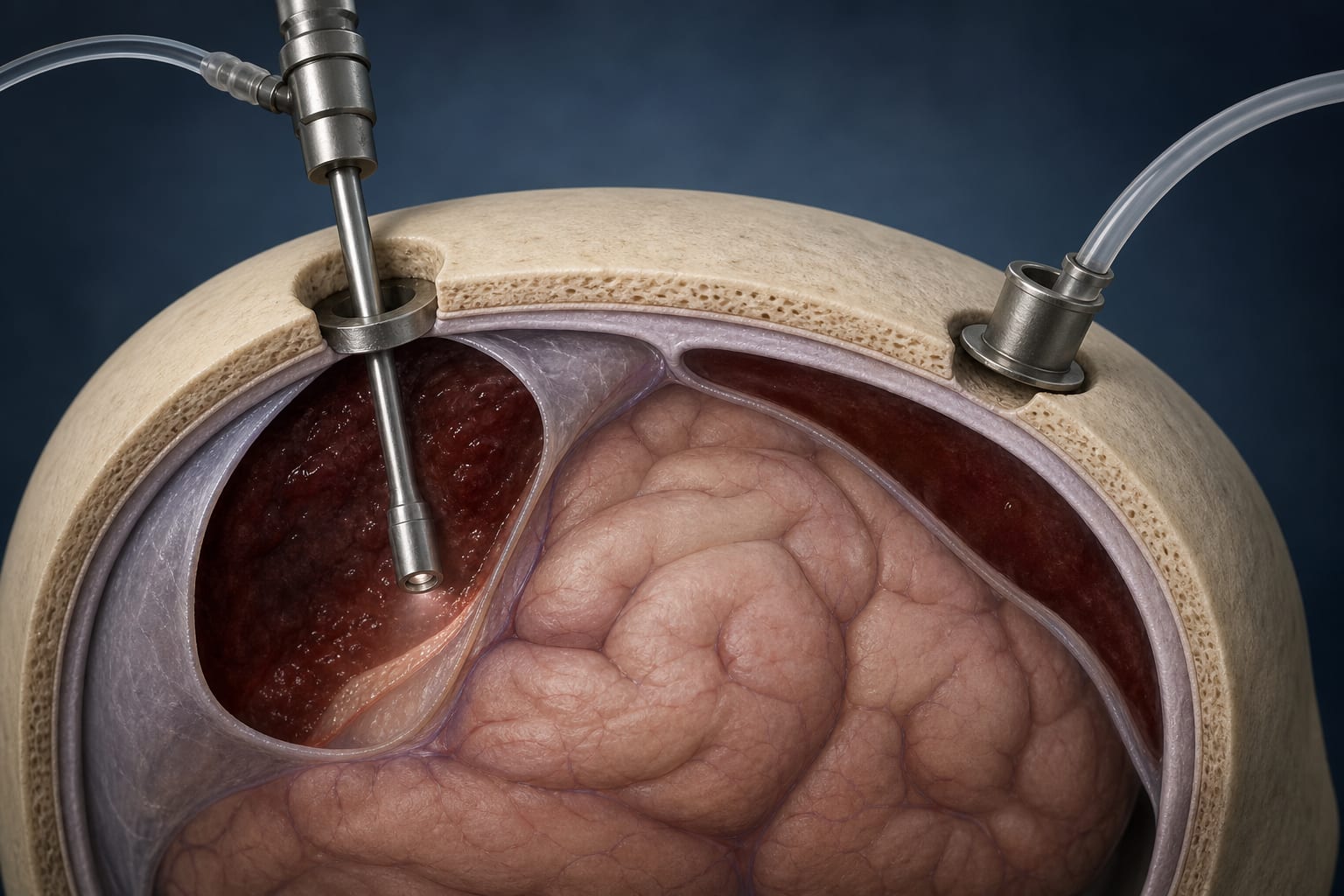
Clinical Report: Comparative Analysis of Endoscopic-Assisted Evacuation Techniques

Overview

Revise to emphasize the implications of increased costs and operative times on clinical practice.

Background

Chronic subdural hematoma (CSDH) is a common neurosurgical condition, particularly among the elderly, with increasing incidence rates projected. Effective surgical intervention is crucial to prevent neurological decline and recurrence. Understanding the comparative effectiveness of surgical techniques is essential for optimizing patient outcomes.

Data Highlights

Verify and correct any discrepancies in the data presented, particularly regarding the odds ratio.

Key Findings

  • Endoscopic-assisted evacuation resulted in a significantly lower residual hematoma rate (35.00% vs. 54.78%, p = 0.0255).
  • Patients in the endoscopic group had better neurological outcomes, with an odds ratio of 0.30 for favorable functional outcomes (p = 0.0021).
  • The operative duration for endoscopic-assisted evacuation was on average 40.12 minutes longer than burr-hole drainage (p < 0.0001).
  • Hospitalization costs were higher for the endoscopic group, averaging ¥9,600 more (p < 0.0001).
  • No significant differences in postoperative complications were observed between the two techniques.
  • Hemoglobin levels were lower in the endoscopic group, but no anemia-related complications were noted.

Clinical Implications

Suggest specific scenarios where endoscopic techniques may be preferred despite higher costs.

Conclusion

Highlight the need for individualized patient assessment in surgical decision-making.
Related Resources & Content

  1. Author(s)/Org, Source, Year -- Title
  2. Frontiers in Neurology, 2026 -- Optimal drain position after evacuation of chronic subdural hematomas: a systematic review and network meta-analysis
  3. Author(s)/Org, Source, Year -- Comparison of Burr Hole Craniostomy and Minicraniotomy Techniques for Treating Chronic Subdural Hematoma: A Cohort Analysis
  4. Author(s)/Org, Source, Year -- Comparison of General and Local Anesthesia for Burr Hole Evacuation of Chronic Subdural Hematoma: A Systematic Review and Meta-Analysis
  5. Management of chronic subdural hematoma: a consensus statement from the 2024 Copenhagen joint iCORIC/DACSUHS symposium | Acta Neurochirurgica | Springer Nature Link
  6. Efficacy of neuroendoscopy-assisted surgery in the treatment of chronic subdural hematoma: a meta-analysis | Chinese Neurosurgical Journal
  7. Adjunctive Middle Meningeal Artery Embolization for Subdural Hematoma - PubMed
  8. Management of chronic subdural hematoma: a consensus statement from the 2024 Copenhagen joint iCORIC/DACSUHS symposium | Acta Neurochirurgica | Springer Nature Link
  9. Efficacy of neuroendoscopy-assisted surgery in the treatment of chronic subdural hematoma: a meta-analysis | Chinese Neurosurgical Journal | Springer Nature Link
  10. Adjunctive Middle Meningeal Artery Embolization for Subdural Hematoma - PubMed

Original Source(s)

Related Content