Rates of hospitalization pre- and post-total pancreatectomy with islet autotransplantation for patients with pancreatitis - Report - MDSpire
Coming Soon: Introducing MDSpire News. Learn more
Conexiant’s news site is now MDSpire News. Learn more

Hospitalization Trends Before and After Total Pancreatectomy with Islet Autotransplantation in Patients with Pancreatitis

  • By

  • Niveditha Jagadesh

  • Anne Eaton

  • Megan B. Ghai

  • Guru Trikudanathan

  • Kathryn D. Robinson

  • Vikesh K. Singh

  • Jaimie D. Nathan

  • Srinath Chinnakotla

  • Maisam Abu-El-Haija

  • Syed A. Ahmad

  • Timothy B. Gardner

  • Luis F. Lara

  • Katherine Morgan

  • Sri Prakash Mokshagundam

  • Bashoo Naziruddin

  • Andrew Posselt

  • Martin Wijkstrom

  • Piotr Witkowski

  • Gregory Beilman

  • Melena D. Bellin

  • August 26, 2026

Share

Hospitalization Trends Before and After Total Pancreatectomy with Islet Autotransplantation in Patients with Pancreatitis

Overview

This study evaluates hospitalization trends in patients undergoing total pancreatectomy with islet autotransplantation (TPIAT) for chronic pancreatitis.

Background

Chronic pancreatitis leads to severe abdominal pain and significant healthcare utilization due to complications. Total pancreatectomy with islet autotransplantation (TPIAT) aims to alleviate pain and improve quality of life.

Data Highlights

Time PeriodHospitalization RateMedian Hospitalizations/YearCumulative Inpatient Days
Pre-TPIAT (18 months)86.8%28
1 Year Post-TPIAT47.3%00
Years 2-4 Post-TPIAT~31%00

Key Findings

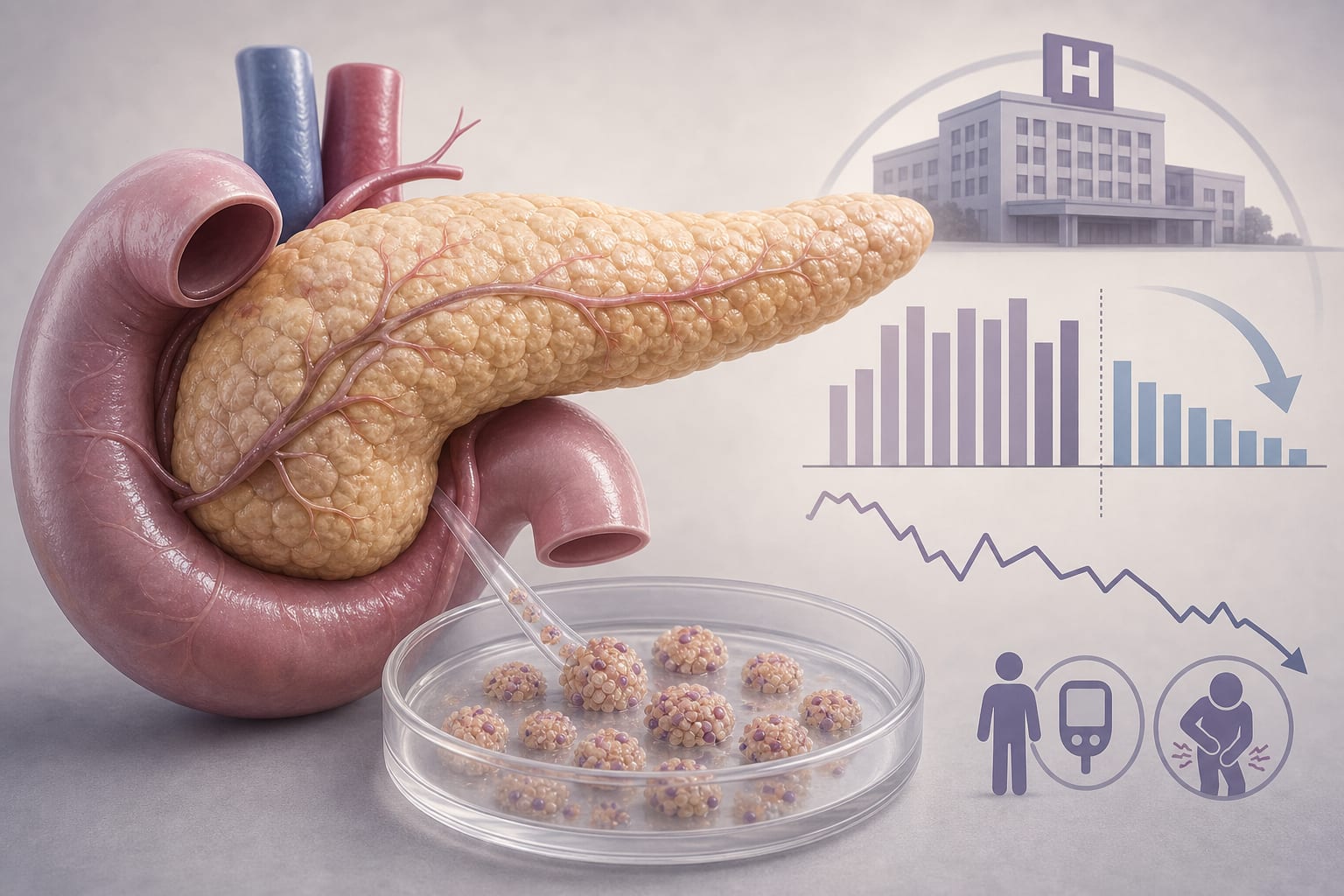
  • Hospitalization rates decreased from 86.8% pre-TPIAT to 47.3% at 1 year and approximately 31% at years 2-4.
  • Median hospitalizations per year dropped from 2 to 0 after TPIAT.
  • Cumulative inpatient days reduced from 8 to 0 at each follow-up interval.
  • Persistent opioid use post-TPIAT was associated with a higher risk of hospital admissions.
  • Abdominal reoperations occurred in about 38% of patients by 4 years post-TPIAT.

Clinical Implications

Ongoing opioid use may necessitate closer monitoring to mitigate readmission risks.

Conclusion

The findings provide insights into hospitalization needs for patients with chronic pancreatitis following TPIAT.

Related Resources & Content

  1. Rates of hospitalization pre- and post-total pancreatectomy with islet autotransplantation for patients with pancreatitis | Surgical Endoscopy | Springer Nature Link
  2. The role of total pancreatectomy with islet autotransplantation in the treatment of chronic pancreatitis: A report from the International Consensus Guidelines in chronic pancreatitis - ScienceDirect
  3. Updates in Surgery — Is Total Pancreatectomy Still a Viable Surgical Option?
  4. The Journal of Clinical Endocrinology & Metabolism — Link Between Intraoperative Hypotension During Pancreatectomy and the Onset of Postoperative Diabetes
  5. A Prospective Investigation into the Impact of Gastroduodenal Artery Reconstruction on Duodenal Oxygen Levels and Enzyme Activity Following Pancreas Transplantation
  6. Updates in Surgery — Evaluation of the Safety and Feasibility of Robotic-Assisted Total Pancreatectomy: A Pilot Study from the Western Region
  7. The role of total pancreatectomy with islet autotransplantation in the treatment of chronic pancreatitis: A report from the International Consensus Guidelines in chronic pancreatitis - ScienceDirect
  8. Rates of hospitalization pre- and post-total pancreatectomy with islet autotransplantation for patients with pancreatitis | Surgical Endoscopy | Springer Nature Link
  9. Long Term Metabolic Outcomes Following Pancreatectomy and Autologous Islet Transplantation: Systematic Review and Meta‐Analysis - Hughes - 2026 - Journal of Surgical Oncology - Wiley Online Library

Original Source(s)

Related Content