Multimodality cardiovascular imaging in arrhythmic mitral valve prolapse: a state-of-the-art review from structural assessment to myocardial tissue characterization - Report - MDSpire

Multimodality cardiovascular imaging in arrhythmic mitral valve prolapse: a state-of-the-art review from structural assessment to myocardial tissue characterization

  • By

  • Giovanni Taverna

  • Kristian Galanti

  • Annagrazia Cecere

  • Francesca Graziano

  • Giancarlo Trimarchi

  • Roberta Antonazzo Panico

  • Antonella Cecchetto

  • Monica De Gaspari

  • Manuel Signorini

  • Aldo Carnevale

  • Giorgio De Conti

  • Raffaella Motta

  • Alberto Cipriani

  • Leonardo Calò

  • Fabrizio Ricci

  • Cristina Basso

  • C. Anwar A. Chahal

  • Martina Perazzolo Marra

  • June 15, 2026

  • 0 min

Share

Clinical Report: Comprehensive Cardiovascular Imaging Approaches in Arrhythmic Mitral Valve Prolapse

Overview

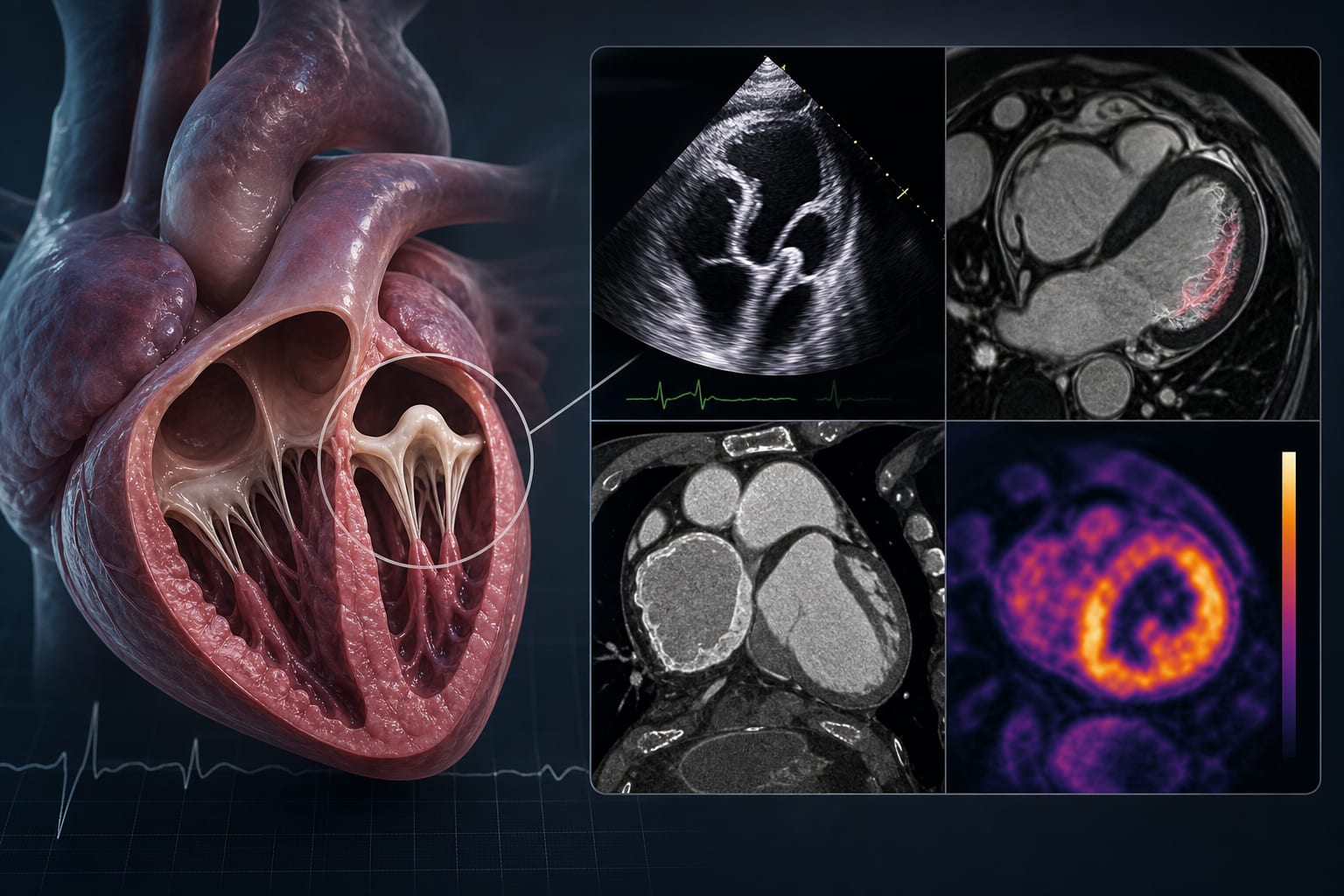
This review examines the role of multimodality imaging in arrhythmic mitral valve prolapse (MVP), focusing on identifying patients at risk for malignant ventricular arrhythmias. It discusses the integration of various imaging techniques.

Background

Mitral valve prolapse is a common heart valve disorder affecting 2-3% of the population, traditionally considered benign. However, a subset of patients is at risk for serious complications, including malignant ventricular arrhythmias and sudden cardiac death.

Data Highlights

No numerical or trial data provided in the source material.

Key Findings

  • Mitral valve prolapse can lead to malignant ventricular arrhythmias in a subset of patients.
  • Advanced imaging techniques, such as CMR, are essential for assessing myocardial tissue characteristics and fibrosis.
  • Mitral annular disjunction is a significant marker associated with arrhythmic outcomes in MVP.
  • Structural abnormalities alone do not fully account for arrhythmogenic risk in MVP patients.
  • There is a need for standardization and validation of imaging biomarkers in clinical pathways.

Clinical Implications

The integration of multimodality imaging can enhance the identification of patients with arrhythmic MVP.

Conclusion

This review emphasizes the importance of a comprehensive imaging approach in understanding and managing arrhythmic MVP.

Related Resources & Content

  1. Frontiers in Cardiovascular Medicine, 2026 -- Recent Advances in Omics-Based Research of Mitral Valve Disease
  2. Houston Methodist Hospital -- Evaluation of Prosthetic Heart Valves with Echo/Doppler: Role of CT/MRI?
  3. Clinical Research in Cardiology -- Echocardiographic Evaluation of Mitral Regurgitation: Exploring Practical and Methodological Considerations for Enhanced Severity Assessment and Diagnostic Accuracy
  4. European Radiology -- Evaluation of Bi-Atrial Function Through CMR Feature Tracking and Long-Axis Shortening Techniques in Patients with Diastolic Dysfunction and Atrial Fibrillation
  5. 2025 ESC/EACTS Guidelines for the management of valvular heart disease
  6. Arrhythmic risk in mitral valve prolapse with mitral annular disjunction: meta-analysis of longitudinal studies - PMC
  7. 2025 ESC/EACTS Guidelines for the management of valvular heart disease
  8. Arrhythmic risk in mitral valve prolapse with mitral annular disjunction: meta-analysis of longitudinal studies - PMC

Original Source(s)

Related Content