Parametrial involvement in cervical cancer is associated with systemic inflammatory indices: a retrospective observational study - Report - MDSpire

Parametrial involvement in cervical cancer is associated with systemic inflammatory indices: a retrospective observational study

  • By

  • Carlo Ronsini

  • Antonino Di Nuzzo

  • Giuseppe Cucinella

  • Maria Cristina Solazzo

  • Eva Iannacone

  • Federica Gherardi

  • Vito Chiantera

  • June 25, 2026

  • 0 min

Share

Clinical Report: Association of Parametrial Invasion in Cervical Cancer

Overview

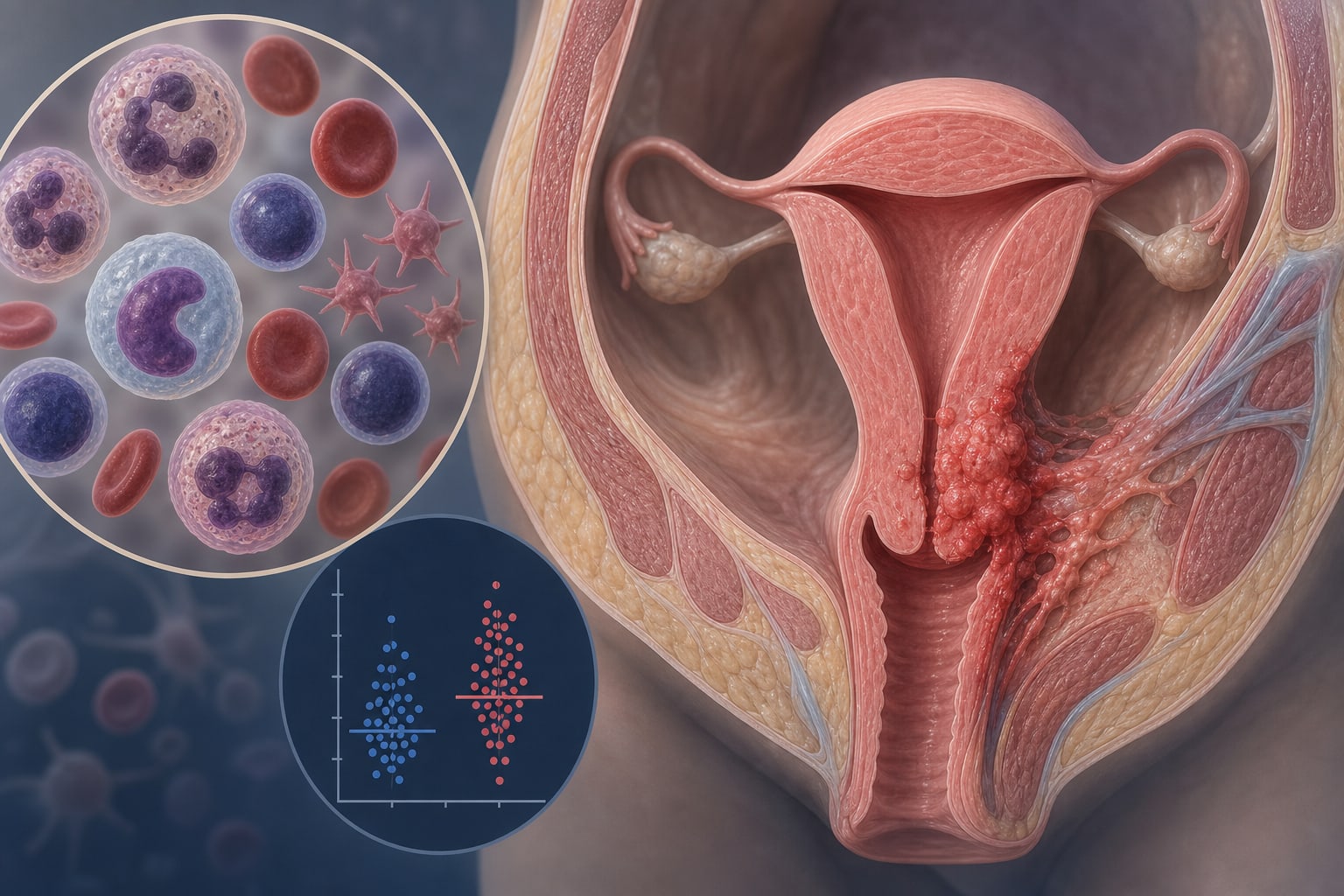
This study evaluates the association between parametrial invasion (PI) and systemic inflammatory indices in cervical cancer patients. It finds that certain inflammatory markers, particularly the monocyte-to-lymphocyte ratio (MLR), are associated with PI.

Background

Parametrial invasion is a critical factor in the staging and treatment of cervical cancer, influencing prognosis and therapeutic decisions. Accurate assessment of PI is essential, yet advanced diagnostic tools may not be accessible in low-resource settings. This study explores the potential of systemic inflammatory markers as alternatives for evaluating local tumor spread.

Data Highlights

Inflammatory IndexAssociation with PI
PLRHigher in PI group
MLRHigher in PI group, significant after adjustment
NLRHigher in PI group
SIRIHigher in PI group
SIRNo significant difference

Key Findings

  • 79 patients were included in the analysis.
  • PLR, MLR, NLR, and SIRI were significantly higher in patients with PI.
  • MLR remained significantly associated with PI after adjustment for local spread parameters.
  • ROC analysis indicated modest standalone discriminative ability for the inflammatory indices.
  • SIR did not show a significant difference between groups.

Clinical Implications

The findings indicate that MLR may be associated with parametrial invasion in cervical cancer. However, the discriminative performance suggests that these indices should be interpreted with caution.

Conclusion

This study highlights the association between systemic inflammatory indices and parametrial invasion in cervical cancer, with MLR showing an association. Further validation in prospective studies is necessary.
Related Resources & Content

  1. Frontiers in Immunology, 2026 -- Prognostic value of an integrated immune-inflammatory phenotype in surgically treated cervical cancer: survival modeling and immunohistochemical validation
  2. Frontiers in Oncology, 2026 -- Inflammatory biomarker-based prognostic model for immunotherapy outcomes in patients with recurrent or metastatic cervical cancer
  3. Techniques in Coloproctology, 2025 -- Employing Inflammatory Markers to Facilitate Safe and Timely Discharge Following Minimally Invasive Colorectal Surgery for Colorectal Cancer
  4. Cervical Cancer Stages | American Cancer Society
  5. The value of amide proton transfer imaging in predicting parametrial invasion of cervical cancer - ScienceDirect
  6. The Prognostic Significance of Inflammatory Markers Prior to Treatment in Localized Prostate Cancer Undergoing Radical Prostatectomy
  7. Cervical Cancer Stages | How to Stage Cervical Cancer | American Cancer Society
  8. The value of amide proton transfer imaging in predicting parametrial invasion and lymph-vascular space invasion of cervical cancer - ScienceDirect
  9. Prognostic value of systemic immune-inflammation index in cervical cancer: a systematic review and meta-analysis - PubMed

Original Source(s)

Related Content