Clinical and CT angiography characteristics of Chinese stroke patients with carotid web: a retrospective study - Report - MDSpire

Clinical and CT angiography characteristics of Chinese stroke patients with carotid web: a retrospective study

  • By

  • Zhuoman Chen

  • Jingjing Cai

  • Xianfu Hu

  • Jiaming Huang

  • Yougang Ke

  • Jing Hu

  • Siping Luo

  • Lijie Ren

  • June 17, 2026

  • 0 min

Share

Clinical Report: Characteristics of Clinical Presentation and CT Angiography in Chinese Stroke Patients with Carotid Web

Overview

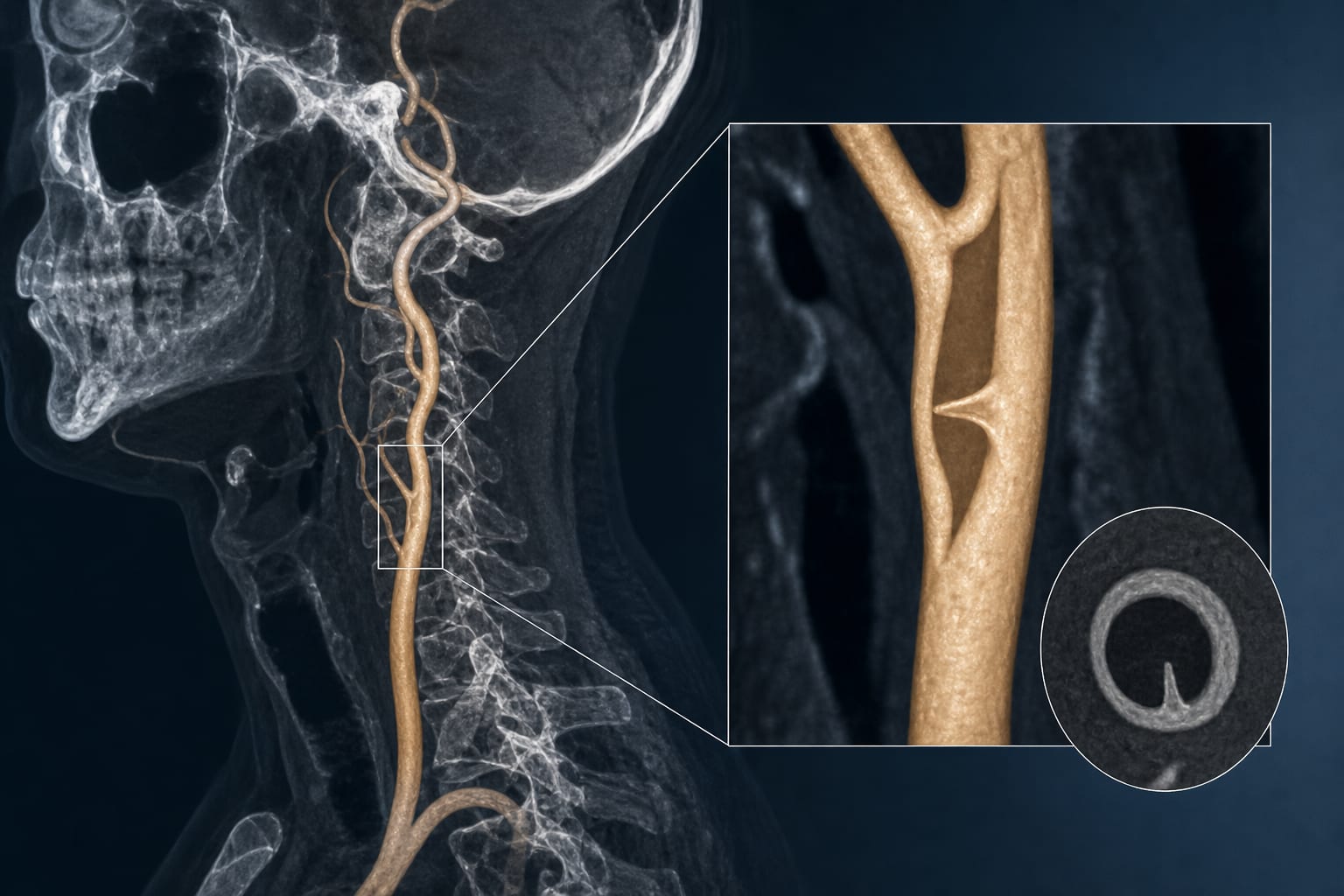
This study investigates the clinical and imaging characteristics of carotid web (CaW) in Chinese stroke patients, revealing a prevalence of 0.37% among a large cohort. Key findings include a significant association between lumen diameter at CaW sites and cerebral infarction, as well as a higher prevalence of hypertension in affected patients.

Background

Carotid web (CaW) is increasingly recognized as a risk factor for ischemic stroke, particularly in younger populations. Understanding its clinical and imaging characteristics is crucial for effective diagnosis and management, especially given the limited data from non-Western populations. This study addresses the gap in knowledge regarding CaW in the Chinese population.

Data Highlights

CharacteristicValue
Number of Patients34
Mean Age56.97 ± 14.75 years
Prevalence of CaW0.37%
Location at CCA Bifurcation88.1%
Cerebral Infarction Diagnosis61.8%
Lumen Diameter (Cerebral Infarction vs Non-Infarction)8.97 ± 2.34 mm vs 6.80 ± 1.90 mm
Hypertension Prevalence (Cerebral Infarction Group)76.2%
Mild Stenosis (1%-30%)64.7%

Key Findings

  • CaW was identified in 34 patients, predominantly males (32 males, 2 females).
  • The majority of CaWs (88.1%) were located at the common carotid artery bifurcation.
  • Cerebral infarction was the most common diagnosis, occurring in 61.8% of patients.
  • Significant differences in lumen diameter were observed between cerebral infarction and non-infarction groups (8.97 mm vs. 6.80 mm).
  • Hypertension was significantly more prevalent in the cerebral infarction group (76.2% vs. 23.1%).
  • Mild stenosis (1%-30%) was present in 64.7% of cases.

Clinical Implications

The findings underscore the importance of recognizing carotid web as a significant risk factor for ischemic stroke in the Chinese population. Clinicians should consider careful evaluation of CTA findings and hypertension management in patients diagnosed with CaW to mitigate stroke risk.

Conclusion

This study highlights the distinct clinical and imaging characteristics of carotid web in Chinese stroke patients, emphasizing the need for tailored management strategies. Further research is warranted to explore the implications of these findings in clinical practice.

Related Resources & Content

  1. Frontiers in Neurology, 2026 -- Symptomatic stratification based on morphological features of carotid WEB (SCORE-WEB)
  2. European Radiology, 2024 -- Progression of Atherosclerotic Plaque as a Predictor of Cerebral Ischemic Events in Patients with Intracranial Atherosclerosis: A Multicenter Longitudinal Study Utilizing High-Resolution MRI
  3. European Radiology, 2023 -- Innovative Imaging Technique for Carotid Artery Walls: Black-Blood Computed Tomography
  4. 2021 Guideline for the Prevention of Stroke in Patients With Stroke and Transient Ischemic Attack: A Guideline From the American Heart Association/American Stroke Association
  5. European Radiology — Baseline CT Imaging of Cortical Atrophy as a Predictor of Clinical Outcomes in Acute Ischemic Stroke Patients Undergoing Endovascular Therapy
  6. Carotid web (Concept Id: CN380963) - MedGen - NCBI
  7. Prevalence, clinical characteristics, and outcomes of carotid web in Chinese patients with acute ischemic stroke due to intracranial large vessel occlusion - PMC
  8. 2021 Guideline for the Prevention of Stroke in Patients With Stroke and Transient Ischemic Attack: A Guideline From the American Heart Association/American Stroke Association
  9. https://j-stroke.org/upload/pdf/jos-2025-00626.pdf
  10. Carotid Revascularization vs. Medical Management for Ischemic Stroke with Ipsilateral Carotid Web: A Systematic Review and Meta-Analysis (S25.005) | Neurology
  11. Clinical, imaging, and management features of symptomatic carotid web: Insight from CAROWEB registry - Stephane Olindo, Nicolas Gaillard, Nicolas Chausson, Cedric Turpinat, Cyril Dargazanli, Quentin Bourgeois-Beauvais, Aissatou Signate, Julien Joux, Mehdi Mejdoubi, Michel Piotin, Mickael Obadia, Jean-Philippe Desilles, François Delvoye, Quentin Holay, Benjamin Gory, Sébastien Richard, Christian Denier, Emmanuelle Robinet-Borgomano, Xavier Carle, Hubert Desal, Benoit Guillon, Alain Viguier, Matthias Lamy, Fernando Pico, Anne Landais, Marion Boulanger, Pauline Renou, Florent Gariel, Papaxanthos Jean, Lhermitte Yann, Lisa Papillon, Gaultier Marnat, Didier Smadja, 2024
  12. Breakthrough of dual-phase CT angiography features of carotid web and its correlation with ischemic stroke - PubMed
  13. Frontiers | Clinical and CT Angiography Characteristics of Chinese Stroke Patients with Carotid Web: A Retrospective Study

Original Source(s)

Related Content