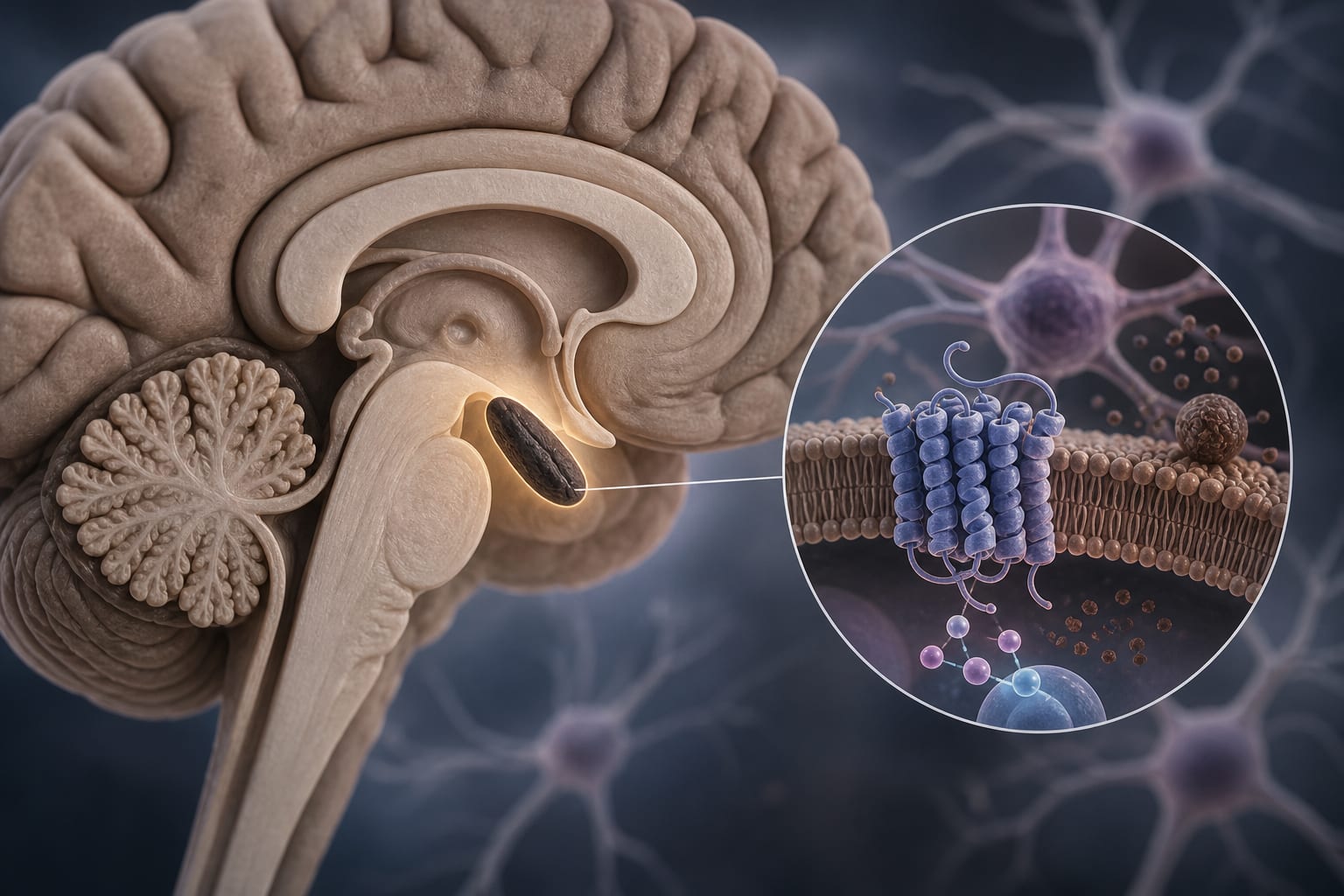
Clinical Report: Common MC1R Genetic Variants and the Course of Parkinson Disease
Overview
This longitudinal cohort study examined whether common MC1R loss-of-function variants are associated with Parkinson disease (PD) progression, using Parkinson Progression Markers Initiative data and an independent pooled replication cohort. The supplied article context describes the study rationale and methods but does not provide its numerical progression results or effect estimates; the web research context reports faster motor decline among carriers, replicated across independent cohorts.
Background
PD progression varies among individuals, and pathogenic LRRK2 and GBA variants explain only part of that variability. MC1R regulates pigmentation and has roles in oxidative-stress responses and cytoprotective pathways; experimental evidence cited in the article links MC1R function to dopaminergic neuronal vulnerability. MC1R loss-of-function variants are common among people of European descent, but whether they influence progression after PD onset had remained uncertain. The study addressed this question using longitudinal clinical observations and an independent replication cohort.
Data Highlights
Study component
Participants or design details reported
PPMI PD cohort
809 participants with PD: 383 classified as sporadic and 426 as monogenic according to LRRK2 and GBA carrier status
Primary analysis group
Sporadic PD: 231 MC1R loss-of-function variant carriers and 152 noncarriers
Prodromal cohort
53 participants without LRRK2 or GBA variants: 34 carriers and 19 noncarriers
Independent replication
Pooled cohort from SURE-PD phase 2, SURE-PD3, and STEADY-PD III; sample size and outcome estimates are not provided in the supplied context
Reported progression finding
The web research context reports faster motor decline among MC1R loss-of-function variant carriers, with replication across independent cohorts; numerical effect estimates are not provided
Key Findings
The study investigated MC1R loss-of-function variants as potential modifiers of PD progression, distinct from their previously studied association with PD susceptibility.
The primary analysis cohort comprised 383 participants classified as having sporadic PD; 231 were MC1R loss-of-function variant carriers and 152 were noncarriers.
MC1R variants were classified by functional evidence and further stratified by penetrance, zygosity, and specific variant.
The study also included 53 prodromal participants without LRRK2 or GBA variants, categorized by MC1R carrier status.
The web research context reports that carriers had faster motor decline than noncarriers and that the finding was replicated in independent cohorts; the supplied material does not include effect sizes or detailed outcome data.
The supplied guideline context describes current PD treatment guidance as focused on symptomatic management and does not identify MC1R variants as a basis for treatment selection.
Clinical Implications
The reported association may inform research into genetic differences in PD progression, but the supplied material does not provide effect estimates or establish how MC1R status should be used in individual prognostication. The guideline context provided does not incorporate MC1R into treatment selection; current care remains framed around clinical diagnosis and symptomatic management.
Conclusion
The study examines a common genetic variant group as a possible modifier of PD progression, and the supplied web research context reports replicated faster motor decline among carriers. Numerical results and evidence for clinical use are not available in the provided material.
by Jackson G. Schumacher, Xinyuan Zhang, Jian Wang, Johannes M. Dijkstra, Hirohisa Watanabe, Xiang Gao, Marianna Cortese, Eric A. Macklin, Michael A. Schwarzschild, Xiqun Chen