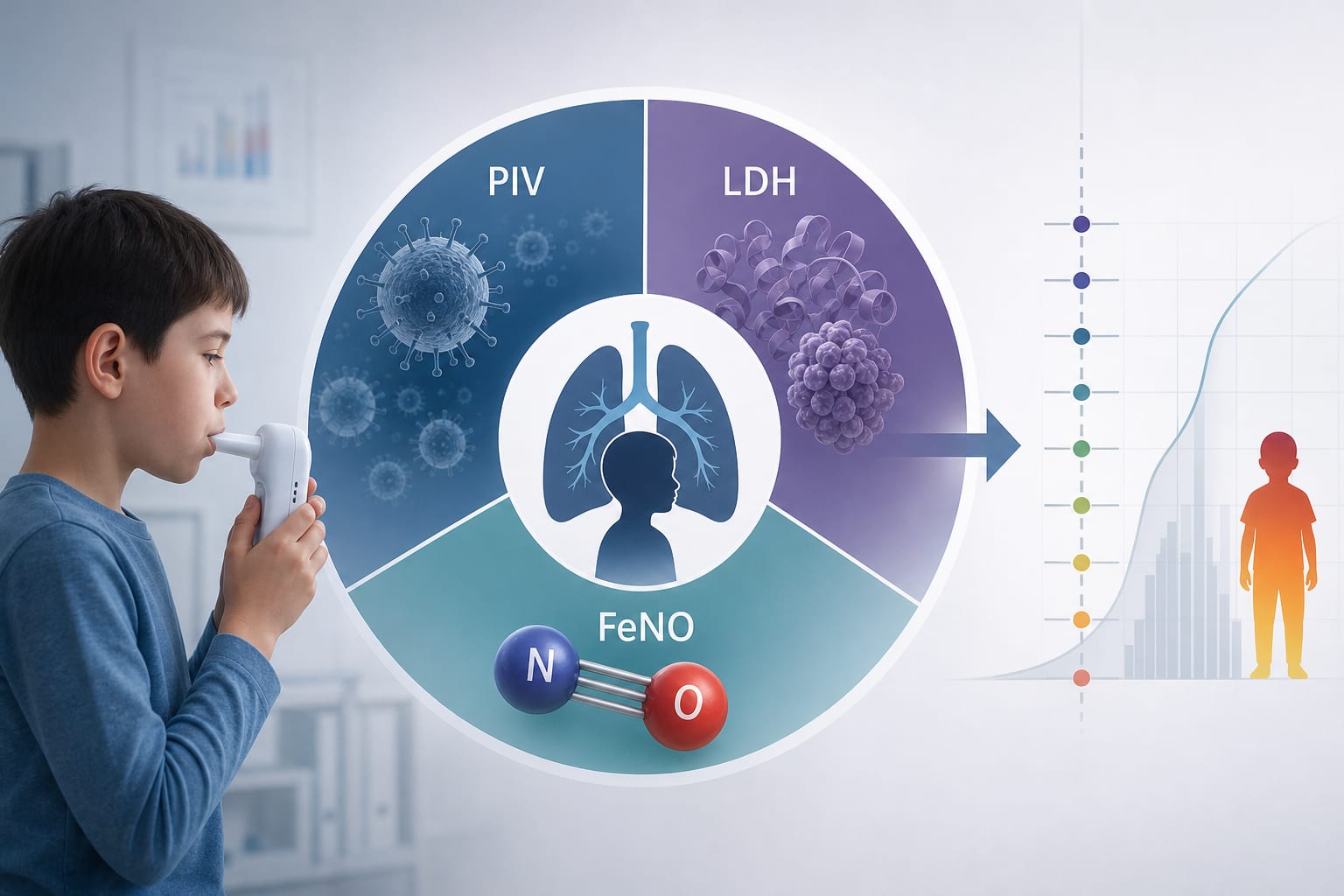
Creation and internal assessment of a comprehensive nomogram combining PIV, LDH, and FeNO to forecast inadequate asthma management in pediatric patients
-
By
-
Zhijian Zhan
-
Tianfu Xu
-
Saiping Huang
-
June 29, 2026
Clinical Report: Comprehensive Nomogram for Inadequate Asthma Management
Overview
This study developed and validated a nomogram integrating PIV, LDH, and FeNO to predict inadequate asthma management in pediatric patients. The model demonstrated superior predictive performance compared to individual biomarkers.
Background
Asthma is a prevalent chronic condition in children, often leading to poor control despite guideline-based treatments. Traditional assessment tools have limitations, necessitating the exploration of objective biomarkers for better risk stratification.
Data Highlights
| Variable | Odds Ratio (OR) |
|---|---|
| PIV | 1.008 |
| LDH | 1.043 |
| FeNO | 1.056 |
| Asthma Duration | 1.251 |
| Vitamin D | 0.891 |
| FEV1% Predicted | 0.953 |
Key Findings
- Six independent predictors of poor asthma control were identified: PIV, LDH, FeNO, Vitamin D, asthma duration, and FEV1% predicted.
- The combined model achieved an AUC of 0.886.
- PIV, LDH, FeNO, and asthma duration were identified as risk factors for poor asthma control.
- Vitamin D and FEV1% predicted were found to be protective factors.
- The nomogram showed good calibration.
Clinical Implications
The integration of multiple biomarkers into a nomogram may enhance the identification of children at risk for poor asthma control. This approach supports personalized management strategies in pediatric asthma care.
Conclusion
The study presents a multidimensional model that effectively stratifies risk for poor asthma control in children, potentially aiding in tailored management strategies.
Related Resources & Content
- Frontiers in Pediatrics, 2026 -- A Decade-Long Real-World Cohort (2016-2025): Development of an Individualized Risk-Stratification Nomogram and Evaluation of Clinical Utility for Recurrent Respiratory Tract Infections in Children
- Frontiers in Pediatrics, 2026 -- Advancements in diagnosis, preventive care, and future directions in the holistic management of pediatric asthma
- 2026 GINA Strategy Report - Global Initiative for Asthma - GINA
- Asthma: diagnosis, monitoring and chronic asthma management (BTS, NICE, SIGN) - NCBI Bookshelf
- Pediatric Cardiology — Assessing Lung Function in Fontan Patients Over a Decade: Does the Fontan Circulation Hinder Pulmonary Development?
- Frontiers in Medicine — Nomograms to predict severe PH and survival in COPD patients using non-invasive parameters
- ERS technical standard: Global Lung Function Initiative reference values for exhaled nitric oxide fraction (FENO50) | European Respiratory Society
- Scientific summary - Treatment guided by fractional exhaled nitric oxide in addition to standard care in 6- to 15-year-olds with asthma: the RAACENO RCT - NCBI Bookshelf
- 2026 GINA Strategy Report - Global Initiative for Asthma - GINA
- Asthma: diagnosis, monitoring and chronic asthma management (BTS, NICE, SIGN) - NCBI Bookshelf
- Evidence reviews for FeNO measures to monitor asthma - NCBI Bookshelf
- Blood eosinophils and fractional exhaled nitric oxide are prognostic and predictive biomarkers in childhood asthma - ScienceDirect
- Distinguishing Childhood Asthma Exacerbations from Stable Asthma: The Utility of Inflammatory White Blood Cell Biomarkers | MDPI
- The role of 14-3-3β in acute asthma in children and analysis of the risk factors for asthma exacerbation - PubMed
- Investigating Machine Learning Techniques for Predicting Risk of Asthma Exacerbations: A Systematic Review | Journal of Medical Systems | Springer Nature Link
Based on findings from:
Development and internal validation of a multidimensional nomogram integrating PIV, LDH, and FeNO for predicting poor asthma control in school-aged children
Zhijian Zhan, Tianfu Xu, Saiping Huang. Frontiers In Pediatrics, 2026.
https://www.frontiersin.org/journals/pediatrics/articles/10.3389/fped.2026.1855307/full
This content is an AI-generated, fully rewritten summary based on a published scholarly article. It does not reproduce the original text and is not a substitute for the original publication. Readers are encouraged to consult the source for full context, data, and methodology.