Type 1 diabetes mellitus induced by sintilimab: a case report and related case literature analysis - Report - MDSpire

Type 1 diabetes mellitus induced by sintilimab: a case report and related case literature analysis

  • By

  • Hao Su

  • Xinyu Zhao

  • Huayu Liu

  • Mianli Li

  • Haitao Geng

  • July 1, 2026

  • 0 min

Share

Clinical Report: Type 1 Diabetes Mellitus Triggered by Sintilimab Therapy

Background

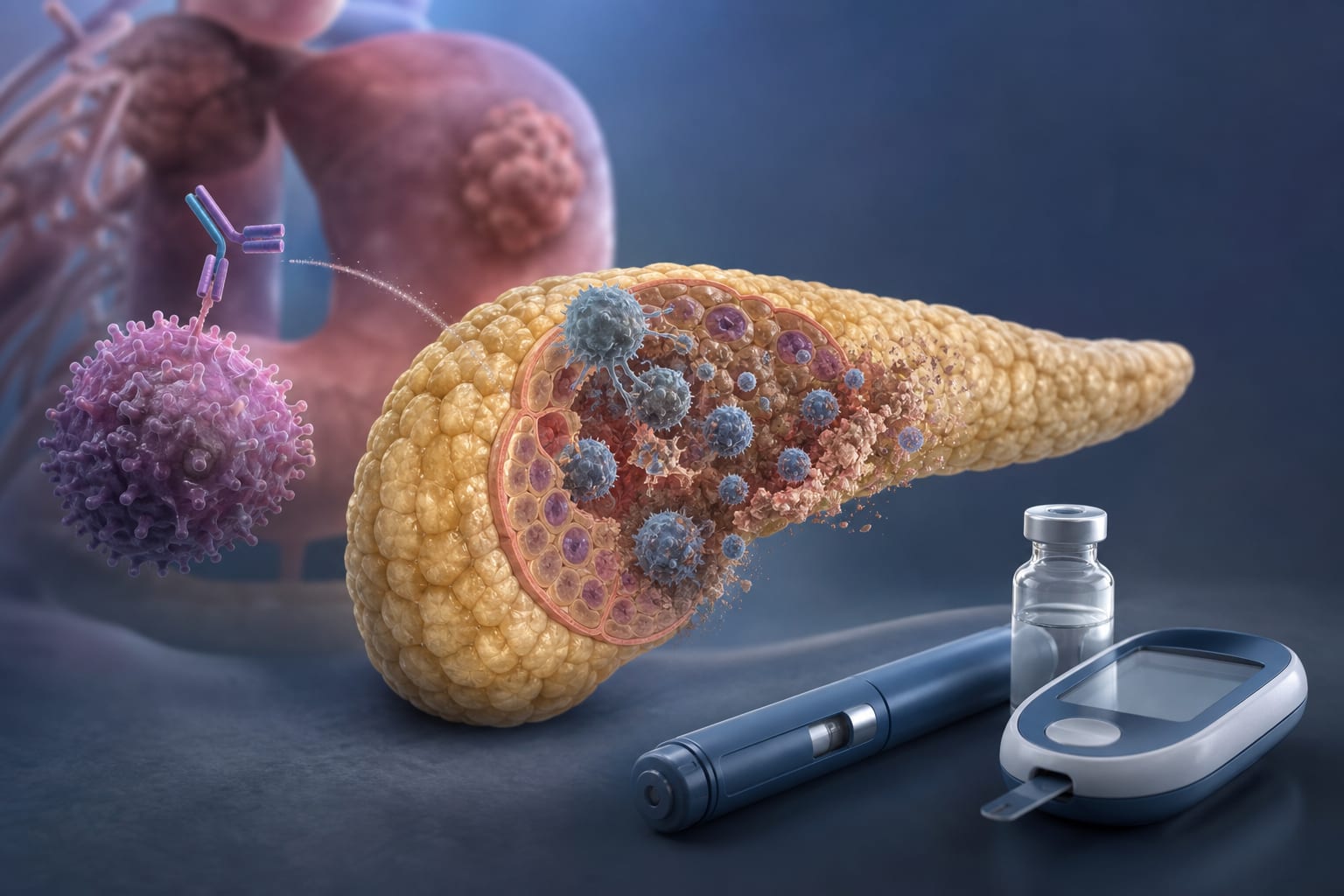
Immune checkpoint inhibitors (ICIs) are increasingly used in cancer treatment but can lead to immune-related adverse events (irAEs), including type 1 diabetes mellitus. Although the incidence of ICI-induced T1DM is low, its irreversible nature and poor response to steroid treatment necessitate careful monitoring. Understanding the pathogenesis and clinical implications of ICI-T1DM is crucial.

Data Highlights

ParameterValue
Blood Glucose Level19.27 mmol/L
Glycosylated Hemoglobin7.5%
Serum β-Hydroxybutyrate2.59 mmol/L
Adrenocorticotropic Hormone14.480 pmol/L

Key Findings

  • Type 1 diabetes mellitus can occur as an immune-related adverse event from ICI therapy.
  • The incidence rate of ICI-induced T1DM is reported to be between 0.2% and 1.4%.
  • Diabetic ketoacidosis may occur in some patients.
  • Steroid treatment is ineffective in reversing β-cell function loss in ICI-T1DM.
  • Blood glucose monitoring is essential during ICI therapy.

Clinical Implications

Clinicians should be aware of the potential for ICI-induced T1DM and implement regular blood glucose monitoring for patients undergoing treatment with immune checkpoint inhibitors. Early identification and management of hyperglycemia are critical.

Conclusion

The case underscores the importance of recognizing ICI-induced T1DM and the need for proactive management strategies.

Related Resources & Content

  1. American Diabetes Association, Diabetes Care, 2026 -- Diagnosis and Classification of Diabetes
  2. Consensus-based disease definitions for endocrine immune-related adverse events, JITC, 2025 -- Endocrine irAEs
  3. Frontiers in Medicine — Case Report: Sintilimab-Associated Acute Interstitial Nephritis in a Patient with Severe Thrombocytopenia: Clinical Diagnosis and Treatment Strategy When Renal Biopsy Is Contraindicated
  4. Frontiers in Endocrinology — A Case Report and Literature Review of Proton Pump Inhibitors Inducing Insulin Autoimmune Syndrome
  5. Frontiers in Endocrinology — Type B insulin resistance with glycemic extremes: a case report and literature review
  6. Frontiers in Medicine — Proliferative glomerulonephritis with monoclonal immunoglobulin IgG1-κ deposition in a patient with type 1 diabetes: a case report and literature review
  7. Case Report: Sintilimab-Associated Acute Interstitial Nephritis
  8. A Case Report and Literature Review of Proton Pump Inhibitors Inducing Insulin Autoimmune Syndrome
  9. Type B insulin resistance with glycemic extremes: a case report and literature review
  10. 2. Diagnosis and Classification of Diabetes: Standards of Care in Diabetes—2026 | Diabetes Care | American Diabetes Association
  11. Consensus-based disease definitions for endocrine immune-related adverse events of immune checkpoint inhibitors
  12. Sintilimab plus a bevacizumab biosimilar (IBI305) versus sorafenib in unresectable hepatocellular carcinoma (ORIENT-32): a randomised, open-label, phase 2–3 study - ScienceDirect

Original Source(s)

Related Content