Alectinib combined with 5-aminolevulinic acid-based photodynamic therapy promotes apoptosis in endometrial cancer cells by targeting ferrochelatase - Report - MDSpire

Alectinib combined with 5-aminolevulinic acid-based photodynamic therapy promotes apoptosis in endometrial cancer cells by targeting ferrochelatase

  • By

  • Pengfei Wang

  • Xian Zhang

  • Haijing Li

  • Lujiadai Xue

  • Yajuan Deng

  • Hu Li

  • Kunyong Xie

  • Xiaoyu Wang

  • Yuanhong Chen

  • June 30, 2026

  • 0 min

Share

Combination of Alectinib and 5-Aminolevulinic Acid-Based Photodynamic Therapy Enhances Apoptosis in Endometrial Cancer Cells by Inhibiting Ferrochelatase Activity

Overview

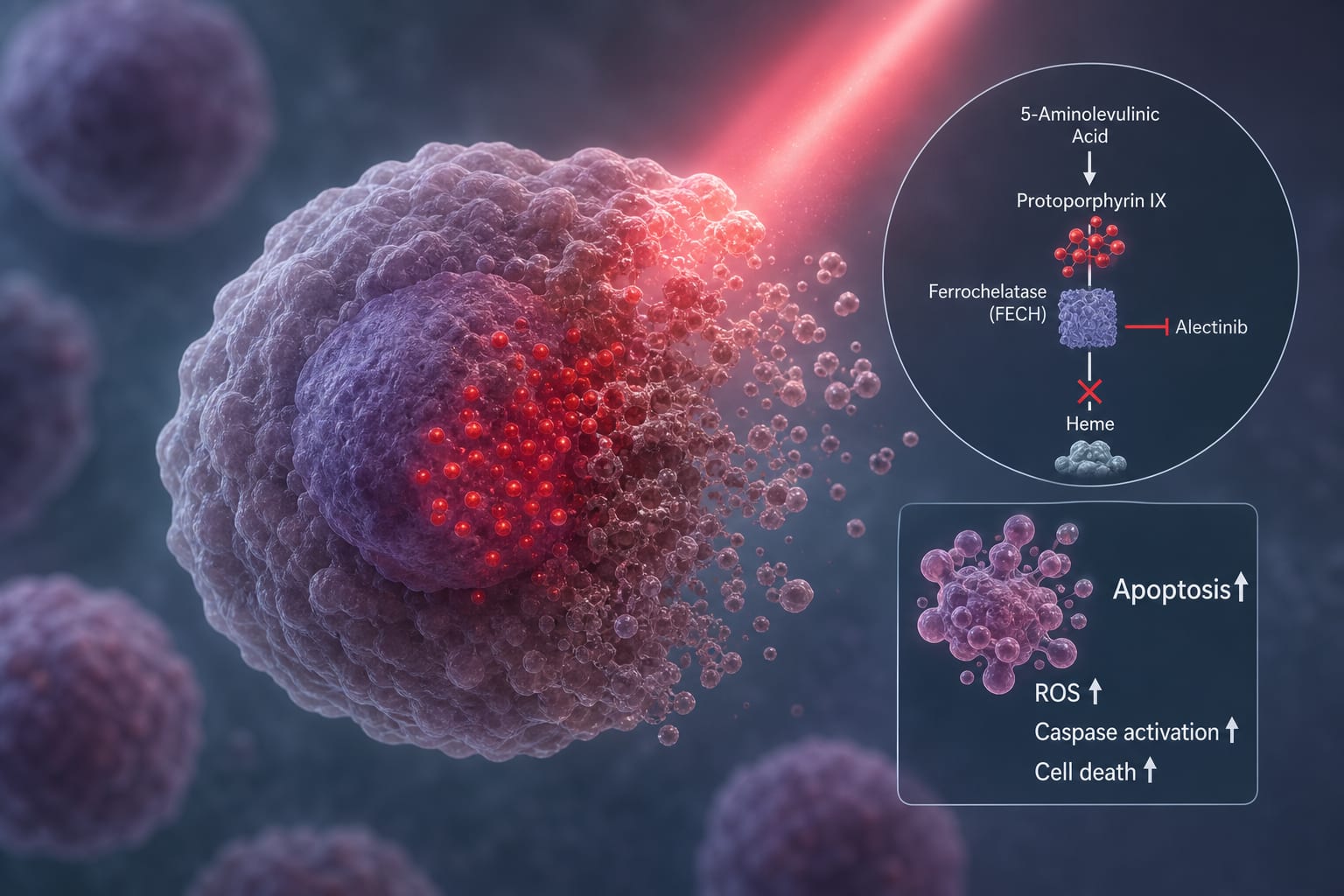
This study investigates the combined effect of alectinib and 5-aminolevulinic acid-based photodynamic therapy (ALA-PDT) on endometrial cancer cells, revealing that alectinib enhances the efficacy of ALA-PDT by inhibiting ferrochelatase activity. The combination treatment significantly increases apoptosis rates in endometrial cancer cells compared to either treatment alone.

Background

Endometrial cancer is a prevalent malignancy among women, often treated with hysterectomy, which carries surgical risks. Photodynamic therapy (PDT) is a promising alternative that utilizes photosensitizers to generate reactive oxygen species (ROS) for tumor cell destruction. However, the effectiveness of PDT can be limited by the activity of ferrochelatase (FECH), which converts protoporphyrin IX (PpIX) into heme, reducing PpIX accumulation necessary for effective PDT.

Data Highlights

Cell LineIC50 (μM)
ISK38.83
HEC-1-A42.70

Key Findings

  • Alectinib significantly inhibits FECH activity, promoting PpIX accumulation.
  • Combination treatment of alectinib and ALA-PDT enhances intracellular ROS generation.
  • Flow cytometry indicates a higher apoptosis rate with combined treatment compared to ALA-PDT or alectinib alone.
  • Alectinib treatment increases FECH mRNA and protein expression levels.
  • PpIX co-localizes with mitochondria, indicating effective targeting of tumor cells.

Clinical Implications

The findings suggest that alectinib may serve as an adjunct to ALA-PDT in endometrial cancer treatment by enhancing apoptosis through FECH inhibition.

Conclusion

The study demonstrates that alectinib enhances the antitumor effects of ALA-PDT in endometrial cancer cells by targeting FECH, leading to increased apoptosis and ROS accumulation.
Related Resources & Content

  1. Frontiers in Medicine, 2026 -- Efficacy of 5-aminolevulinic acid photodynamic therapy for the treatment of female lower reproductive tract intraepithelial lesions and its predictive biomarker: DNA methylation
  2. Frontiers in Immunology, 2026 -- Combination of metformin and parthenolide inhibits breast cancer in mice by apoptosis induction and angiogenesis inhibition
  3. Alectinib Combined with 5-Aminolevulinic Acid-Based Photodynamic Therapy Promotes Apoptosis in Endometrial Cancer Cells by Targeting Ferrochelatase, Frontiers in Oncology, 2026
  4. PEGylated liposomal fluopsin C triggers cuproptosis and ferroptosis pathways and suppresses 3D tumor spheroid growth in NCI-H460 cells
  5. The ASCO Post — Combination Therapy of Olaparib, Cyclophosphamide, and Metformin Under Study in Advanced Endometrial Cancer
  6. 2025 ESGO–ESTRO–ESP guideline update on endometrial carcinoma
  7. FDA approves pembrolizumab with chemotherapy for endometrial carcinoma
  8. Dostarlimab for Primary Advanced or Recurrent Endometrial Cancer | New England Journal of Medicine
  9. Pembrolizumab plus chemotherapy in advanced or recurrent endometrial cancer: overall survival and exploratory analyses of the NRG GY018 phase 3 randomized trial | Nature Medicine
  10. Durvalumab Plus Carboplatin/Paclitaxel Followed by Maintenance Durvalumab With or Without Olaparib as First-Line Treatment for Advanced Endometrial Cancer: The Phase III DUO-E Trial - PMC
  11. Randomized phase II trial of carboplatin-paclitaxel compared to carboplatin-paclitaxel-trastuzumab in advanced (stage III-IV) or recurrent uterine serous carcinomas that overexpress Her2/Neu (NCT01367002): updated overall survival analysis - PMC
  12. Selective photosensitizer localization in the human endometrium after intrauterine application of 5-aminolevulinic acid - PubMed
  13. MEK reduces cancer-specific PpIX accumulation through the RSK-ABCB1 and HIF-1α-FECH axes - PMC
  14. Chemical Proteomics Reveals Ferrochelatase as a Common Off-target of Kinase Inhibitors | ACS Chemical Biology
  15. Alectinib treatment improves photodynamic therapy in cancer cell lines of different origin - PMC
  16. Frontiers | Alectinib Combined with 5-Aminolevulinic Acid-Based Photodynamic Therapy Promotes Apoptosis in Endometrial Cancer Cells by Targeting Ferrochelatase
  17. Effectiveness of lapatinib for enhancing 5-aminolevulinic acid-mediated protoporphyrin IX fluorescence and photodynamic therapy in human cancer cell lines with varied ABCG2 activities - PubMed

Original Source(s)

Related Content