Advances in AI-based diagnosis of Alzheimer’s disease using MRI: a comprehensive survey - Report - MDSpire

Advances in AI-based diagnosis of Alzheimer’s disease using MRI: a comprehensive survey

  • By

  • Hasan Issa Raheem Alyaqoobi

  • Jose Manuel Lopez-Guede

  • Omer Asghar Dara

  • Jose Antonio Ramos-Hernanz

  • Iñigo Aramendia

  • Daniel Teso-Fz-Betoño

  • June 1, 2026

  • 0 min

Share

Clinical Report: Progress in AI-Driven MRI Diagnostics for Alzheimer’s Disease

Overview

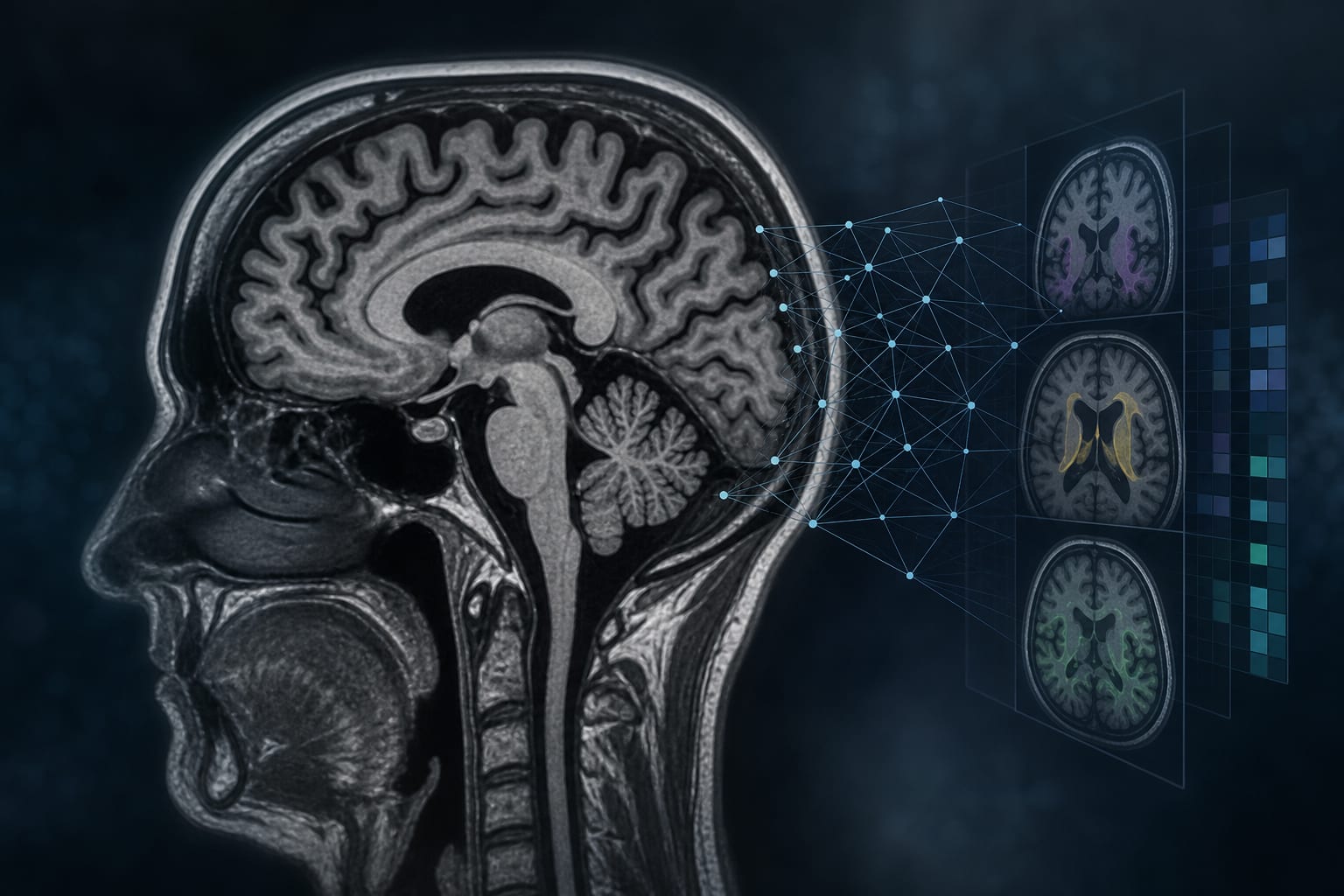
This report reviews the advancements and challenges in utilizing AI-driven MRI diagnostics for Alzheimer's disease (AD). Key limitations include data access, model complexity, and the need for improved interpretability and clinical validation.

Background

Alzheimer's disease is a significant global health concern, affecting millions and leading to substantial economic burdens. Early detection through advanced imaging techniques like MRI is crucial for timely intervention and management. However, the integration of AI in this domain faces several methodological challenges that must be addressed to enhance diagnostic accuracy and clinical applicability.

Data Highlights

No numerical data available in the source material.

Key Findings

  • AI and deep learning have shown promise in diagnosing Alzheimer's disease through MRI.
  • Key challenges include limited access to diverse datasets and high model complexity.
  • There is a need for improved interpretability of AI models to facilitate clinical use.
  • Current research often focuses on marginal accuracy improvements rather than addressing translational obstacles.
  • Federated learning and explainable AI frameworks are essential for overcoming data scarcity and enhancing model usability.

Clinical Implications

Healthcare professionals should be aware of the limitations of current AI-driven MRI diagnostics for Alzheimer's disease. Emphasizing the need for standardized protocols and improved data access can facilitate better integration of AI tools in clinical practice.

Conclusion

Addressing the challenges in AI-driven MRI diagnostics is vital for improving early detection of Alzheimer's disease. Continued research and development are necessary to enhance the clinical applicability of these technologies.

Related Resources & Content

  1. Frontiers in Neurology, 2026 -- Stage-stratified benefits of AI-radiomics PET in early Alzheimer’s disease: a systematic review and meta-analysis
  2. Int. Journal of Computer Assisted Radiology and Surgery (Springer), 2026 -- Cogninet: an explainable deep learning model for multi-class MRI-based Alzheimer’s disease staging
  3. European Radiology, 2025 -- A Systematic Review and Meta-Analysis of Deep Learning Approaches for Diagnosing Breast Cancer via MRI
  4. Criteria for Diagnosis and Staging of Alzheimer's Disease | alz.org
  5. Alzheimer Disease as a Clinical-Biological Construct—An International Working Group Recommendation | JAMA Neurology
  6. European Radiology — Embracing Artificial Intelligence in Radiology: Balancing Its Potential Benefits with Current Limitations in Clinical Practice
  7. FDA to recommend additional, earlier MRI monitoring for patients with Alzheimer’s disease taking Leqembi (lecanemab)
  8. Criteria for Diagnosis and Staging of Alzheimer's Disease | alz.org
  9. Alzheimer Disease as a Clinical-Biological Construct—An International Working Group Recommendation | Dementia and Cognitive Impairment | JAMA Neurology | JAMA Network
  10. Preview
  11. Alzheimer's Association Clinical Practice Guideline on the use of blood-based biomarkers in the diagnostic workup of suspected Alzheimer's disease within specialized care settings - PubMed
  12. Lecanemab in Early Alzheimer’s Disease | New England Journal of Medicine
  13. HIGHLIGHTS OF PRESCRIBING INFORMATION
  14. Donanemab in Early Symptomatic Alzheimer Disease: The TRAILBLAZER-ALZ 2 Randomized Clinical Trial - PMC
  15. label
  16. Deep Learning and Machine Learning for Early Detection of Alzheimer's Disease: A Systematic Review and Meta-Analysis | medRxiv
  17. Deep Learning Models Predicting MCI-to-Alzheimer’s Conversion via Structural MRI: A Systematic Review and Meta-analysis - ScienceDirect
  18. Revolutionizing early Alzheimer's disease and mild cognitive impairment diagnosis: a deep learning MRI meta-analysis - PMC

Original Source(s)

Related Content