Clinical response in advanced non-small cell lung cancer with high PD-L1 expression and MET exon 14 skipping mutation: a case analysis of overcoming immunotherapy resistance and literature review - Report - MDSpire

Clinical response in advanced non-small cell lung cancer with high PD-L1 expression and MET exon 14 skipping mutation: a case analysis of overcoming immunotherapy resistance and literature review

  • By

  • Yefei Ruan

  • Lin Qiu

  • May 12, 2026

  • 0 min

Share

Clinical Report: Therapeutic Outcomes in Advanced Non-Small Cell Lung Cancer

Overview

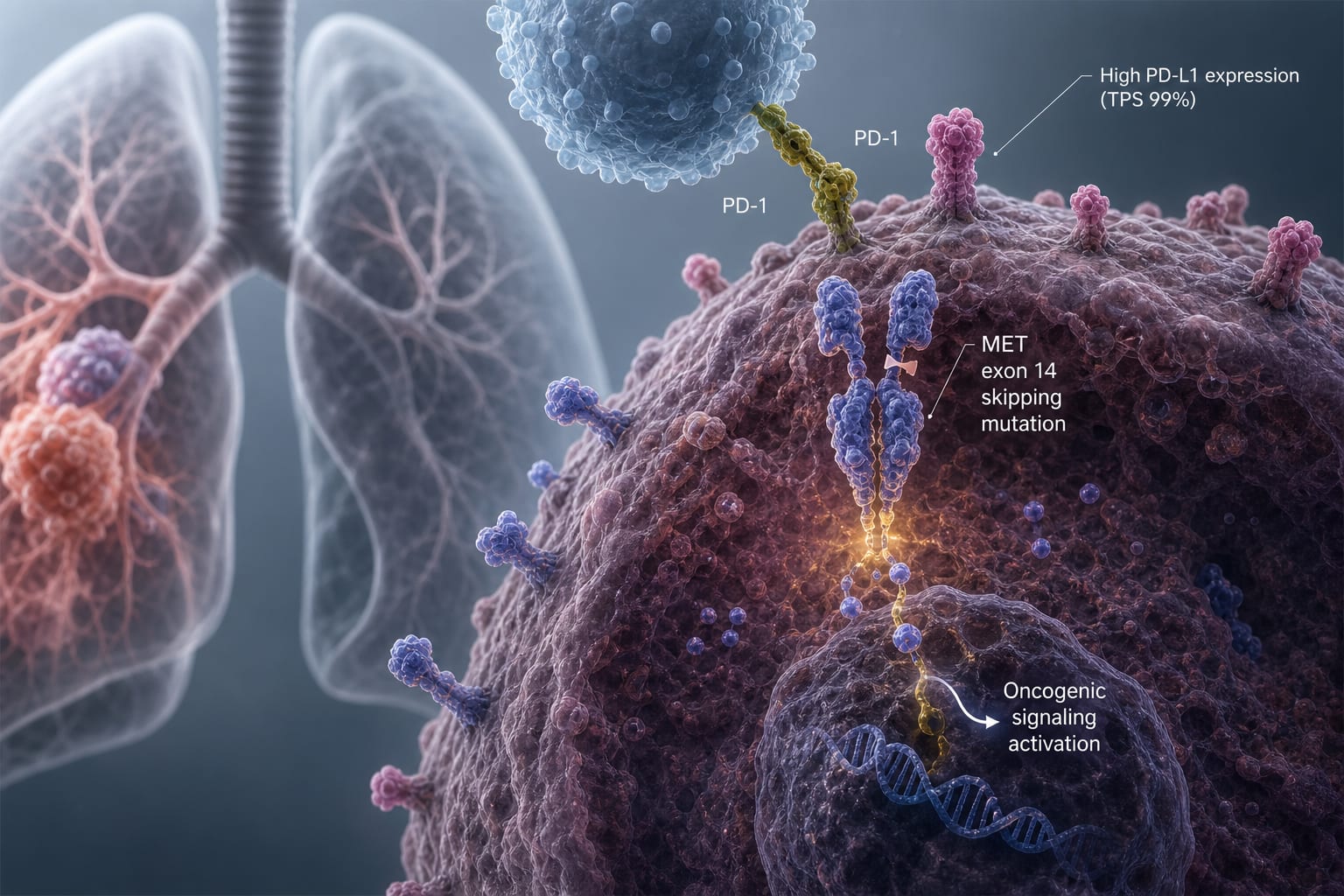
This report presents a case of advanced NSCLC with high PD-L1 levels and a MET exon 14 mutation, highlighting the therapeutic sequence of Tislelizumab and Savolitinib. The findings suggest that sequential MET inhibitor treatment may restore sensitivity to immunotherapy, addressing challenges in managing dual-positive cases.

Background

Non-small cell lung cancer (NSCLC) is a leading cause of cancer mortality, with precision medicine focusing on targeted therapies and immunotherapy. The coexistence of MET exon 14 mutations and high PD-L1 expression presents a clinical challenge, as current guidelines do not provide clear management strategies for these 'double-positive' cases. Understanding the interplay between these molecular characteristics is crucial for optimizing treatment outcomes.

Data Highlights

No numerical data provided in the article.

Key Findings

  • The patient exhibited high PD-L1 expression (TPS 99%) and a MET exon 14 mutation.
  • Initial treatment with Tislelizumab resulted in a progression-free survival of 7 months.
  • Switching to Savolitinib led to significant tumor reduction.
  • Reintroducing Tislelizumab after Savolitinib was discontinued due to liver injury successfully controlled the disease.
  • This case suggests that MET inhibitors may counteract acquired resistance to PD-1 inhibitors.
  • Sequential treatment strategies may enhance immunotherapy responses by modifying the tumor microenvironment.

Clinical Implications

Clinicians should consider the potential for sequential therapy in patients with advanced NSCLC exhibiting both high PD-L1 expression and MET exon 14 mutations. This approach may provide a novel strategy to overcome resistance to immunotherapy and improve patient outcomes.

Conclusion

The case underscores the importance of personalized treatment strategies in advanced NSCLC and highlights the need for further research into the therapeutic interplay between targeted therapies and immunotherapy.

Related Resources & Content

  1. NCCN Clinical Practice Guidelines in Oncology (NCCN Guidelines®), 2024 -- Non-Small Cell Lung Cancer
  2. Capmatinib in MET exon 14-mutated non-small-cell lung cancer: final results from the open-label, phase 2 GEOMETRY mono-1 trial - ScienceDirect
  3. Frontiers in Immunology — Multi-omics biomarkers for predicting resistance, hyperprogression, and immune-related toxicity during PD-1/PD-L1 therapy in lung cancer: a literature review
  4. The ASCO Post — Highlights From the ESMO Congress 2022
  5. the asco post — Survival With Dual CTLA-4 and PD-L1/PD-1 Blockade in Advanced NSCLC
  6. The ASCO Post — Immunotherapy for Metastatic Mismatch Repair–Deficient Colorectal Cancer: Game-Changer for Small Group of Patients
  7. Highlights From the ESMO Congress 2022
  8. Survival With Dual CTLA-4 and PD-L1/PD-1 Blockade in Advanced NSCLC
  9. NCCN Clinical Practice Guidelines in Oncology (NCCN Guidelines®)
  10. Capmatinib in MET exon 14-mutated non-small-cell lung cancer: final results from the open-label, phase 2 GEOMETRY mono-1 trial - ScienceDirect
  11. Frontiers | Biomarker Testing Patterns and Treatment Outcomes in Patients With Advanced Non-Small Cell Lung Cancer and MET Exon 14 Skipping Mutations: A Descriptive Analysis From the US

Original Source(s)

Related Content