Development and validation of a machine learning model for predicting stroke-associated pneumonia in older patients with acute ischemic stroke - Report - MDSpire

Development and validation of a machine learning model for predicting stroke-associated pneumonia in older patients with acute ischemic stroke

  • By

  • Wen-Jie Chu

  • Si-Ran Zhang

  • Qi-Lun Lai

  • Jing-Ying Yu

  • Yi-Qian Xu

  • June 10, 2026

  • 0 min

Share

Clinical Report: Machine Learning for Forecasting Pneumonia in Stroke Patients

Overview

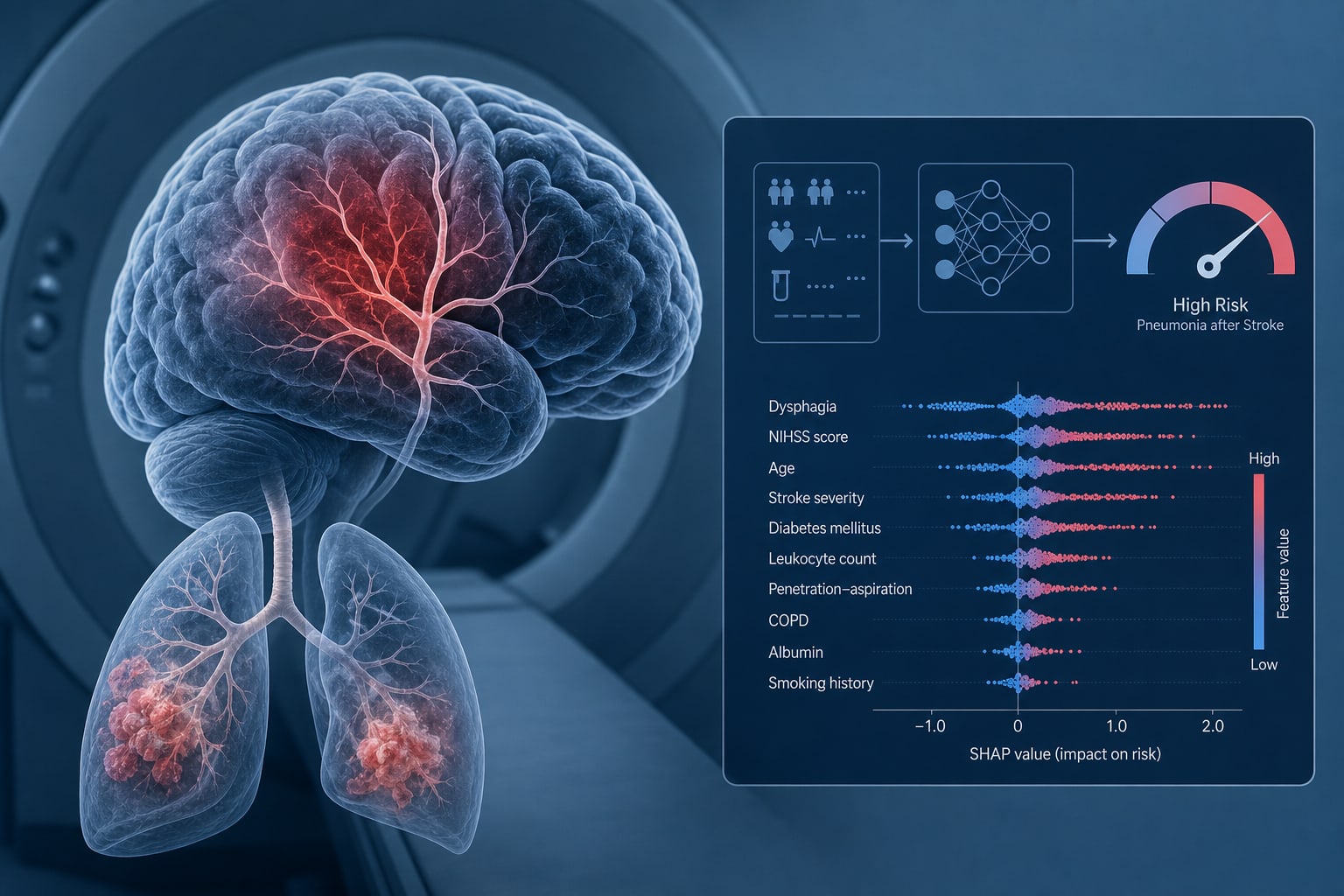
This study developed and validated a machine learning model to predict stroke-associated pneumonia (SAP) in elderly patients with acute ischemic stroke (AIS). The model demonstrated a predictive accuracy of 77.3%, highlighting its potential for early identification of high-risk patients.

Background

Stroke-associated pneumonia is a significant complication in older adults with acute ischemic stroke, leading to increased morbidity and mortality. Early identification of patients at risk for SAP can facilitate timely interventions and improve clinical outcomes. Current predictive models are limited, underscoring the need for innovative approaches such as machine learning to enhance risk stratification.

Data Highlights

MetricValue
Incidence of SAP18.79%
Model Accuracy0.773
Sensitivity0.667
Specificity0.798
AUC0.794 (95% CI: 0.748–0.839)

Key Findings

  • The study included 1,011 patients aged ≥65 years with AIS.
  • The SVM model achieved an accuracy of 77.3% in predicting SAP risk.
  • SHAP analysis identified 12 key predictive features influencing SAP risk.
  • The incidence of SAP in the study population was found to be 18.79%.
  • An online platform was developed for clinical use to facilitate risk assessment.

Clinical Implications

The machine learning model provides a valuable tool for clinicians to identify older patients at high risk for SAP, enabling proactive management strategies. Incorporating this model into clinical practice may enhance patient outcomes and reduce the burden of SAP in this vulnerable population.

Conclusion

The development of an interpretable machine learning model for predicting SAP in older AIS patients represents a significant advancement in clinical risk assessment. This model could improve early intervention strategies and ultimately enhance patient care.

Related Resources & Content

  1. Frontiers in Neurology, 2026 -- Machine learning-based prediction model for cognitive frailty in elderly patients with ischaemic stroke: a prospective cohort study
  2. npj Digital Medicine, 2026 -- Development and evaluation of a machine learning model predicting out-of-hospital cardiac arrest using environmental factors
  3. Frontiers in Psychiatry, 2026 -- Prediction model for postoperative delirium risk in elderly hypertensive patients: machine learning-based development and validation
  4. European stroke organisation guideline on stroke-associated pneumonia - PMC, 2026
  5. 2026 Guideline for the Early Management of Patients With Acute Ischemic Stroke - Professional Heart Daily | American Heart Association
  6. Frontiers in Neurology — Machine learning model for unfavorable outcome prediction in neurosurgical patients: the potential role of liver function markers
  7. Comparison of six risk scores for stroke-associated pneumonia in patients with acute ischemic stroke: A systematic review and Bayesian network meta-analysis
  8. Risk factors of stroke-associated pneumonia in patients with acute ischemic stroke treated by endovascular thrombectomy | BMC Neurology
  9. European stroke organisation guideline on stroke-associated pneumonia - PMC
  10. 2026 Guideline for the Early Management of Patients With Acute Ischemic Stroke - Professional Heart Daily | American Heart Association
  11. The Preventive Antibiotics in Stroke Study (PASS): a pragmatic randomised open-label masked endpoint clinical trial - ScienceDirect
  12. Procalcitonin and biomarkers for stroke-associated pneumonia: a systematic review and meta-analysis | BMC Pulmonary Medicine | Springer Nature Link
  13. Machine learning prediction models for stroke-associated pneumonia:Meta-analysis - ScienceDirect
  14. Prediction of stroke-associated hospital-acquired pneumonia: Machine learning approach - ScienceDirect
  15. Frontiers | Risk prediction of stroke-associated pneumonia in acute ischemic stroke with atrial fibrillation using machine learning models

Original Source(s)

Related Content