Post-traumatic hydrocephalus in adults: the mechanisms of development, predictors of progression and management strategies. A narrative review and case series analysis - Report - MDSpire

Post-traumatic hydrocephalus in adults: the mechanisms of development, predictors of progression and management strategies. A narrative review and case series analysis

  • By

  • Bruno Splavski

  • Dario Muzevic

  • June 24, 2026

  • 0 min

Share

Clinical Report: Adult Post-Traumatic Hydrocephalus: Mechanisms and Management

Overview

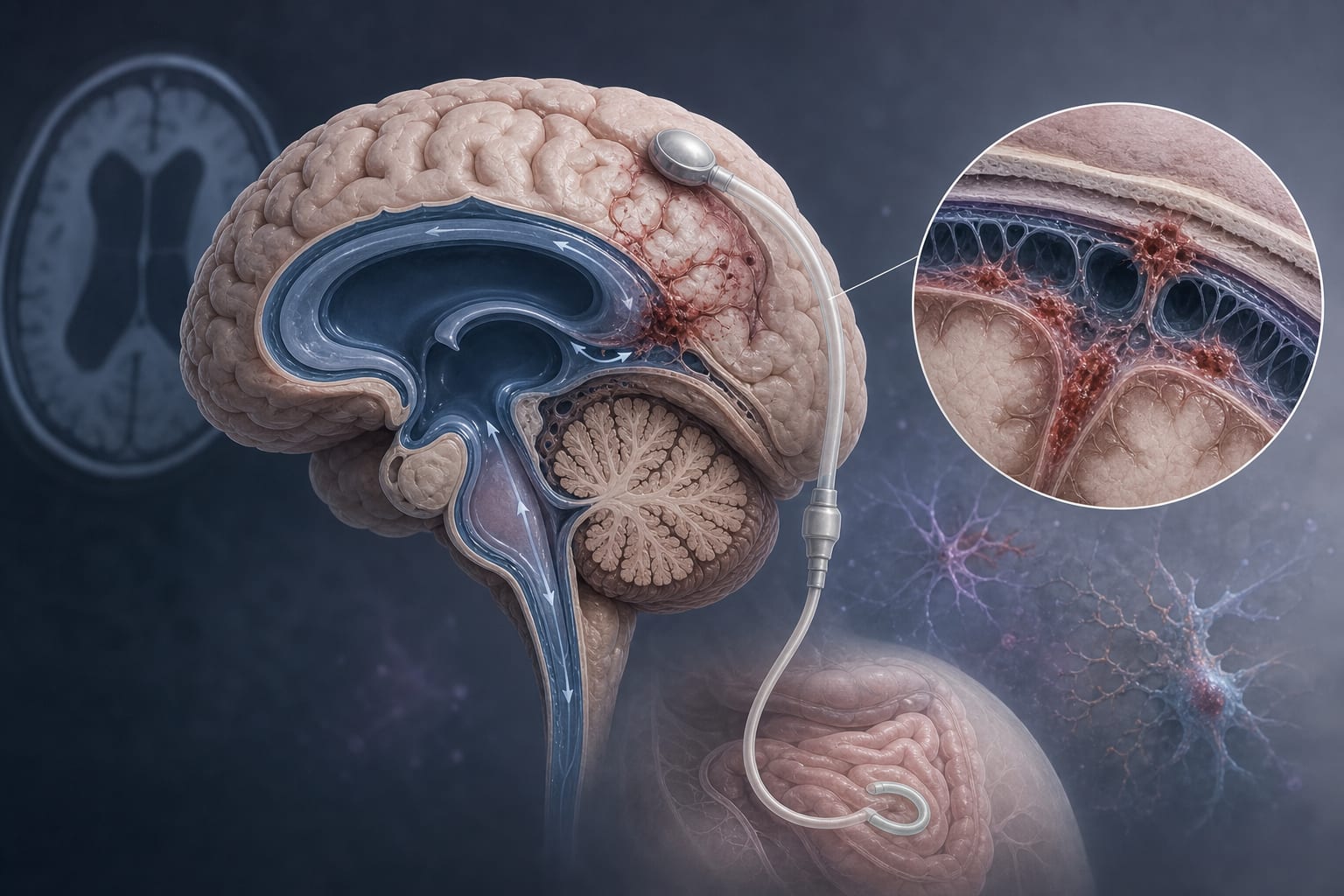
Post-traumatic hydrocephalus (PTH) is a significant complication following traumatic brain injury (TBI), affecting 21.05% of patients in a recent study.

Background

PTH is a serious complication of TBI that can lead to increased morbidity and mortality. Its development is linked to various factors, including severe TBI and hemorrhagic events.

Data Highlights

ParameterFindings
PTH Incidence21.05% in TBI patients
Acute Subdural Hematoma70.0% of PTH patients
Midline Shift/Cisternal Compression65.0% of PTH patients
Correlation with ICPStrong correlation with low GCS and severe TBI
Age CorrelationOlder age linked to aSDH and poor outcomes

Key Findings

  • PTH occurred in 21.05% of TBI patients studied.
  • Acute subdural hematoma was present in 70.0% of PTH cases.
  • Midline shift and cisternal compression were found in 65.0% of patients.
  • Low admission GCS and elevated ICP are strong predictors of poor outcomes.
  • Older age is associated with aSDH and unfavorable prognosis in PTH patients.

Clinical Implications

Clinicians should monitor TBI patients for signs of PTH, particularly those with low GCS and elevated ICP. Surgical intervention may be necessary for patients with acute symptoms, while those with chronic symptoms may be observed for progression.

Conclusion

PTH is a critical complication of TBI, with specific predictors indicating the need for careful management and potential surgical intervention. Understanding these factors can aid in improving patient care.
Related Resources & Content

  1. Frontiers in Neurology, 2026 -- Clinical manifestations, progression and treatment of post-traumatic hydrocephalus accompanied by contralateral subdural effusion after decompressive craniectomy: a single-center retrospective study
  2. Frontiers in Neurology, 2026 -- Factors determining hydrocephalus after decompressive craniectomy: the role of interhemispheric hygroma
  3. Consensus-based recommendations for diagnosis and surgical management of cranioplasty and post-traumatic hydrocephalus from a European panel - PMC
  4. The ASPECT Hydrocephalus Framework: A Descriptive System for Clinical Application
  5. BMC Neurology — Revision rate and postoperative volume development of chronic subdural hematomas after burr hole craniotomy in combination with tranexamic acid vs. surgery alone – a single-center propensity score-matched analysis
  6. Brain Trauma Foundation Guidelines for the Management of Penetrating Traumatic Brain Injury, Second Edition - PubMed
  7. Post-craniectomy hydrocephalus in adult traumatic brain injury patients: a systematic review and meta-analysis of risk factors and outcome | Neurosurgical Review
  8. Consensus-based recommendations for diagnosis and surgical management of cranioplasty and post-traumatic hydrocephalus from a European panel - PMC
  9. Early risk prediction to guide surveillance for post-traumatic hydrocephalus after decompressive craniectomy in adult TBI: a single-center retrospective study | European Journal of Medical Research | Springer Nature Link
  10. Optimal timing of cranioplasty post-decompressive craniectomy in traumatic brain injury: a systematic review, meta-analysis, and overview of ongoing trials - PubMed
  11. Optimal timing of ventriculoperitoneal shunt insertion relative to cranioplasty post-decompressive craniectomy: a frequentist network meta-analysis | Acta Neurochirurgica | Springer Nature Link

Original Source(s)

Related Content