Development and validation of a 24-h predictive model for hypertriglyceridemic moderately severe acute pancreatitis: a single-center retrospective study - Report - MDSpire

Development and validation of a 24-h predictive model for hypertriglyceridemic moderately severe acute pancreatitis: a single-center retrospective study

  • By

  • Songlong Yang

  • Chaoqun Li

  • Kaiping Zeng

  • Minguang Zhang

  • Wenrong Wang

  • July 2, 2026

  • 0 min

Share

Clinical Report: Risk Prediction Model for Moderately Severe Acute Pancreatitis

Overview

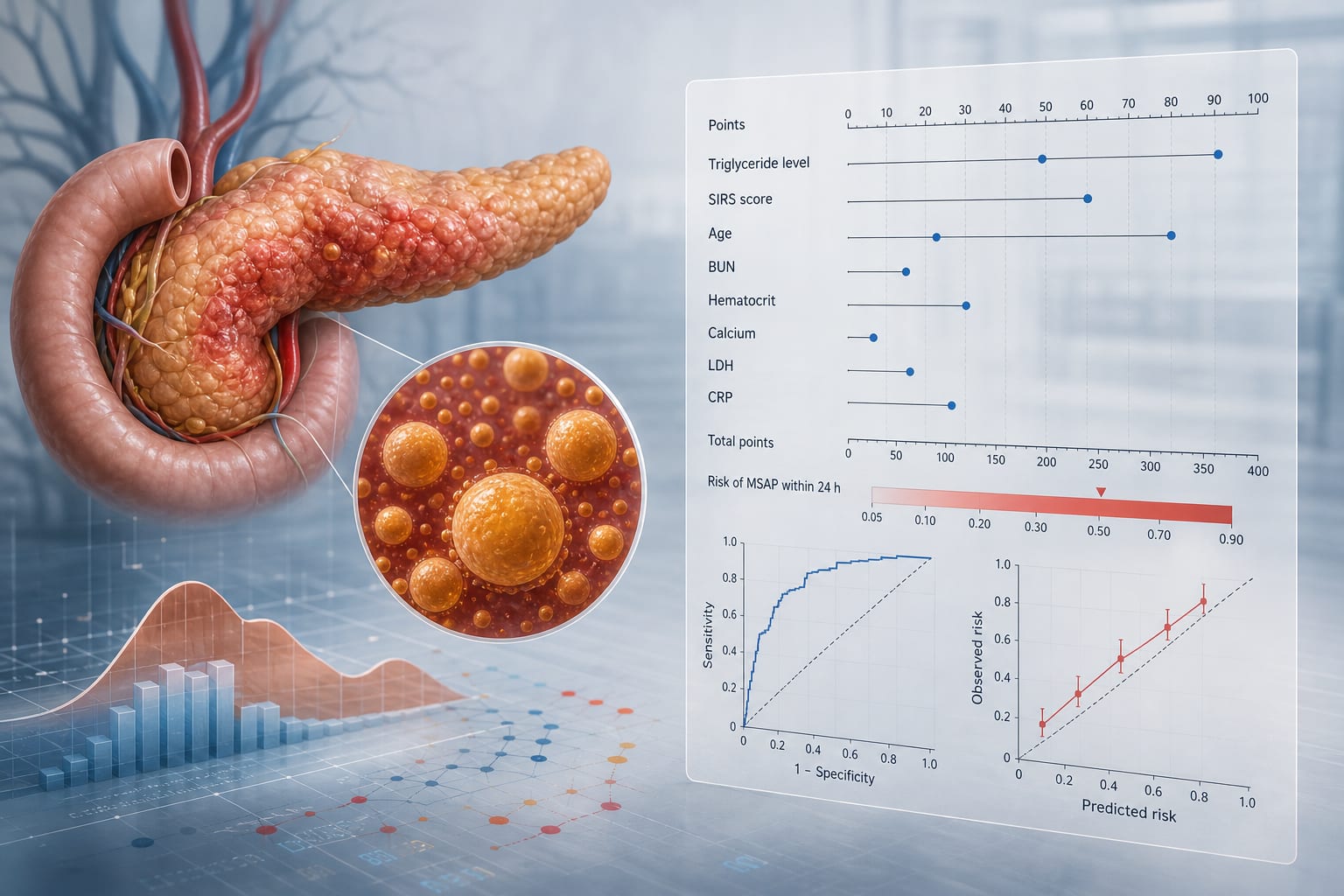
This study developed and validated a risk prediction model for identifying patients with hypertriglyceridemia-induced acute pancreatitis at risk of progressing to moderately severe acute pancreatitis within 24 hours of admission.

Background

Hypertriglyceridemic acute pancreatitis (HTG-AP) is increasingly recognized as a significant cause of acute pancreatitis, particularly in China. Early identification of patients at risk for moderately severe acute pancreatitis (MSAP) is crucial for timely intervention. Current scoring systems often lack the efficiency for early prediction, highlighting the need for improved models.

Data Highlights

VariableOdds Ratio (OR)p-value
SIRS202.469< 0.001
Elevated TG levels1.0660.013
Validation AUC0.909N/A
24-h TG level AUC0.690N/A

Key Findings

  • SIRS and elevated triglyceride levels are independent predictors of progression to MSAP.
  • The prediction model achieved an AUC of 0.909 in the validation cohort.
  • The sensitivity and specificity of the model were 86.2% and 90.9%, respectively.
  • A 24-h triglyceride level below 18.41 mmol/L indicates a lower risk of progression to MSAP.
  • The model was developed using a Firth penalized likelihood logistic regression approach.

Clinical Implications

Clinicians should consider SIRS and triglyceride levels within the first 24 hours of admission as critical factors in assessing the risk of progression to moderately severe acute pancreatitis.

Conclusion

The developed risk prediction model identifies patients at risk for moderately severe acute pancreatitis due to hypertriglyceridemia.

Related Resources & Content

  1. Author(s)/Org, Source, Year -- Title
  2. Frontiers in Digital Health, 2026 -- Creation and validation of interpretable machine learning models for assessing the risk of pancreatic pseudocyst formation in acute pancreatitis patients
  3. Frontiers in Endocrinology, 2026 -- Early prediction of late-pregnancy hypertriglyceridemia in women with gestational diabetes: development and internal validation of a clinical risk model
  4. Acute Pancreatitis - StatPearls - NCBI Bookshelf
  5. Frontiers in Endocrinology — Differences in clinical features and prognosis between hypertriglyceridemia and other causes of acute pancreatitis: a dual perspective based on metabolic disorders and inflammatory response
  6. Acute Pancreatitis - StatPearls - NCBI Bookshelf
  7. Efficacy and safety of pharmacological and procedural interventions in the management of hypertriglyceridemia-induced acute pancreatitis: a systematic review - PMC
  8. Acute Pancreatitis: An Update of Evidence‐Based Management and Recent Trends in Treatment Strategies

Original Source(s)

Related Content