Serum cytokine profiling reveals CXCL10 (IP-10) as a major predictor of severe COVID-19 outcomes in hospitalized patients during the first pandemic wave in Italy - Report - MDSpire
Advertisement
Serum cytokine profiling reveals CXCL10 (IP-10) as a major predictor of severe COVID-19 outcomes in hospitalized patients during the first pandemic wave in Italy
Cytokine Profile Analysis Identifies CXCL10 as a Significant Indicator of Severe COVID-19 Outcomes
Overview
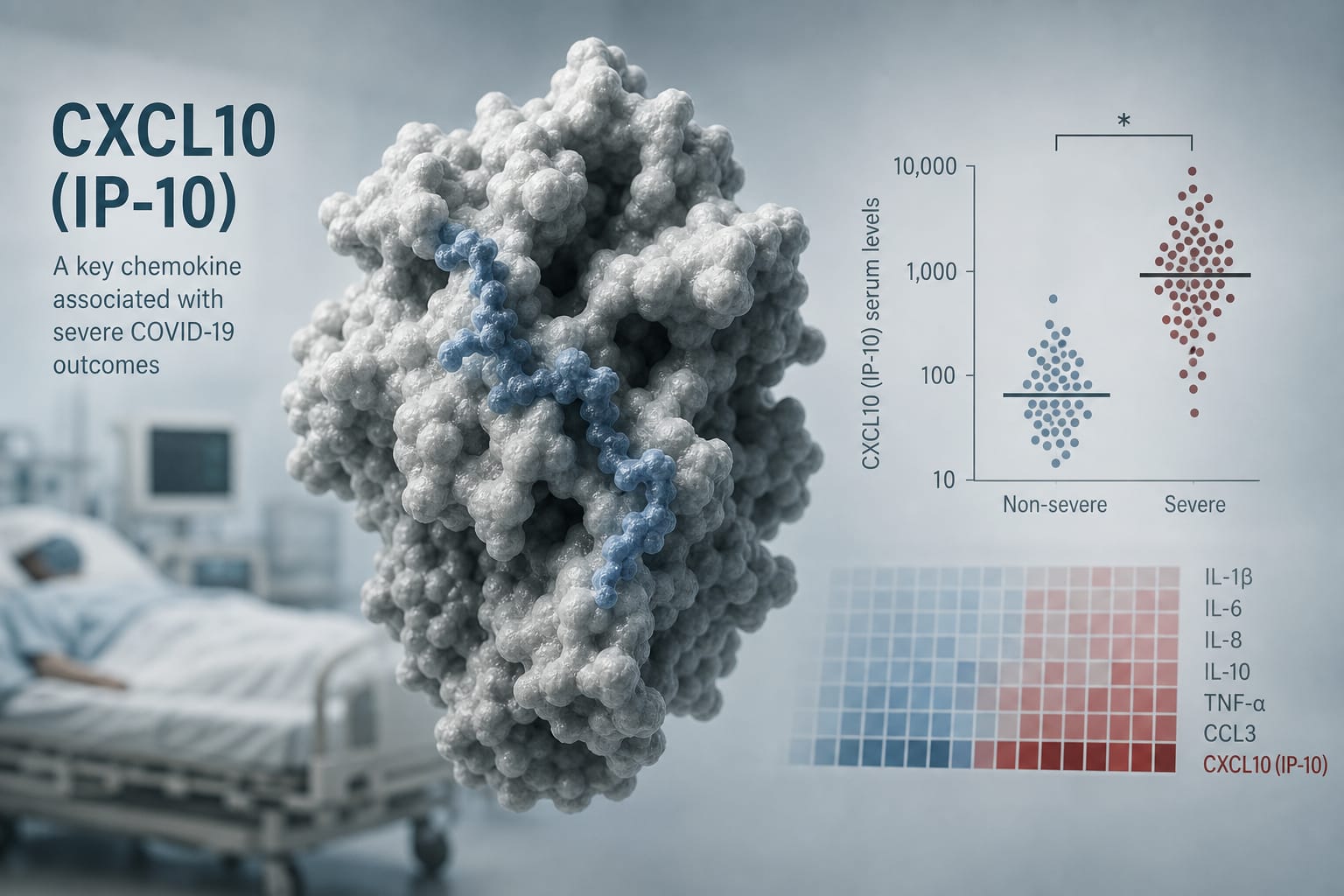
This study identifies CXCL10 as a predictor of severe outcomes in COVID-19 patients. Elevated levels of CXCL10 at hospital admission correlate with increased odds of mortality and ICU admission.
Background
The COVID-19 pandemic has highlighted the importance of understanding inflammatory responses in predicting disease severity. Dysregulated immune responses, characterized by cytokine storms, can lead to severe complications such as acute respiratory distress syndrome (ARDS).
Data Highlights
Outcome
Odds Ratio (OR)
95% Confidence Interval (CI)
Death
1.26
1.17-1.35
ICU Admission
1.13
1.06-1.21
Composite Outcome (Death or ICU Admission)
1.21
1.12-1.31
Key Findings
CXCL10 is associated with adverse outcomes in COVID-19 patients.
Each 1,000 pg/mL increase in CXCL10 correlates with higher odds of death and ICU admission.
ICU admission occurred in 6.8% of patients, with mortality at 11.7%.
Elevated respiratory frequency and blood urea nitrogen are also associated with worse outcomes.
Other cytokines like IL-6 were not significant predictors in the study.
Clinical Implications
Monitoring CXCL10 levels at hospital admission may provide information for risk assessment in COVID-19 patients.
Conclusion
CXCL10 serves as a significant early immunological predictor of severe COVID-19 outcomes, warranting further investigation in larger studies.
Related Resources & Content
Intensive Care Medicine, Temporal Analysis of Mortality Risk Factors in 1260 Critically Ill COVID-19 Patients Across 24 Intensive Care Units in Italy, 2021 -- https://link.springer.com/article/10.1007/s00134-021-06495-y
Infection, Predictive Value and Patterns of Inflammatory Markers for Clinical Outcomes in COVID-19 Patients Undergoing Tocilizumab Treatment, 2024 -- https://link.springer.com/article/10.1007/s15010-024-02375-x
Infection, Epigenetic Insights on COVID-19 Infection and the Associated Cytokine Storm: A Comprehensive Review, 2023 -- https://link.springer.com/article/10.1007/s15010-023-02017-8
Intensive Care Medicine, Diverse Clinical Phenotypes Reveal Varied Links Between Corticosteroid Therapy and Survival Rates in Severe COVID-19 Cases, 2024 -- https://link.springer.com/article/10.1007/s00134-024-07593-3
Frontiers, Chemokines as potential biomarkers for predicting the course of COVID-19 – a review of the literature, 2025 -- https://www.frontiersin.org/articles/10.3389/fimmu.2025.1662643?utm_source=openai
Role of Procalcitonin as a Prognostic Biomarker in Hospitalized COVID-19 Patients: A Comparative Analysis - PubMed, 2023 -- https://pubmed.ncbi.nlm.nih.gov/40386243/?utm_source=openai