Repeatability of AI-quantified incidental findings on lung cancer screening CT scans in the NELSON trial - Report - MDSpire

Repeatability of AI-quantified incidental findings on lung cancer screening CT scans in the NELSON trial

  • By

  • Stijn Bunk

  • Thijs Bruins Slot

  • Edwin Bennink

  • Grigory Sidorenkov

  • Nils van der Velden

  • Niels Schurink

  • Félix Lades

  • Markus Sebald

  • Marjolein A. Heuvelmans

  • Hester A. Gietema

  • Joachim G. Aerts

  • Geertruida H. de Bock

  • Cornelia Schaefer-Prokop

  • Pim A. de Jong

  • Rozemarijn Vliegenthart

  • Firdaus A. A. Mohamed Hoesein

  • June 17, 2026

  • 0 min

Share

Consistency of AI-Detected Incidental Findings in Lung Cancer Screening CT Scans

Overview

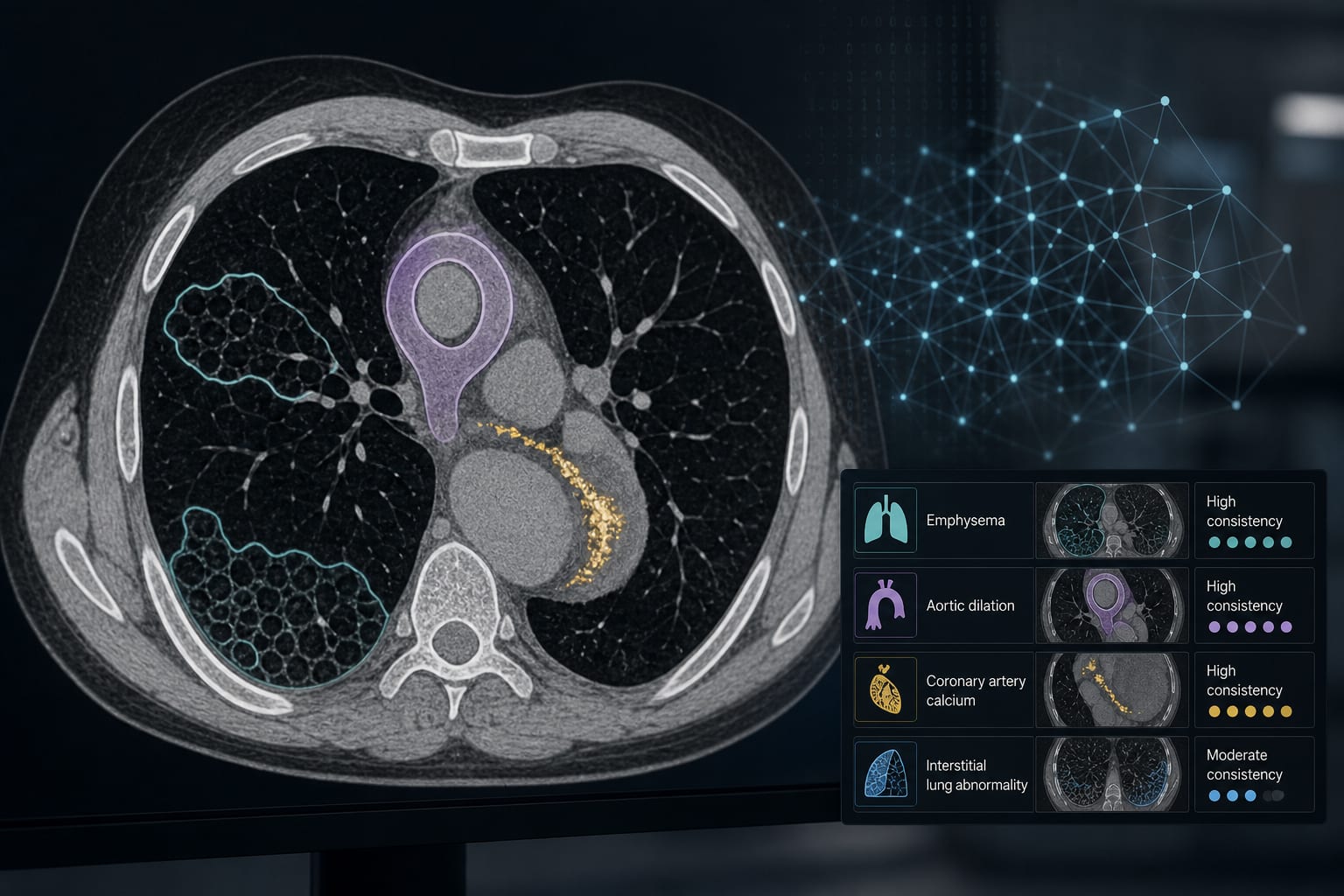
This study evaluates the repeatability and agreement of AI measurements for incidental findings in lung cancer screening CT scans from the NELSON trial. The findings suggest that AI can effectively measure various incidental findings, potentially reducing radiologist workload.

Background

Lung cancer screening using low-dose CT has been shown to significantly reduce mortality rates. Incidental findings during these screenings can indicate other health issues, increasing the radiologist's workload and the potential for interpretive errors. The integration of AI in analyzing these findings may enhance efficiency and accuracy in lung cancer screening.

Data Highlights

No numerical data provided in the article.

Key Findings

  • AI algorithms demonstrated good accuracy in measuring incidental findings on lung cancer screening CT scans.
  • Repeatability of AI measurements for various incidental findings was assessed in short-term follow-up scans.
  • AI-based measurements showed high concordance with manual readings for coronary artery calcium and aortic diameters.
  • The study emphasizes the need for further validation of AI measurements in lung cancer screening settings.
  • Automated analysis may alleviate the increased workload faced by radiologists due to incidental findings.

Clinical Implications

The use of AI in measuring incidental findings could streamline the workflow for radiologists, allowing for more efficient screening processes. This may lead to better management of incidental findings and improved patient outcomes in lung cancer screening programs.

Conclusion

The study supports the potential of AI to enhance the measurement of incidental findings in lung cancer screening, which may improve clinical workflows and patient care.

Related Resources & Content

  1. The ASCO Post, 2013 -- Low-Dose CT Screening Identifies More Early Lung Cancer but Has Lower Positive Predictive Value vs Radiography
  2. The ASCO Post, 2022 -- NELSON vs NLST: Nodule Management Based on Volumetry Shows Increased Benefits
  3. The ASCO Post, 2013 -- Evaluation of Lung Cancer Screening Strategy in the First Three Rounds of the NELSON Trial
  4. European Radiology -- The Role of Artificial Intelligence in Assessing Risk-Dominant Lung Nodules: Impact of CT Reconstruction Settings
  5. Reduced Lung-Cancer Mortality with Low-Dose Computed Tomographic Screening
  6. Recommendation: Lung Cancer: Screening
  7. Lung Cancer Screening, Version 1.2025 Featured Updates to the NCCN Guidelines
  8. Lung-RADS® v2022
  9. An umbrella review of systematic evidence on the Low Dose Computed Tomography (LDCT) for lung cancer screening - PubMed
  10. Emphysema at Baseline Low-Dose CT Lung Cancer Screening Predicts Death from Chronic Obstructive Pulmonary Disease and Cardiovascular Disease Up to 25 Years Later | Radiology
  11. 2025 GOLD Report - Global Initiative for Chronic Obstructive Lung Disease - GOLD
  12. ELCAP Coronary Artery Calcium Score at Lung Cancer Screening CT Predicts Up to 25-Year Mortality | Radiology
  13. Coronary Artery Calcification Identified on Lung Cancer Screening CT Scans: A Scoping Review - ScienceDirect
  14. Prevalence and clinical characteristics of non-malignant CT detected incidental findings in the SUMMIT lung cancer screening cohort - PMC
  15. 2022 ACC/AHA Guideline for the Diagnosis and Management of Aortic Disease: A Report of the American Heart Association/American College of Cardiology Joint Committee on Clinical Practice Guidelines | Circulation
  16. Approach to the Evaluation and Management of Interstitial Lung Abnormalities: An Official American Thoracic Society Clinical Statement - PMC
  17. Approach to the Evaluation and Management of Interstitial Lung Abnormalities: An Official American Thoracic Society Clinical Statement | American Journal of Respiratory and Critical Care Medicine
  18. Repeatability of AI-based, automatic measurement of vertebral and cardiovascular imaging biomarkers in low-dose chest CT: the ImaLife cohort | European Radiology | Springer Nature Link
  19. AI for Multistructure Incidental Findings and Mortality Prediction at Chest CT in Lung Cancer Screening - PMC

Original Source(s)

Related Content