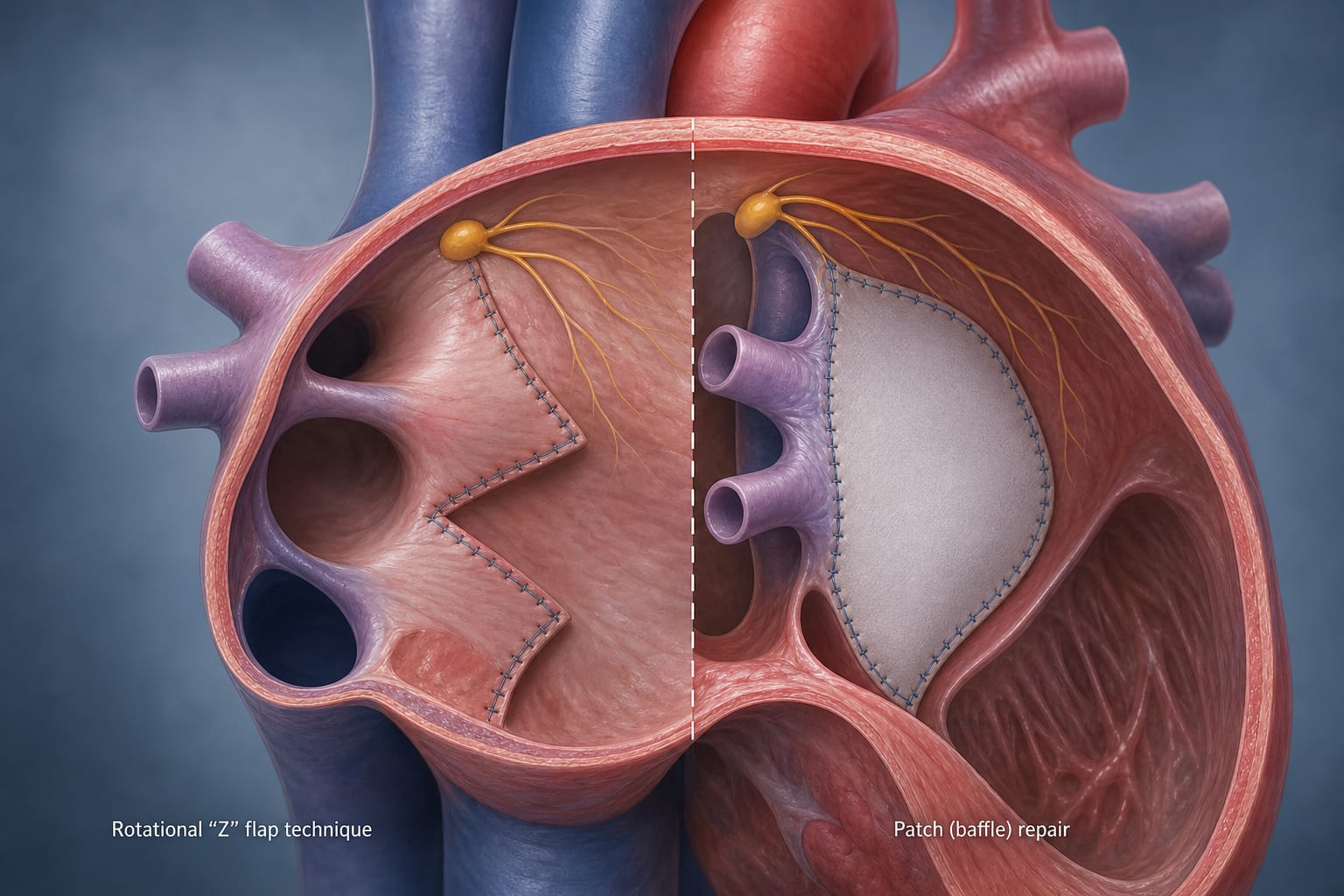
Same-same, but different? Postoperative rhythm disturbances and other analysis after rotational Z-flap vs. patch repair of sinus venosus atrial defects - Report - MDSpire
Clinical Report: Comparative Analysis of Postoperative Arrhythmias Following Rotational Z-Flap Versus Patch Repair Techniques for Sinus Venosus Atrial Septal Defects
Overview
This study compares postoperative arrhythmias following two surgical techniques for sinus venosus atrial septal defects (SVASD). The rotational Z-flap technique demonstrated shorter operative times but a higher incidence of junctional rhythms compared to the conventional patch repair.
Background
Sinus venosus atrial septal defects (SVASD) are often associated with partial anomalous pulmonary venous return (PAPVR) and require surgical intervention. While surgical correction has low mortality, postoperative arrhythmias remain a significant concern due to the proximity of the sinus node. Understanding the outcomes of different surgical techniques is crucial for optimizing patient care and minimizing complications.
Data Highlights
Technique
Total Operative Time (min)
Bypass Time (min)
Cross-Clamp Time (min)
Postoperative Rhythm Disturbances (%)
Sinoatrial Block (%)
Z-Flap
182.6
71.4
35.7
54.5
17.5
Baffle
209
96.1
46
54.5
4.3
Key Findings
The Z-flap technique resulted in significantly shorter total operative, bypass, and cross-clamp times compared to the baffle technique.
Postoperative rhythm disturbances were observed in 54.5% of patients, with right bundle branch block being the most common (40.1%).
The Z-flap group had a significantly higher incidence of sinoatrial block with junctional rhythm (17.5% vs. 4.3%; p = 0.035).
No patients required permanent pacemaker implantation post-surgery.
No significant differences were found in residual shunts or superior vena cava stenosis between the two techniques.
Clinical Implications
Surgeons should consider the trade-offs between surgical efficiency and the risk of postoperative arrhythmias when selecting a technique for SVASD repair. Continuous monitoring for rhythm disturbances postoperatively is essential, particularly for patients undergoing the Z-flap technique.
Conclusion
Both the Z-flap and baffle techniques are effective for SVASD correction, each with unique advantages and risks. The choice of technique should be tailored to individual patient anatomy and risk factors.
A first-of-its-kind randomized trial in in-hospital cardiac arrest found no statistically significant increase in sustained return of spontaneous circulation with sodium bicarbonate vs placebo.