Inflammatory marker profiles vary by BMI across Crohn’s disease, ulcerative colitis, psoriasis, and psoriatic arthritis - Report - MDSpire

Profiles of Inflammatory Markers Differ by Body Mass Index in Crohn’s Disease, Ulcerative Colitis, Psoriasis, and Psoriatic Arthritis

  • By

  • Stephen A. Shields

  • Ann Von Holle

  • Ruthvik Padival

  • Joseph F. Merola

  • Rachael Zuckerman

  • Jeff T. Mohl

  • Elizabeth L. Ciemins

  • July 17, 2026

Share

Profiles of Inflammatory Markers Differ by Body Mass Index in IMIDs

Overview

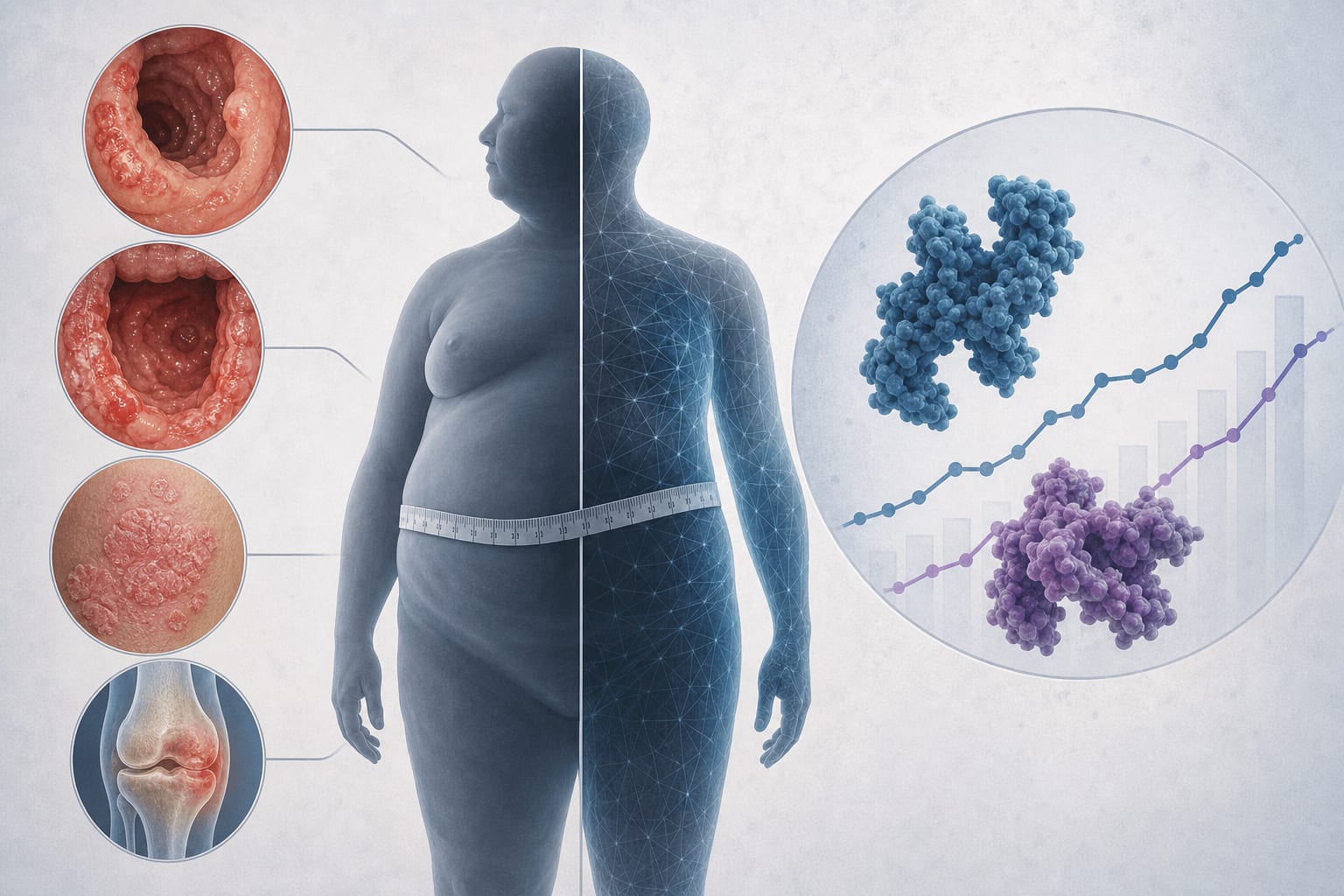
This study evaluates the relationship between body mass index (BMI) and systemic inflammatory markers in patients with Crohn’s disease, ulcerative colitis, psoriasis, and psoriatic arthritis. Findings indicate that obesity is associated with significantly elevated levels of C-reactive protein (CRP) and erythrocyte sedimentation rate (ESR) across these conditions.

Background

Obesity is recognized as a state of chronic low-grade inflammation, which may exacerbate immune-mediated inflammatory diseases (IMIDs) such as Crohn’s disease and psoriasis. This study aims to fill the gap in knowledge regarding how obesity impacts inflammatory markers across various IMIDs.

Data Highlights

ConditionCRP IncreaseESR Increase
Obesity49–83% higher24–48% higher
Overweight + High-risk Comorbidities34–55% higher13–30% higher

Key Findings

  • Patients with obesity showed significantly elevated CRP and ESR compared to healthy-weight individuals.
  • CRP levels were 49–83% higher in obese patients across all four conditions studied.
  • ESR levels were 24–48% higher in obese patients compared to healthy-weight counterparts.
  • Patients with overweight plus high-risk comorbidities had intermediate elevations in CRP and ESR.
  • Ferritin levels showed near null associations across all conditions.
  • Elevated inflammatory markers persisted statistically significant through year 5 of the study.

Clinical Implications

The findings suggest that obesity may contribute to an increased systemic inflammatory burden in patients with IMIDs, which could influence treatment responses and disease management. Clinicians should consider the impact of BMI on inflammatory markers when assessing disease activity and treatment efficacy.

Conclusion

This study highlights the consistent elevation of CRP and ESR in obese patients with IMIDs.
Related Resources & Content

  1. Frontiers in Immunology, 2026 -- Shared inflammatory architecture and therapeutic tensions between psoriasis and Crohn’s disease
  2. Journal of Crohn's and Colitis, 2023 -- Analysis of Serum Proteomics to Explore Heterogeneity in Inflammatory Bowel Disease
  3. Clinical Rheumatology, 2016 -- Early Phase Hormonal, Metabolic Peptide, and Nutrient Profiles in Rheumatoid Arthritis
  4. Assessment of Interleukin-6 and Its Soluble Receptor Components as Inflammatory Markers in IBD
  5. American Gastroenterological Association -- Living guideline for pharmacological management of moderate-to-severe ulcerative colitis
  6. AGA Clinical Practice Guideline on the Role of Biomarkers for the Management of Ulcerative Colitis
  7. BMC Rheumatology -- A six-month weight loss intervention is associated with significant changes in serum biomarkers in obese patients with psoriatic arthritis
  8. Living guideline for pharmacological management of moderate-to-severe ulcerative colitis - American Gastroenterological Association
  9. AGA Clinical Practice Guideline on the Role of Biomarkers for the Management of Ulcerative Colitis - ScienceDirect
  10. A six-month weight loss intervention is associated with significant changes in serum biomarkers related to inflammation, bone and cartilage metabolism in obese patients with psoriatic arthritis and matched controls | BMC Rheumatology | Springer Nature Link

Original Source(s)

Related Content