Multicentre evaluation of artificial intelligence risk classification for detection of clinically significant prostate cancer on biparametric MRI - Report - MDSpire
Coming Soon: Introducing MDSpire News. Learn more
Conexiant’s news site is now MDSpire News. Learn more

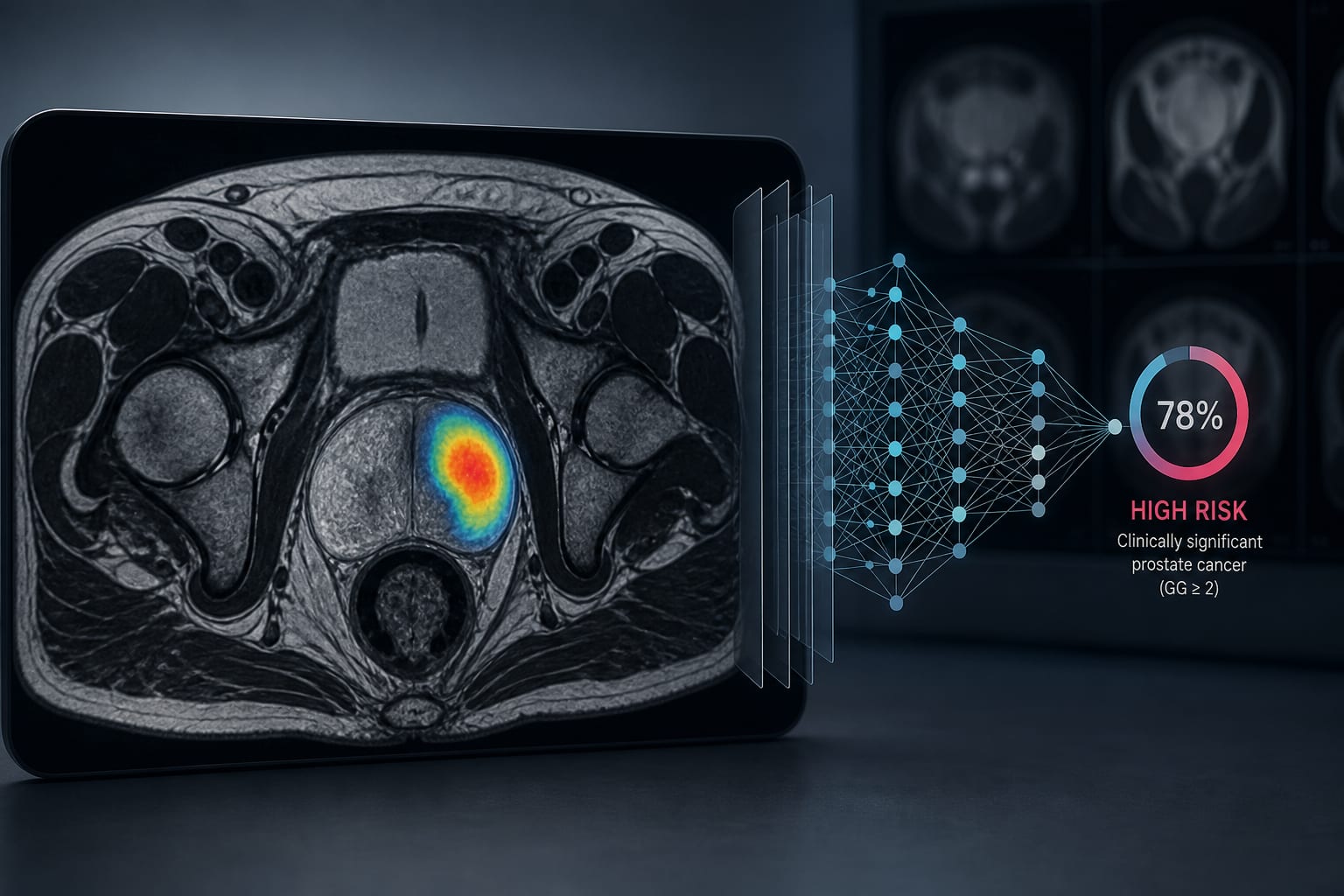
Multicenter Assessment of AI-Based Risk Stratification for Identifying Clinically Relevant Prostate Cancer via Biparametric MRI

  • By

  • Karsten Guenzel

  • Maarten G. Poirot

  • Almar van Loon

  • Emanuele Messina

  • Martina Pecoraro

  • Valeria Panebianco

  • Robert Princenthal

  • Francesco Giganti

  • September 26, 2026

Share

Clinical Report: AI-Based Risk Stratification for Prostate Cancer via MRI

Overview

This multicenter study evaluates the diagnostic accuracy of AI-based risk classification compared to radiologist-assigned PI-RADS for detecting clinically significant prostate cancer (csPCa).

Background

Clinically significant prostate cancer (csPCa) detection is crucial for reducing mortality while minimizing overtreatment. Multiparametric MRI (mpMRI) has become a key tool in this process, but inter-reader variability in PI-RADS scoring poses challenges. AI-based systems may enhance diagnostic accuracy and streamline risk stratification in clinical practice.

Data Highlights

No numerical data was provided in the source material.

Key Findings

  • The study compared AI-derived risk classification with radiologist-assigned PI-RADS for csPCa detection.
  • AI tools categorized lesions into Low, Medium, or High-risk classifications.
  • Histopathology served as the reference standard for csPCa detection.
  • Inter-reader variability in PI-RADS scoring was noted, particularly for PI-RADS 3 lesions.
  • The study included data from multiple centers across Germany, the Netherlands, and the United States.

Clinical Implications

The integration of AI in prostate MRI may assist in managing equivocal lesions.

Conclusion

Further studies are needed to validate these findings across diverse clinical settings.
Related Resources & Content

  1. European Radiology, 2024 -- Evaluating the Safety of Biparametric MRI in Prostate Cancer Patients Undergoing Active Surveillance
  2. European Radiology, 2026 -- AI decision support for increasing prostate biopsy efficiency: a retrospective multicentre, multiscanner study
  3. Tailoring Prostate Cancer Diagnosis through Multivariate Risk Assessment: The Role of MRI in Clinical Practice
  4. Frontiers in Oncology, 2026 -- Creation and external assessment of a straightforward pre-biopsy risk assessment tool for significant prostate cancer in males with PI-RADS 3 lesions: findings from a multicenter transperineal biopsy investigation
  5. EAU Guidelines on Prostate Cancer 2026
  6. NCCN Guidelines® Insights: Prostate Cancer, Version 5.2026
  7. Biparametric vs Multiparametric MRI for Prostate Cancer Diagnosis: The PRIME Diagnostic Clinical Trial
  8. Diagnostic Performance of Biparametric versus Multiparametric Magnetic Resonance Imaging for Prostate Cancer Diagnosis: An Updated Systematic Review and Meta-analysis - UCL Discovery
  9. Abbreviated biparametric versus multiparametric MRI for the detection of clinically significant prostate cancer in treatment-naïve patients: a diagnostic test accuracy systematic review and meta-analysis - PubMed
  10. NPV of Biparametric and Multiparametric Prostate MRI: A Comparative Systematic Review and Meta-Analysis - PubMed
  11. Artificial intelligence and radiologists in prostate cancer detection on MRI (PI-CAI): an international, paired, non-inferiority, confirmatory study - PMC
  12. Artificial-intelligence models vs. radiologists in the detection of clinically significant prostate cancer on mpMRI: a meta-analysis - PubMed
  13. Requirements for AI Development and Reporting for MRI Prostate Cancer Detection in Biopsy-Naive Men: PI-RADS Steering Committee, Version 1.0
  14. Deep Learning Artificial Intelligence and Restriction Spectrum Imaging for Patient-level Detection of Clinically Significant Prostate Cancer on Biparametric Magnetic Resonance Imaging - ScienceDirect

Original Source(s)

Related Content