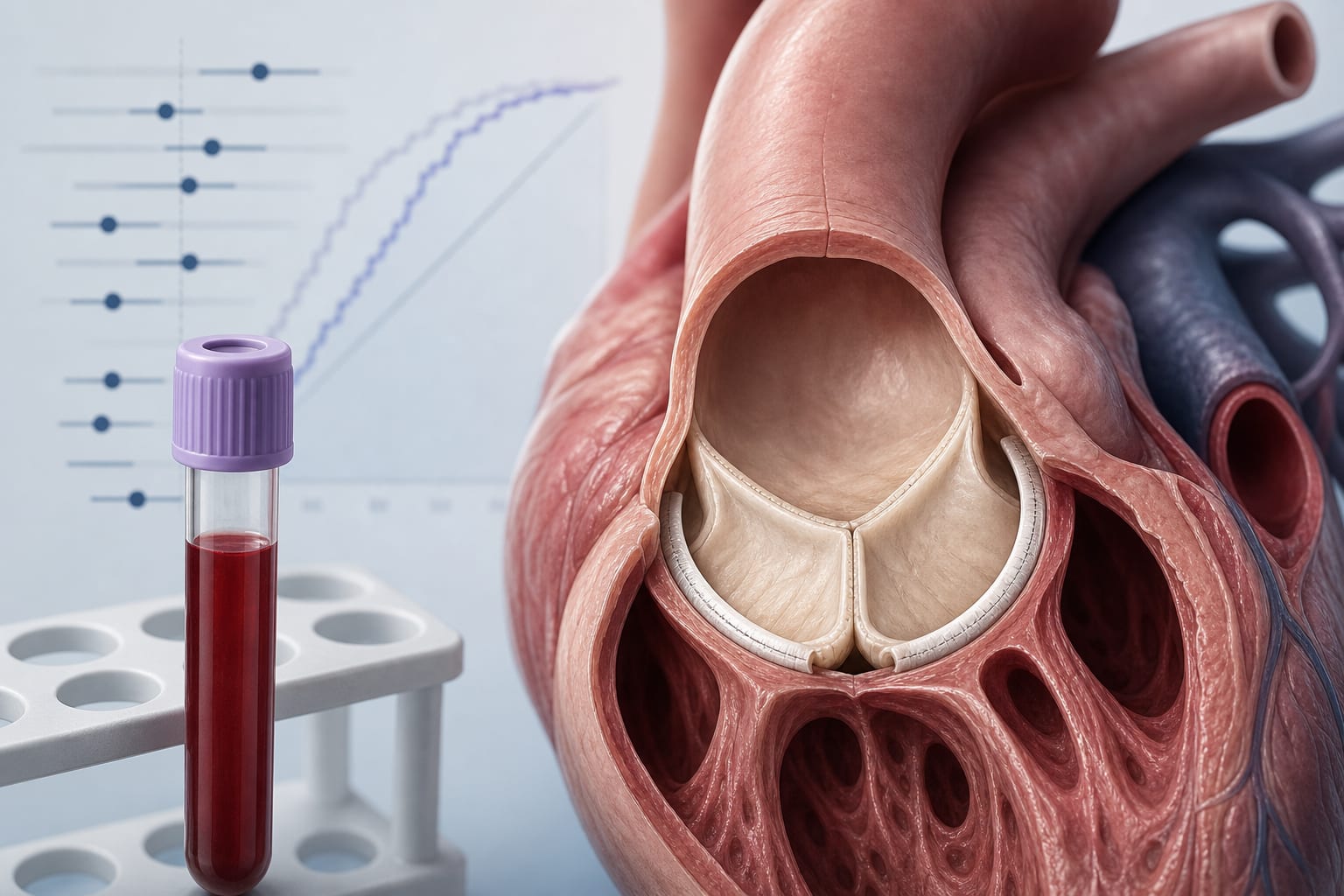
Clinical Report: Preoperative Circulating Biomarkers Enhance Prediction of Postoperative Outcomes Following Aortic Valve Surgery
Overview
This study investigates the association between preoperative circulating biomarkers and postoperative outcomes in patients undergoing aortic valve surgery.
Background
Predicting postoperative complications following aortic valve surgery is critical for patient management and decision-making. Current risk stratification tools, such as EuroSCORE-II, may not fully capture the complexity of individual patient risks. The integration of preoperative biomarkers could enhance the predictive capabilities of these models.
Data Highlights
Biomarker
Odds Ratio (OR)
95% Confidence Interval (CI)
p-value
Hemoglobin
0.70
0.57, 0.87
<0.001
Creatinine
4.09
1.63, 10.26
0.003
hsTrop-I
1.48
1.11, 1.95
0.007
GOT
2.49
1.06, 5.86
0.036
INR
4.74
1.32, 17.05
0.017
CRP
2.14
1.53, 3.00
<0.001
NT-proBNP
2.06
1.41, 3.00
<0.001
WBC
5.82
1.88, 17.97
0.002
Key Findings
Preoperative hemoglobin levels were inversely associated with 30-day mortality.
Higher creatinine levels were linked to increased odds of postoperative mortality.
High-sensitivity troponin I levels showed a positive correlation with adverse outcomes.
Combining biomarkers with EuroSCORE-II improved predictive performance for mortality.
Clinical Implications
The findings suggest that preoperative biomarker assessment can enhance risk stratification for patients undergoing aortic valve surgery. Clinicians may consider integrating these biomarkers into decision-making processes to better predict postoperative outcomes.
Conclusion
The study demonstrates the association between preoperative circulating biomarkers and postoperative outcomes following aortic valve surgery.
by Till Joscha Demal, Jenny Bialczak, Alina Goßling, Francisco Miguel Ojeda, Oliver Daniel Bhadra, Björn Sill, Johannes Petersen, Sebastian Ludwig, David Grundmann, Lisa Voigtländer, Lara Waldschmidt, Laura Hannen, Niklas Schofer, Stefan Blankenberg, Paulus Kirchhof, Thomas Renné, Lenard Conradi, Hermann Reichenspurner, Evaldas Girdauskas, Andreas Schaefer