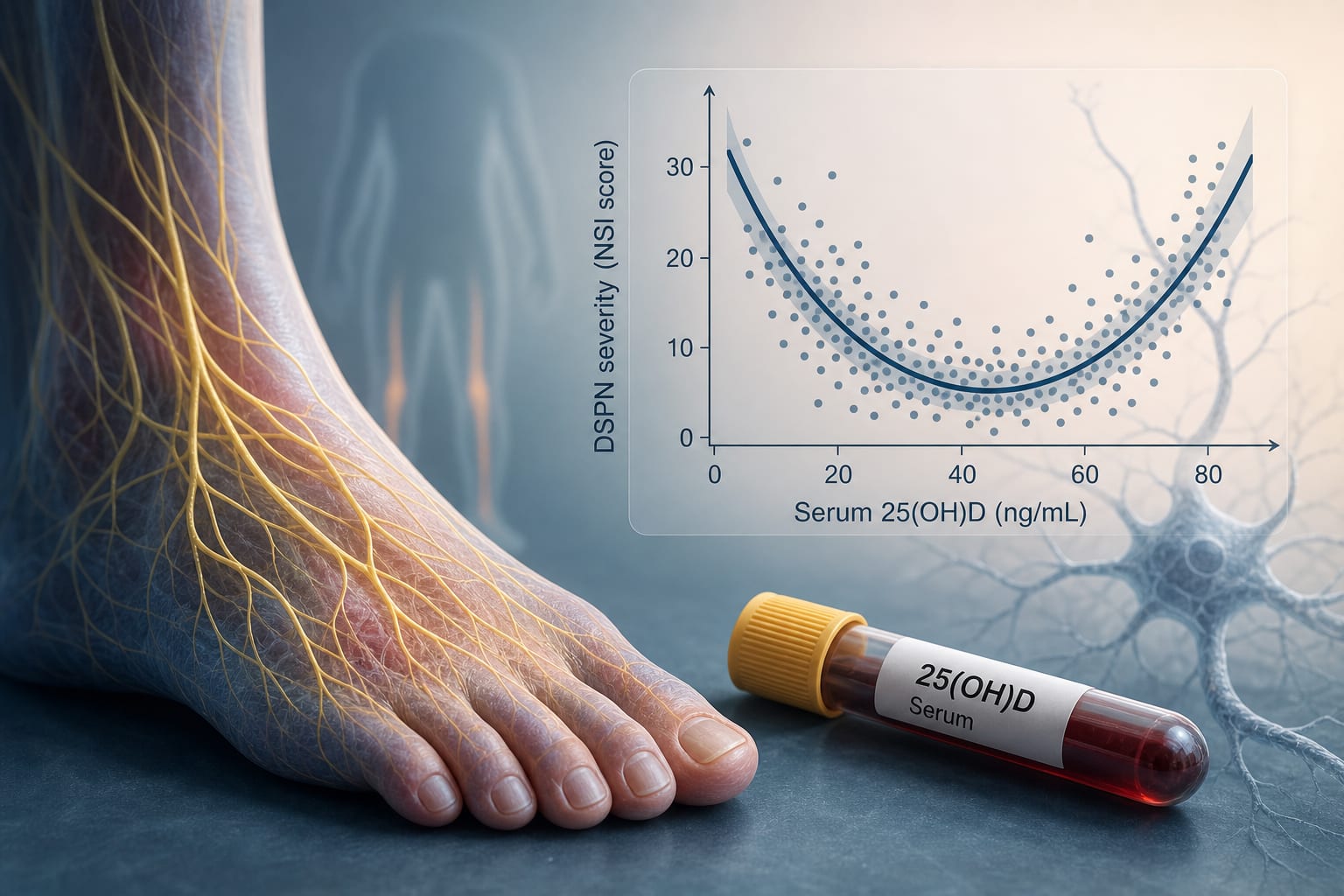
Lower serum 25-hydroxyvitamin D levels predict higher risk of DSPN in type 2 diabetes, and exhibit a non-linear association with the severity of DSPN
-
By
-
Tao Chen
-
Yi Feng
-
July 13, 2026
Reduced serum 25-hydroxyvitamin D concentrations and distal symmetric polyneuropathy
Overview
This study found that lower serum 25-hydroxyvitamin D levels are significantly associated with distal symmetric polyneuropathy (DSPN) in individuals with type 2 diabetes. A nonlinear relationship was observed between vitamin D levels and the severity of DSPN, with a critical threshold identified at approximately 26.1 ng/mL.
Background
Distal symmetric polyneuropathy (DSPN) is a common complication of type 2 diabetes mellitus (T2DM), affecting a significant proportion of patients. Identifying a clinically significant cutoff for vitamin D levels could aid in early detection and management of DSPN.
Data Highlights
| Group | 25(OH)D (ng/mL) |
|---|---|
| Non-DSPN (n=148) | 32.31 ± 5.97 |
| DSPN (n=421) | 23.95 ± 5.14 |
Key Findings
- Individuals with DSPN had significantly lower serum 25(OH)D levels compared to non-DSPN individuals (23.95 ± 5.14 vs. 32.31 ± 5.97 ng/mL, P < 0.001).
- There was a significant downward trend in the risk of DSPN with increasing 25(OH)D levels (P for trend < 0.001).
- A nonlinear relationship was observed between 25(OH)D levels and the severity of DSPN, with a turning point at approximately 26.1 ng/mL.
- As 25(OH)D levels dropped below 26.1 ng/mL, the severity of DSPN increased significantly.
- Multivariable logistic regression confirmed that 25(OH)D had an independent protective effect against DSPN.
- Propensity score matching validated the findings regarding the association between vitamin D levels and DSPN.
Clinical Implications
Clinicians should consider monitoring serum 25-hydroxyvitamin D levels in patients with type 2 diabetes to assess the risk of distal symmetric polyneuropathy. Identifying patients with levels below 26.1 ng/mL may facilitate early intervention and management strategies.
Conclusion
The study highlights the inverse association between serum 25(OH)D levels and the risk and severity of distal symmetric polyneuropathy in type 2 diabetes. These findings suggest that vitamin D levels could serve as a useful clinical indicator for assessing neuropathy risk.
Related Resources & Content
- Frontiers in Endocrinology, 2026 -- Association of serum 25-hydroxyvitamin D levels with indicators of target organ damage in patients with diabetes: a cross-sectional study
- Frontiers in Endocrinology, 2026 -- Serum 25-hydroxyvitamin D is associated with islet function in postmenopausal women with type 2 diabetes and osteoporosis
- Frontiers in Endocrinology, 2026 -- Association of 25(OH)D status with calcium metabolism, inflammation, and thyroid autoimmunity in patients with type 2 diabetes mellitus
- Retinopathy, Neuropathy, and Foot Care: Standards of Care in Diabetes—2026
- European Journal of Medical Research, 2026 -- Serum 25-hydroxyvitamin D, immune-inflammatory indices, and electrophysiological diabetic peripheral neuropathy in newly diagnosed type 2 diabetes patients requiring short-term intensive insulin therapy
- Blood Cancer Journal — Validation of a vitamin D replacement strategy in vitamin D-insufficient patients with lymphoma or chronic lymphocytic leukemia
- 12. Retinopathy, Neuropathy, and Foot Care: Standards of Care in Diabetes—2026
- Serum 25-hydroxyvitamin D, immune-inflammatory indices, and electrophysiological diabetic peripheral neuropathy in newly diagnosed type 2 diabetes patients requiring short-term intensive insulin therapy | European Journal of Medical Research | Springer Nature Link
- Frontiers | Association of serum 25-hydroxyvitamin D levels with indicators of target organ damage in patients with diabetes: a cross-sectional study
This content is an AI-generated, fully rewritten summary based on a published scholarly article. It does not reproduce the original text and is not a substitute for the original publication. Readers are encouraged to consult the source for full context, data, and methodology.