The Cuneus Vein: Exploring Its Existence and Surgical Implications
-
By
-
Goetz Benndorf
-
June 6, 2026
Clinical Report: The Cuneus Vein: Exploring Its Existence and Surgical Implications
Overview
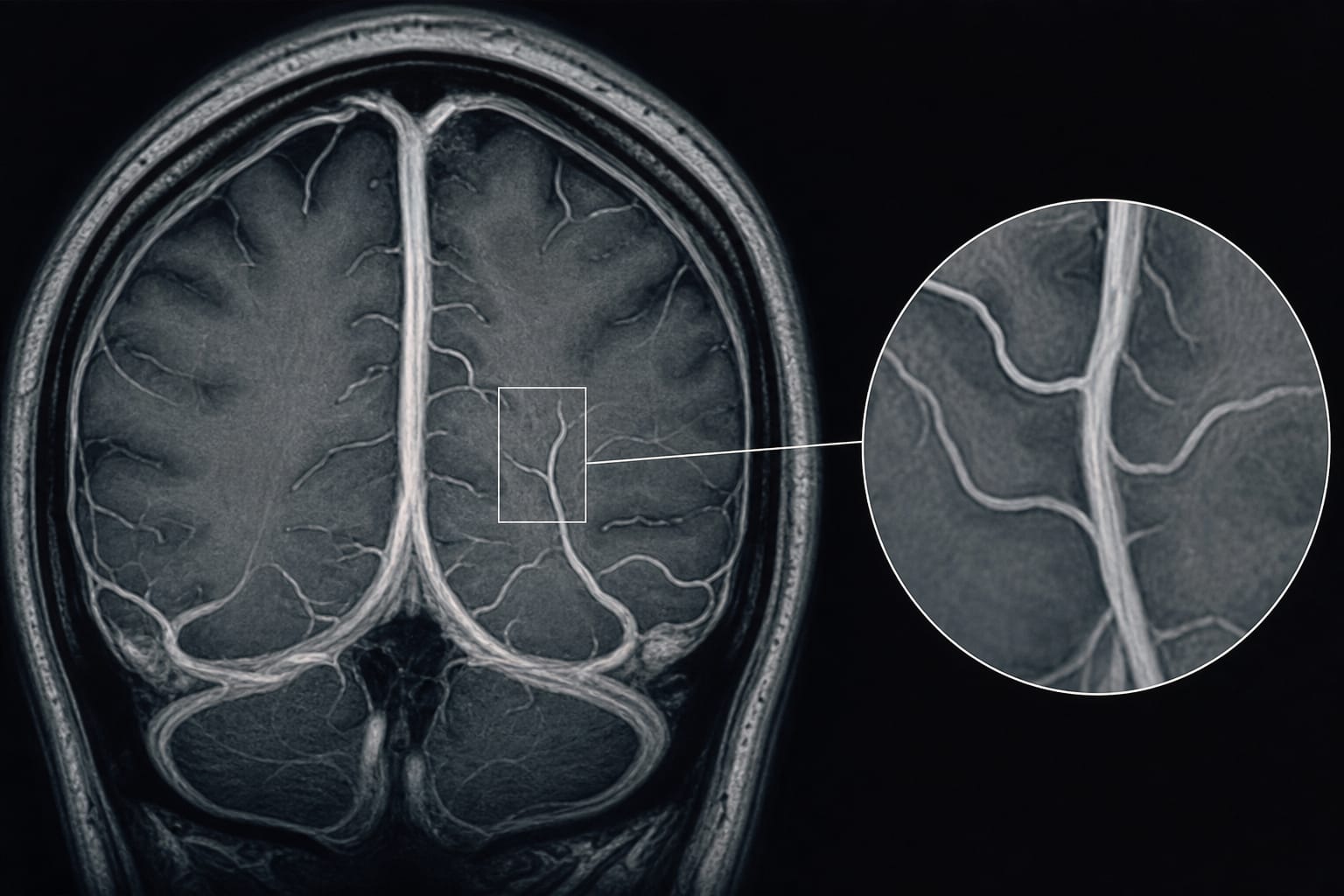
This report discusses the identification of the cuneus vein in neurosurgical practice, highlighting its presence in 4% of cases reviewed. The study emphasizes the importance of preserving venous flow during surgical procedures, despite methodological limitations in preoperative imaging.
Background
The cuneus vein represents a previously unreported venous structure that may play a critical role in neurosurgical outcomes. Understanding and preserving such anatomical variations is essential to prevent complications like venous infarction and postoperative edema. As MRI technology evolves, accurate preoperative mapping of venous structures becomes increasingly important for surgical planning.
Data Highlights
No numerical data available.
Key Findings
- The cuneus vein was identified in 12 out of 303 surgical cases (4%).
- Preservation of venous flow is crucial in neurosurgery to avoid complications.
- The study's retrospective design limits the generalizability of its findings.
- Preoperative MRI failed to visualize the cuneus vein in the reviewed cases.
- Modern MRI techniques have advanced significantly, potentially improving visualization of small veins.
Clinical Implications
Surgeons should be aware of the cuneus vein and consider its preservation during posterior interhemispheric approaches. Enhanced imaging techniques may aid in identifying such anatomical variants preoperatively, thereby improving surgical outcomes.
Conclusion
The identification of the cuneus vein underscores the need for meticulous venous mapping in neurosurgery. Continued advancements in imaging technology may facilitate better preoperative planning and patient outcomes.
Related Resources & Content
- Gurse et al., Acta Neurochirurgica, 2026 -- The Cuneus Vein: Initial Anatomical Description and Preservation Technique for Posterior Interhemispheric Approaches
- Gurse et al., Acta Neurochirurgica, 2021 -- Surgical Techniques for Totally Implantable Venous Access Ports: A Comprehensive Strategy to Mitigate Complications Associated with Percutaneous Approaches
- Gurse et al., Acta Neurochirurgica, 2025 -- Anatomical Variations of Venous Structures Related to the Suboccipital Transhorizontal Fissure Approach: Insights from Imaging and Cadaveric Research with Clinical Implications
- Frontiers in Oncology, 2026 -- Case Report: A novel strategy for superior petrosal vein management in cerebellopontine angle surgery
- Frontiers, 2024 -- Bridging veins: an analysis of surgical anatomy and histology correlated with interhemispheric approaches
- SNO-EANO-EURACAN consensus on management of pineal parenchymal tumors | Neuro-Oncology | Oxford Academic, 2024
- Diagnosis and Management of Cerebral Venous Thrombosis: A Scientific Statement From the American Heart Association
- Frontiers | Bridging veins: an analysis of surgical anatomy and histology correlated with interhemispheric approaches
- SNO-EANO-EURACAN consensus on management of pineal parenchymal tumors | Neuro-Oncology | Oxford Academic
- Diagnosis and Management of Cerebral Venous Thrombosis: A Scientific Statement From the American Heart Association
Based on findings from:
The invisible “cuneus vein”…does it even exist?
Goetz Benndorf. Acta Neurochirurgica, 2026.
https://link.springer.com/article/10.1007/s00701-026-06917-0
This content is an AI-generated, fully rewritten summary based on a published scholarly article. It does not reproduce the original text and is not a substitute for the original publication. Readers are encouraged to consult the source for full context, data, and methodology.